


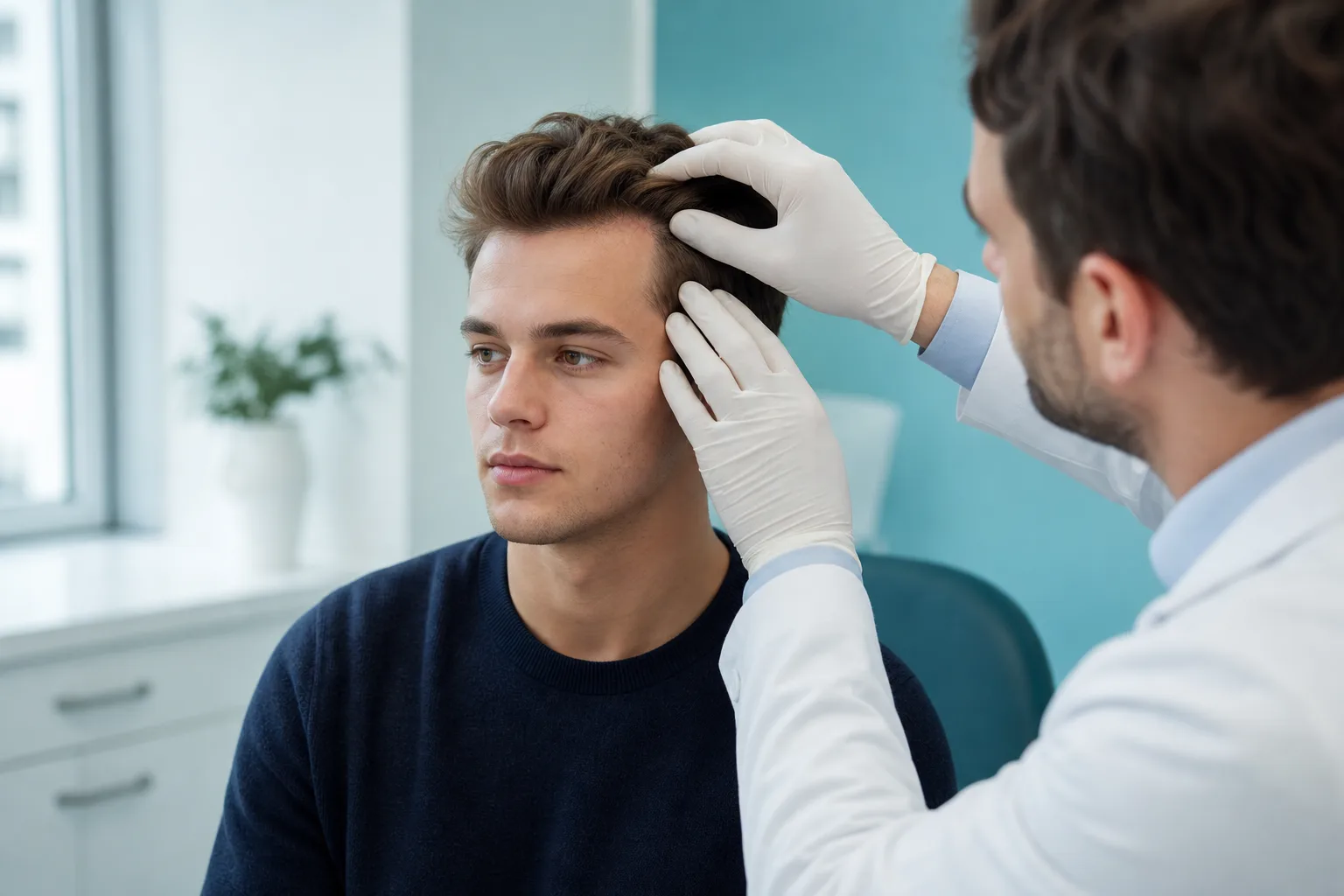
Can you have a hair transplant under 25? Yes, in some cases, but it is not always the right first step. Before age 25, hereditary hair loss is often still actively developing. You need a plan that considers both how you look today and how your hair may change over the coming years.
If you are young and concerned about hair loss, choosing the right timing matters more than having surgery as soon as possible. Everything starts with a free consultation, or learn more about hair transplantation in Sweden.
Why many people under 25 worry about hair loss
Hair loss can affect confidence at an early age. According to YouGov, 59 percent of men aged 18–24 report significant concern about losing their hair. For those aged 25–34, the figure is around 51 percent.
The concern is understandable, but it should not determine the treatment choice. Many young people mistake a normal mature hairline for early baldness. A mature hairline often develops between approximately 17 and 30, when it moves around 1–2 cm upward and then stabilises. This is physiological maturation, not the same as progressive androgenetic alopecia or other male hair loss.
The first step is therefore always a correct diagnosis, not quick surgery.
Can you have a hair transplant under 25?
Yes, in selected cases. This depends on:
- the pattern and rate of hair loss, assessed with the Norwood scale
- donor-area density and quality
- family history and expected progression
- whether medical treatment has already been tried
- your short- and long-term goals
Everything starts with a free consultation in Stockholm (Alvik/Bromma) or remotely by video. Being under 25 is not an automatic no, but it is a signal for more conservative planning. The younger you are, the more important it is not to use up the donor area too early or create a hairline that becomes too low if hair loss continues.
Why is early hair transplantation riskier?
1. Hair loss may continue around the transplant
Transplanted donor hair is resistant to DHT and remains in place. But the hair behind and around it can keep thinning. Surgery too early, without a long-term plan, can leave new sparse zones, for example on the crown or behind the temples, making the result look patchy.
2. A hairline that is too low ages less well
A teenage, aggressively low hairline may look good in photos at age 21 and unnatural at 35. For younger men, we therefore often place the hairline slightly higher so the result remains suitable as they age. Read about natural hairline design and temple hair transplantation.
3. The donor area is a limited resource
A hair transplant does not create new follicles, it moves existing ones. We always keep the donor area in good condition, so more grafts remain available if you need further hair transplants later.
4. The wrong diagnosis leads to the wrong treatment
Diffuse hair loss, telogen effluvium after stress, nutritional deficiencies or alopecia areata require different management than classic androgenetic alopecia. Surgery is the wrong route if follicles can still recover with medical treatment.
What should you do before surgery under 25?
For many younger patients, the right sequence is:
- Medical assessment of the scalp and type of hair loss
- Treatment to slow progression in hereditary hair loss
- Follow-up of progression over months to years
- Hair transplantation once the pattern is clearer and the plan is long-term
Medical treatment
For early hair loss, finasteride and/or minoxidil can slow thinning and preserve existing follicles. In practice, this can reduce the size of the area that later needs transplanting. Treatment is always discussed medically based on diagnosis, risk profile and goals. You can also read more about hair-loss treatments.
PRP
PRP treatment often works particularly well for women and younger men who have recently noticed thinning, while follicles are still intact. PRP can strengthen weak follicles and can also be used as a complement after hair transplantation.
Styling and everyday life
The right hairstyle can reduce the appearance of early temple recession or a thinning crown while you build a long-term plan. See our guide to hairstyles for men with thin hair.
When can hair transplantation under 25 still be appropriate?
Hair transplantation may be considered earlier when:
- the diagnosis is clearly androgenetic alopecia with a defined pattern
- the donor area is strong
- you have realistic expectations and understand that further procedures may be needed
- medical treatment is already part of the plan or is considered unsuitable
- the design is conservative, with a higher hairline and sparing use of grafts
Examples include limited temple recession where the goal is soft correction, not maximum lowering of the whole front, or minor density work where the remaining hair is protected medically.
Method selection follows the same principles as for other patients. Sapphire FUE is often suitable for greater needs. DHI treatment may suit smaller zones. Compare them in FUE vs DHI.
What the plan should look like if you are under 25
We have performed more than 15 000 hair transplants since 2011. If you are young, it is particularly important that:
| Principle | What it means for you |
|---|---|
| Individual assessment | Age is one factor, not the only factor |
| Conservative design | The hairline is often placed slightly higher |
| Future hair loss | The plan allows for continued hair loss |
| Protecting the donor area | Grafts are saved for potential future procedures |
| Medical foundation | Finasteride, minoxidil and/or PRP as needed |
| Transparent price | Fixed price after assessment, see the pricing page |
Everything starts with a free consultation in Stockholm (Alvik/Bromma) or remotely by video. Learn more about the process and how to slow hair loss before surgery.
What does it cost?
Price is determined by graft count and method, not age. Typical prices for small to moderate procedures, which are common in early stages:
| Number of grafts | Price (standard FUE in Sweden) |
|---|---|
| 1 000 | 38 000 kr |
| 1 500 | 45 000 kr |
| 2 000 | 50 000 kr |
Aftercare products and support are included. A written growth guarantee is offered when the conditions are met. See current packages under hair transplant pricing.
Aftercare and expectations
Aftercare is the same regardless of age: follow instructions for washing, activity and healing. Read our aftercare guide and what is normal or unusual in our article on hair transplant risks.
The approximate timeline is:
- Days 1–10: healing
- Week 2 to month 3: temporary shedding (shock loss) is normal
- Months 3–6: early growth, learn more about how quickly hair grows
- Months 6–12: increasing density
- Around 12 months: final assessment
For patients under 25, it is equally important to continue the medical plan after surgery, so remaining hair is protected while the transplanted follicles establish themselves.
Frequently asked questions
Tags
Related information
Explore more about our treatments and services
Firo Esmer
CEO, Akacia Medical
Firo Esmer is CEO and founder of Akacia Medical and writes about hair transplantation, hair loss and treatment planning based on the clinic's experience and patient journey.
References
- 1.YouGov. Most young people are “terrified” of going bald. Enkät av 32 601 vuxna i USA, oktober 2019–oktober 2020.
- 2.Sinclair R. Male pattern androgenetic alopecia. BMJ. 1998;317(7162):865-869.
- 3.Kaufman KD et al. Finasteride in the treatment of men with androgenetic alopecia. J Am Acad Dermatol. 1998.
- 4.Jiménez-Cauhe J et al. Effectiveness and safety of low-dose oral minoxidil in male androgenetic alopecia. J Am Acad Dermatol. 2019;81(2):648-649.
- 5.Goldin J, Zito PM, Raggio BS. Hair Transplantation. StatPearls. Updated 2025.
- 6.Limmer BL. The density issue in hair transplantation. Dermatol Surg. 1997.
Related articles
September 10, 2026
Does a hair transplant hurt?
Does a hair transplant hurt? How local anaesthesia works, what you feel during the procedure and how tenderness is handled in the first days.
September 3, 2026
Hair transplant scars – FUE, FUT and healing
How visible are scars after a hair transplant? The difference between FUE and FUT, healing in the donor area, and how older scars can be hidden.
August 14, 2026
How many hair transplants can you have?
How many hair transplants can you have? Donor area, healing and planning set the limit. Learn about treatments, timing and consultation.
Book a free consultation
We will review your circumstances and recommend the right next step for you.