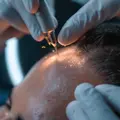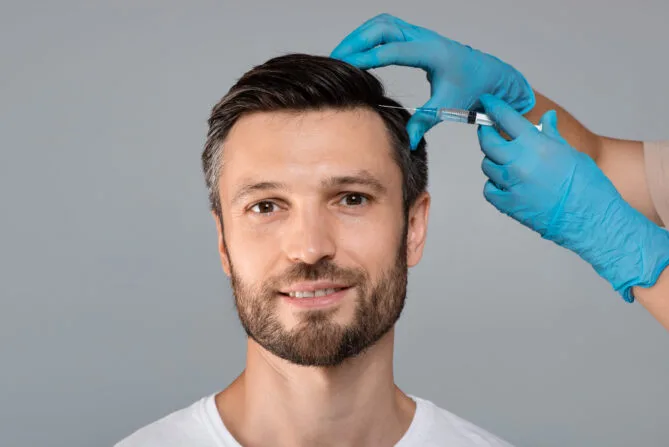
What is PRP (Platelet Rich Plasma) and how does it work?
PRP is a treatment using your own blood, with no synthetic additives or chemical preparations. Plasma with a high concentration of platelets (thrombocytes) is taken from an ordinary blood sample and injected into the scalp. Because everything comes from you, the risk of allergy or rejection is very low.
The platelets contain growth factors such as PDGF, TGF-β, VEGF and EGF. When the plasma is injected, these substances are released, which can stimulate the hair follicle and prolong the active growth phase (the anagen phase). At the same time, blood flow and oxygenation around weakened follicles improve.
Clinically proven effect against hair loss
Research and meta-analyses show that PRP can improve hair density in hereditary hair loss. Below is a summary of study outcomes – and what happens biologically in the scalp.
0%
Positive results
Systematic reviews in androgenetic alopecia (hereditary hair loss) show that PRP can increase hair density in some patients, although the evidence varies between studies.
+0%
Growth after hair transplantation
Studies of PRP in connection with hair surgery suggest that biological stimulation can support grafts and healing, although protocols and results vary.
↓
Calmer scalp
Improved blood flow in the scalp can reduce stinging, itching, dryness and hair breakage.
| Parameter | Study outcomes | What it means |
|---|---|---|
| Cell renewal | Stimulated stem cells | The platelets can activate stem cells at the root of the follicle (the bulge) so that hair growth is accelerated. |
| Platelet concentration | 3–5 times higher than in normal blood | Centrifugation yields plasma with far more platelets than whole blood, which kicks off renewal in the follicle. |
Cell renewal
Stimulated stem cells
The platelets can activate stem cells at the root of the follicle (the bulge) so that hair growth is accelerated.
Platelet concentration
3–5 times higher than in normal blood
Centrifugation yields plasma with far more platelets than whole blood, which kicks off renewal in the follicle.
How is a PRP treatment done?
A PRP treatment at Akacia Medical takes about 30–45 minutes. You can return to everyday life straight after the visit.
Step 1: Free consultation & analysis
We assess the scalp, the pattern of hair loss and your goals. You get an individual plan – free of charge and with no obligation – and we decide whether PRP, a hair transplant or a combination suits you best.
See the treatment in practice

How a PRP treatment is done
See how the PRP process works step by step, from blood sample to treatment of the scalp.
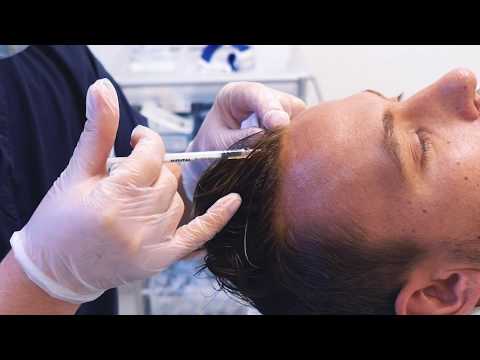
Follow a patient through a PRP treatment
Watch a patient undergo a PRP treatment with us and get a clearer picture of how the treatment works in practice.
Why choose Akacia Medical's PRP technique?
The difference lies in how the plasma is prepared. Open or basic test tubes often give a lower platelet concentration and a higher risk of contamination. Closed separation with Arthrex ACP® and RegenLab® keeps the platelets intact and yields purer growth factors – the part that actually reaches the follicles.
At Akacia Medical we use closed premium systems from Arthrex (ACP Double Syringe System) and RegenLab according to clinical protocols. The plasma is separated with high precision, giving more controlled handling than open or simpler tube systems.
Where other clinics sometimes need several tubes to reach the same effect, we can often reach therapeutic concentration with a single tube – saving time and reducing discomfort during treatment.
An independent study comparing several PRP systems showed that Arthrex generated significantly more growth factors than simpler tubes – between 2 and 7 times more, depending on which factor was measured.
For more information on PRP concentration and clinical outcomes, see the study here.



Medically reviewed by a specialist
Dr Mohammed Abas · Medically responsible physician
Who is PRP treatment suitable for?
PRP is an individual medical treatment. It works best when the hair follicles are still active but have weakened. If an area has become completely bald and the follicles have stopped producing hair, PRP is not enough – then a hair transplant may be an option.
Audiences
PRP for men
The most common cause of hair loss in men is androgenetic alopecia – male hereditary hair loss – often linked to the hormone DHT (dihydrotestosterone). The follicles gradually shrink and produce thinner hairs. PRP can counteract this by stimulating the follicle and improving blood supply, which can increase both the number of hairs and hair thickness while the follicles are still active.
Read about hereditary hair loss →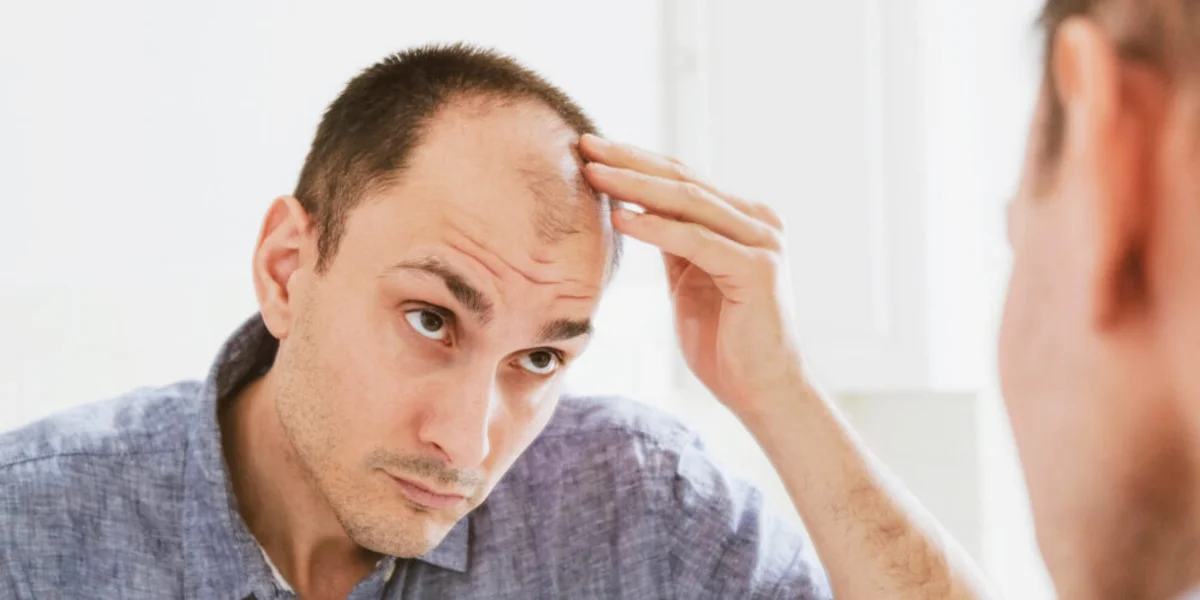
PRP for women
Hair loss in women often appears as diffuse thinning over the crown – for example with hormonal changes, stress, nutritional deficiency or menopause. PRP is made from your own plasma and strengthens the hair from within without chemical preparations. With structured courses we see high patient satisfaction and measurable improvements.
Hair loss in women →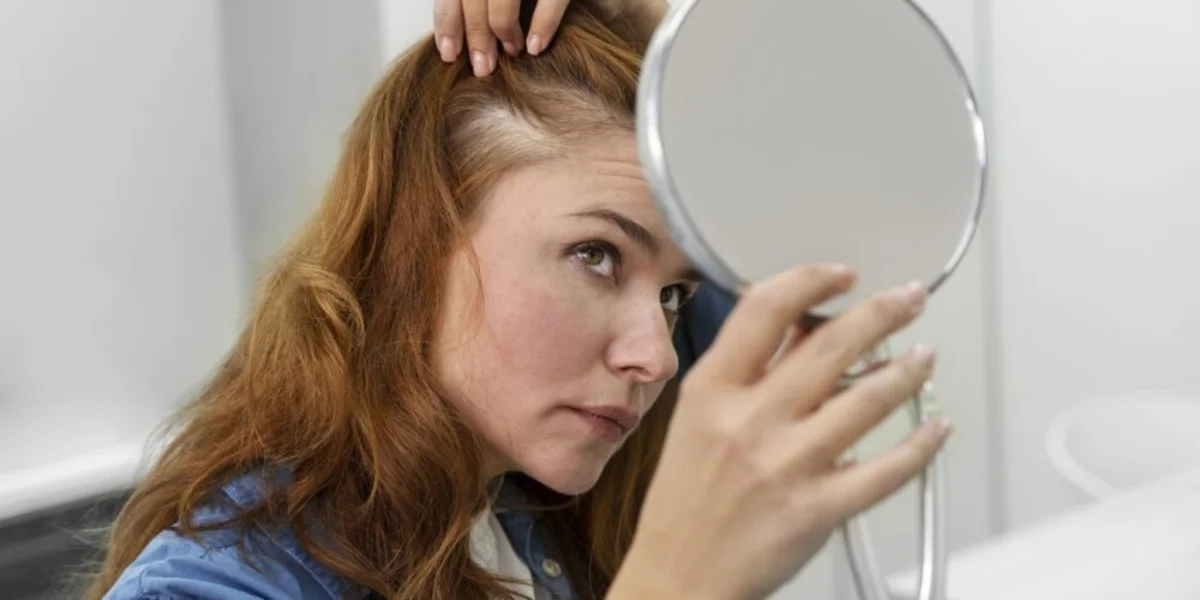
Patchy hair loss (alopecia areata)
Alopecia areata is an autoimmune condition in which the body attacks the hair follicles, causing round, bald patches. PRP with concentrated growth factors can dampen the inflammation and help the follicles back into the growth phase. The treatment can also relieve dryness, itching and stinging in the scalp.
Read about alopecia areata →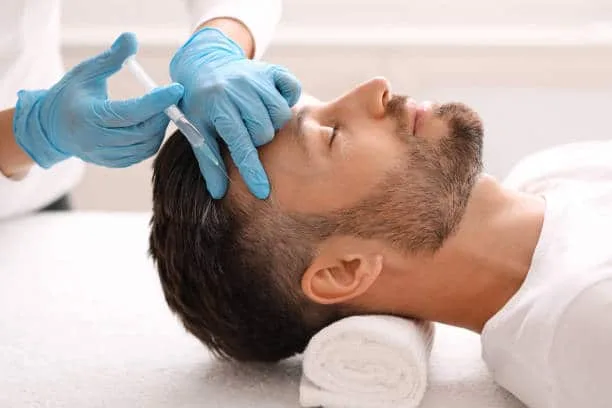
Traction alopecia
Traction alopecia occurs when the hair is exposed to prolonged pulling – for example from tight hairstyles, heavy braids or hair extensions. Once the cause has been removed, PRP can improve the healing environment and stimulate regrowth, as long as the follicles have not been replaced by scar tissue.
Read about traction alopecia →PRP compared with other treatments for hair loss
PRP is one of several routes. The table shows how PRP relates to medication and hair transplantation – the treatments are not mutually exclusive, and the right combination is decided at the consultation.
| Treatment | How it works | Commitment | Duration | Best suited for |
|---|---|---|---|---|
| PRP | The body's own growth factors are injected into the scalp and stimulate active follicles. | 30–45 min per session, 3 treatments as a starting course, then maintenance. | The effect fades gradually without maintenance – usually after 6–12 months. | Early or moderate hair loss, thin hair, complement to a hair transplant. |
| Minoxidil | Over-the-counter solution or foam that increases blood flow and prolongs the hair growth phase. | Applied daily, indefinitely. | For as long as the treatment continues – the effect disappears when you stop. | Diffuse hair loss in both men and women. |
| Finasteride | Prescription tablet that blocks DHT, the hormone that shrinks the follicles in hereditary hair loss. | One tablet daily, indefinitely. | For as long as the treatment continues. | Hereditary hair loss in men. |
| Hair transplant | Your own follicles are moved from the back of the head to thin or bald areas (FUE or DHI). | A one-day procedure, sometimes two sessions. | Permanent – the transplanted follicles are insensitive to DHT. | Bald patches, receding hairline and a thin crown where the follicles have stopped producing hair. |
PRP and hair transplantation: the ultimate combination
Akacia Medical specialises in permanent hair solutions. Combining a hair transplant (FUE or DHI) with PRP creates better conditions for a lasting result.
How PRP and transplantation work together
When follicular units (grafts) are moved they are vulnerable during the first days before a new blood supply has been established. PRP in connection with the procedure and during follow-up gives the transplanted follicles extra nourishment and stimulation.
The growth factors can increase the formation of new fine blood vessels, which can shorten healing time in the donor and recipient areas and improve graft survival. PRP can also slow further hair loss in areas where you have kept your natural hair.
For patients who combine PRP with a hair transplant we recommend 6 PRP treatments in total, spread around the different phases of the operation. This differs from our recommendation for PRP alone without a transplant, where we start with 3 treatments and evaluate the result before deciding whether more are needed.
How long do the results of PRP last?
PRP is not a permanent solution. Reduced hair loss is often noticed after 3–4 weeks and clearer density after 3–6 months from the starting course. Without maintenance the effect fades gradually – in clinical practice usually within 6–12 months after the last treatment, because the cause of the hair loss (for example hereditary sensitivity to DHT) remains.
How long the result lasts depends on what causes the hair loss, how active the follicles are when treatment starts and whether PRP is combined with something else – minoxidil, finasteride or a hair transplant. After evaluating the starting course we set up an individual maintenance plan, usually one to two treatments per year.
Side effects and risks of PRP
PRP is made from your own blood, with no drugs or foreign substances. The side effects are therefore few and temporary – but they exist, and you should know about them before you book.
Common and temporary (1–2 days)
Tenderness, slight swelling and redness in the scalp, and small bruises at the injection sites. Some experience a headache or a tight-feeling scalp the same day.
Temporary increase in shedding
Some notice a brief increase in hair shedding during the first weeks. This is because resting hairs are pushed out as new ones start to grow, and it usually resolves on its own.
Uncommon
Infection at the injection sites is very rare when the treatment is performed sterilely in closed systems by licensed staff. If you take blood thinners or have a bleeding disorder, suitability is always assessed at the consultation.
Very low risk of allergy
Because the plasma is your own, the risk of allergy or rejection is very low. The local anaesthetic is the only thing added from outside – always tell us about previous reactions to anaesthetics.
Aftercare and important instructions
PRP is a minor procedure with a short recovery – no sick leave is needed. Follow the clinic's advice before and after the treatment for the best result.
After the treatment
Avoid washing your hair
- Timeframe
- At least 24 hours
- Why
- Lets the injection points close and protects the PRP in the scalp.
Avoid exercise and sauna
- Timeframe
- 48 hours
- Why
- Reduces the risk of swelling and irritation.
Clean headwear
- Timeframe
- First 24 hours
- Why
- Reduces the risk of infection.
Clean pillowcase
- Timeframe
- The evening of treatment
- Why
- Protects the scalp overnight.
Avoid strong sun
- Timeframe
- 1 week
- Why
- Reduces irritation in the scalp.
| Action | Timeframe | Why |
|---|---|---|
| Avoid washing your hair | At least 24 hours | Lets the injection points close and protects the PRP in the scalp. |
| Avoid exercise and sauna | 48 hours | Reduces the risk of swelling and irritation. |
| Clean headwear | First 24 hours | Reduces the risk of infection. |
| Clean pillowcase | The evening of treatment | Protects the scalp overnight. |
| Avoid strong sun | 1 week | Reduces irritation in the scalp. |
Before your visit
Avoid NSAIDs (ibuprofen etc.)
- Timeframe
- 48 hours before
- Why
- Anti-inflammatory drugs can inhibit platelet function.
Avoid omega-3
- Timeframe
- 3 days before
- Why
- Can increase the risk of bruising.
Refrain from alcohol
- Timeframe
- Before the treatment
- Why
- Better for the platelets.
Drink plenty of water
- Timeframe
- On the day of treatment
- Why
- Makes the blood sample easier.
Keep your arms warm
- Timeframe
- Before the visit
- Why
- Makes it easier to take the blood sample.
| Preparation | Timeframe | Why |
|---|---|---|
| Avoid NSAIDs (ibuprofen etc.) | 48 hours before | Anti-inflammatory drugs can inhibit platelet function. |
| Avoid omega-3 | 3 days before | Can increase the risk of bruising. |
| Refrain from alcohol | Before the treatment | Better for the platelets. |
| Drink plenty of water | On the day of treatment | Makes the blood sample easier. |
| Keep your arms warm | Before the visit | Makes it easier to take the blood sample. |
Follow-up during your treatment
PRP is given as a series of treatments, not a single session. At each visit we follow up how the scalp and hair growth have developed since the last treatment, and adjust the plan for the rest of the course if needed.
If you have PRP alone without a hair transplant, we evaluate the result together after the three initial treatments to decide whether more are needed. If you combine PRP with a hair transplant, the follow-up is part of the 6 treatments around the operation.
Follow-up is part of the treatment plan from the start – not a separate add-on you need to book yourself.
Medical safety & contraindications
The treatment is not performed in cases of critically low platelet count, ongoing blood infection (sepsis), certain blood disorders, active cancer or infection in the area of the scalp to be treated.
Price of PRP treatment at Akacia Medical
Akacia Medical has transparent prices with no hidden fees – you see the cost before you book. PRP is performed in a sterile clinical environment by licensed staff with equipment from Arthrex and RegenLab. A free consultation is always included.
1 treatment (PRP)
3 900 kr
Single treatment – often as maintenance after a completed course.
See price on the pricing page →3 treatments (starting course)
8 700 kr11 700 kr
SEK 2,900 per treatment
For PRP alone against hair loss we recommend 3 treatments and then evaluate the result. In combination with a hair transplant we recommend 6 treatments in total.
See price on the pricing page →PRP stimulates the follicles biologically – it is not a permanent surgical change. For PRP alone without a transplant we start with three treatments and then evaluate the result. If PRP is combined with a hair transplant we recommend 6 treatments in total.
The full price list also includes mesotherapy and hair transplantation – always see our price list for current amounts and packages.
See current PRP pricesFrequently asked questions about PRP treatment
The change is gradual. Reduced hair loss is often noticeable after 3–4 weeks. Clearer density and thickness is often seen after 3–6 months, which is why we evaluate the result after the initial treatment plan.
Scientific references and clinical studies
- [1]Cruciani M et al. Platelet-rich plasma for the treatment of alopecia: systematic review and meta-analysis.
- [2]Cervantes J et al. Effectiveness of platelet-rich plasma for androgenetic alopecia: review of the literature.
- [3]Georgescu SR et al. Effectiveness of platelet-rich plasma therapy in androgenic alopecia: meta-analysis.
- [4]Trink A et al. PRP for alopecia areata: randomized, double-blind, placebo-controlled crossover study.
- [5]Giordano S et al. A meta-analysis on evidence of platelet-rich plasma for androgenetic alopecia.
- [6]Alves R et al. Randomized placebo-controlled half-head study of PRP for androgenetic alopecia.
- [7]Schiavone G et al. Platelet-rich plasma for androgenetic alopecia: a pilot study.
- [8]Gentile P et al. The effect of platelet-rich plasma in hair regrowth: a randomized placebo-controlled trial.
- [9]Gentile P et al. Systematic review of platelet-rich plasma use in androgenetic alopecia compared with other therapies.
- [10]Ho A et al. Trichologic response of platelet-rich plasma in androgenetic alopecia is maintained during combination therapy.
- [11]Zhou S et al. Platelet-rich plasma in female androgenic alopecia: systematic review and meta-analysis.