


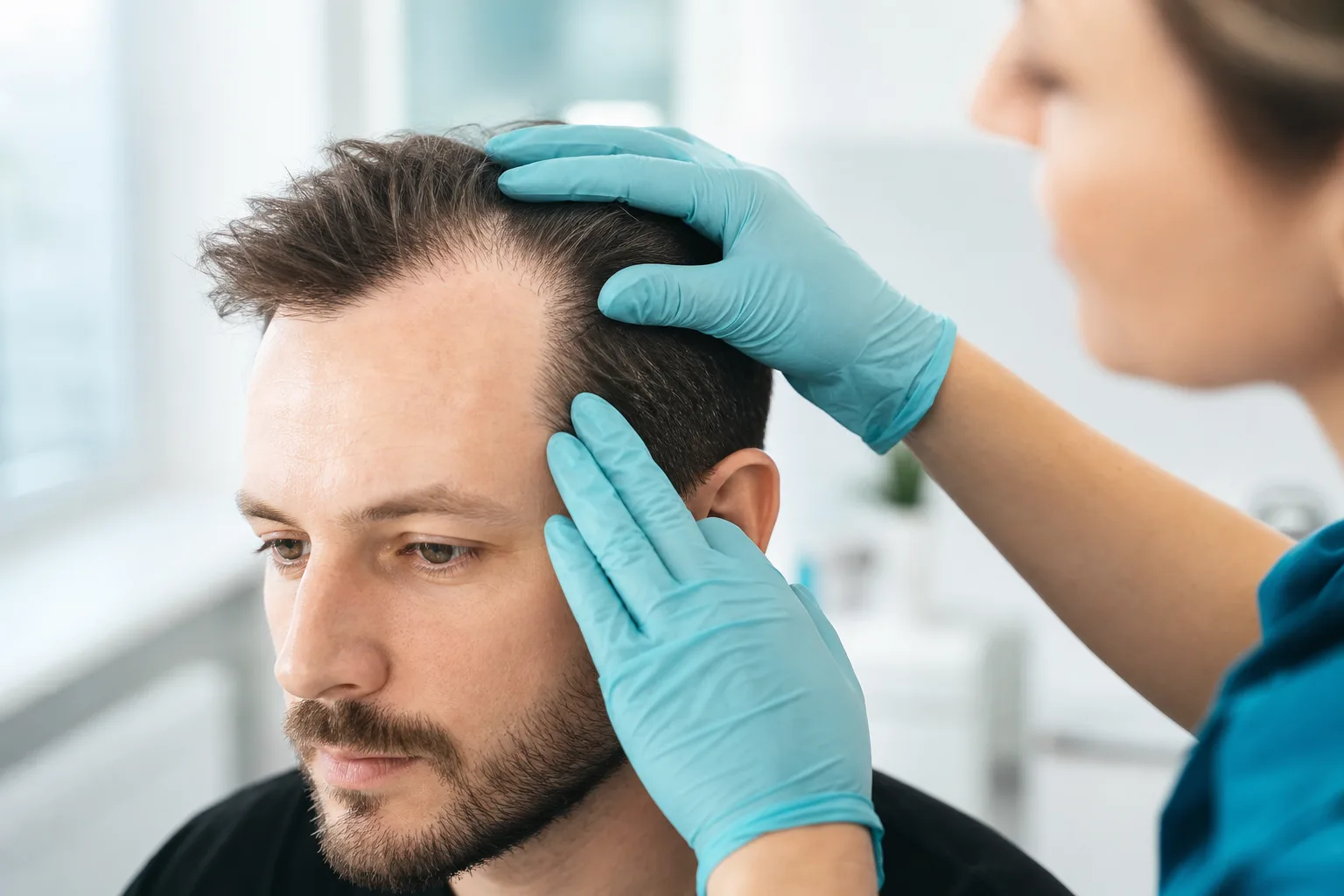
A receding hairline and deep temple recession are often the first signs of hereditary hair loss in men. With a temple hair transplant, you can restore your natural hairline, fill sparse areas and create a symmetrical frame for the face.
The number of grafts needed, the hairline design and the cost all depend on how deep your temple recession is, and how you want the result to look in ten years. Learn more about a receding hairline and hair transplantation in Sweden.
Why do temples recede?
Deep temple recession is almost always caused by androgenetic alopecia, hereditary hair loss. Follicles at the temples are especially sensitive to the hormone DHT (dihydrotestosterone). As they are affected, hairs gradually become thinner, shorter and lighter until the area appears as a clear M-shaped recession.
Common signs that the temples may need treatment:
- The hairline has started moving back at the temples
- Your hairstyle increasingly needs to compensate for open areas
- Your face looks longer or “older” in the mirror and in photos
- The right and left temples look uneven
It is important to understand that a mature hairline or a slight M shape can be stable and genetic. That is why every treatment starts with a free consultation before a hair transplant is recommended. The aim is a sustainable line that suits your face today and in ten years, not an unnaturally low teenage hairline. If you are under 25, special principles apply, see our guide to hair transplantation for younger patients.
Want to understand different hairlines and receding hairlines better? Read our article about the hairline.
How many grafts are needed to fill receding temples?
The number of grafts is determined by three factors:
- Depth and width of the recession: the actual size of the hairless area
- Desired density: a soft transition or more pronounced density
- Quality of the donor area: density, calibre and how much can safely be extracted from the back and sides
A graft is a natural follicular group containing one or more hairs. At the front, we mainly use single-hair grafts for a soft transition. Further back in the temples, multi-hair grafts are used for volume. Graft count is therefore not the same as the number of visible hairs.
The table below provides a realistic estimate when the focus is on filling receding temples. The exact need is always determined at a free consultation.
Example table: graft numbers based on temple recession
| Extent of recession | Description | Estimated graft count |
|---|---|---|
| Mild recession | Minor indentation at the temples | 800–1 200 grafts |
| Moderate recession | Clear M-shaped hairline moving backwards | 1 200–1 800 grafts |
| Deep recession | Significant temple hair loss approaching the crown | 1 800–2 500+ grafts |
For comparison, the Norwood scale often indicates around 500–800 grafts for mild temple recession (stage 2), and more as the temples become more pronounced. When the entire frontal area is reconstructed, or the crown is treated at the same time, graft needs increase further.
Want to understand the calculation in more detail? Read our guide to what a graft is and how graft requirements are planned.
Hairline design: symmetry, angle and a natural result
Filling receding temples is not simply about “putting in hair”. It is about recreating a hairline with the right height, softness and direction, so the result looks like your own hair, not an addition.
Adapted to face shape and age
Before surgery, the hairline is designed around:
- facial proportions and forehead height
- your age and how the hairline should realistically look in the future
- symmetry between the right and left sides
- existing hairs and their direction of growth in the area
We do not lower the hairline too far. An overly aggressive “young” hairline can look unnatural after just a few years, especially if hair loss behind the temples continues. A good design should age well and harmonise with the face.
Before the procedure, the line is measured and marked so both temples achieve the same visual balance. Precision in angle and direction is crucial for light to fall naturally through the hair.
Single-hair vs multi-hair grafts at the front
Temple design depends on selecting the right grafts:
- Single-hair grafts are placed at the very front of the hairline. This creates a soft, feathered transition and avoids a “doll-hair effect”.
- Double- and multi-hair grafts are placed just behind the front line to build volume and density in the temple area.
This layering, fine at the front and denser behind, is what makes a temple hair transplant look natural at close range.
Choosing a method for the temples: FUE or DHI?
Both FUE and DHI treatment work very well for the temples. The difference is more about workflow, graft numbers and whether the recipient area needs to be shaved.
DHI treatment may suit you when:
- the area is smaller and more defined
- you want a high level of control over placement and direction at the hairline
- it is valuable to avoid shaving the recipient area in selected cases (hair transplantation without shaving)
- you need approximately 1 000–1 500 grafts per procedure
Sapphire FUE is often the right choice when:
- the temples are deeper and require more grafts
- you need a more efficient workflow for broader coverage
- a proven and more cost-effective approach provides the best conditions
DHI is not automatically “better” than FUE. The end goal is the same: a natural, well-planned and lasting result. Read our FUE vs DHI comparison for a more detailed review.
What does a temple hair transplant cost?
We use fixed, transparent pricing. In Sweden, this includes aftercare products, lunch on the day of surgery and support during healing. A written growth guarantee is offered when the conditions are met.
As most temple treatments fall within approximately 1 000–2 500 grafts, the price list below gives a good indication of the level. Current packages and Medical Finance funding are available on the hair transplant pricing page.
Guide prices in Sweden (standard FUE)
| Number of grafts | Price |
|---|---|
| 1 000 | 38 000 kr |
| 1 500 | 45 000 kr |
| 2 000 | 50 000 kr |
| 2 500 | 55 000 kr |
For DHI treatment without shaving the recipient area, pricing is higher (55 000 kr for 1 000 grafts and 60 000 kr for 1 500 grafts) because the method is more time-consuming.
Want to know how many grafts your temples require?
Everything starts with a free consultation in Stockholm (Alvik/Bromma) or remotely by video. You then receive a fixed price proposal. Learn about the process from the first meeting to follow-up.
Aftercare and results after a temple hair transplant
Aftercare follows the same principles as other hair transplantation: gentle washing, avoiding friction against the recipient area in the first days, and following the clinic’s instructions. Read more in our aftercare guide.
Timeline at a glance:
- Days 1–10: healing and scabs
- Week 2 to month 3: temporary hair shedding (shock loss) is normal, read more about how quickly hair grows after the procedure
- Months 3–6: early growth becomes visible
- Months 6–12: density increases
- Around 12 months: the final result is assessed
For unusual symptoms during healing, see our article on hair transplant risks.
Want to see what results can look like in practice? View our before and after photos.
Frequently asked questions
Tags
Related information
Explore more about our treatments and services

Firo Esmer
CEO, Akacia Medical
Firo Esmer is CEO and founder of Akacia Medical and writes about hair transplantation, hair loss and treatment planning based on the clinic's experience and patient journey.
References
- 1.Sinclair R. Male pattern androgenetic alopecia. BMJ. 1998;317(7162):865-869.
- 2.Kaufman KD et al. Finasteride in the treatment of men with androgenetic alopecia. J Am Acad Dermatol. 1998.
- 3.Rassman WR, Bernstein RM, McClellan R, Jones R, Worton E, Uyttendaele H. Follicular unit extraction: minimally invasive surgery for hair transplantation. Dermatol Surg. 2002;28(8):720-728.
- 4.Limmer BL. The density issue in hair transplantation. Dermatol Surg. 1997.
- 5.Goldin J, Zito PM, Raggio BS. Hair Transplantation. StatPearls. Updated 2025.
- 6.Parsley WM, Perez-Meza D. Review of factors affecting the growth and survival of follicular grafts. J Cutan Aesthet Surg. 2010;3(2):69-75.
Related articles
September 13, 2026
How long does a hair transplant last?
How long does a hair transplant last? Transplanted hair is usually permanent. Surrounding hair can keep thinning – this is how the result is kept over time.
September 10, 2026
Does a hair transplant hurt?
Does a hair transplant hurt? How local anaesthesia works, what you feel during the procedure and how tenderness is handled in the first days.
September 3, 2026
Hair transplant scars – FUE, FUT and healing
How visible are scars after a hair transplant? The difference between FUE and FUT, healing in the donor area, and how older scars can be hidden.
Book a free consultation
We will review your circumstances and recommend the right next step for you.