

When you are considering a hair transplant, it is natural to wonder which technique suits you best. The two most common options are FUE (Follicular Unit Extraction) and DHI (Direct Hair Implantation). Both can produce natural results, but they suit different needs.
The difference lies in how grafts are placed, the size of the area that can be treated, the cost of treatment and how aftercare affects the result. If you are unsure, a free consultation is the right next step.
Short answer: FUE or DHI?
In short: Both can produce natural, lasting results when planning, surgical precision and aftercare are right. DHI is not automatically a better method than FUE, it is mainly a different approach to implantation.
| Question | Sapphire FUE | DHI treatment |
|---|---|---|
| What is it? | Individual extraction + channels + placement | Individual extraction + more direct implantation |
| Best for | Larger areas and higher graft counts | Smaller, defined areas, such as the hairline and temples |
| Shaving the recipient area | Yes | Always avoided |
| Approximate capacity per procedure | Up to approximately 3 500 grafts | Normally approximately 1 000–1 500 grafts |
| Time required | More efficient workflow | More time-consuming and complex |
| Price level in Sweden (1 000 grafts) | From 38 000 kr | 55 000 kr (without shaving) |
| End goal | Natural, well-planned result | Same end goal |
Read more about the FUE method and DHI treatment.
What is FUE?
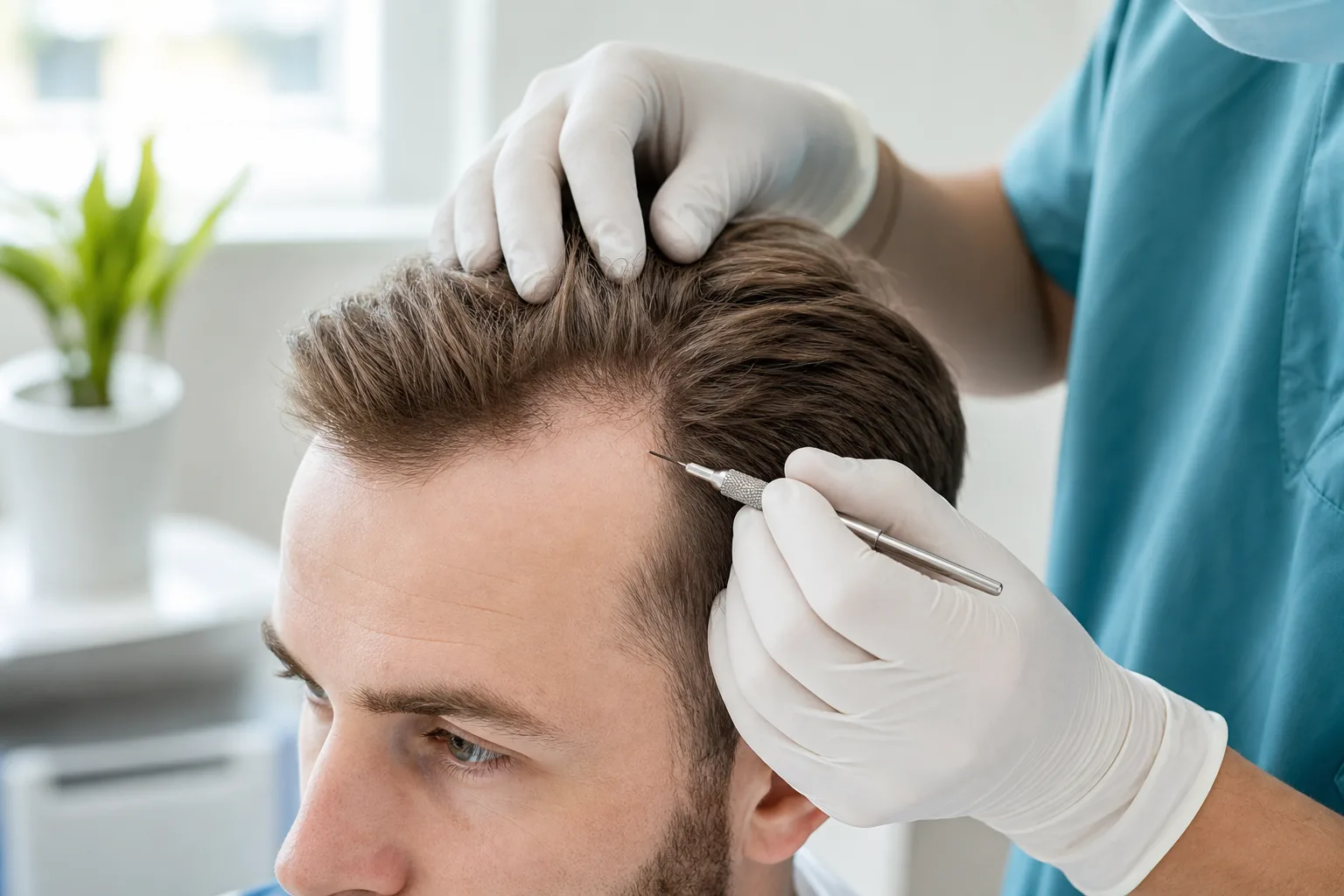
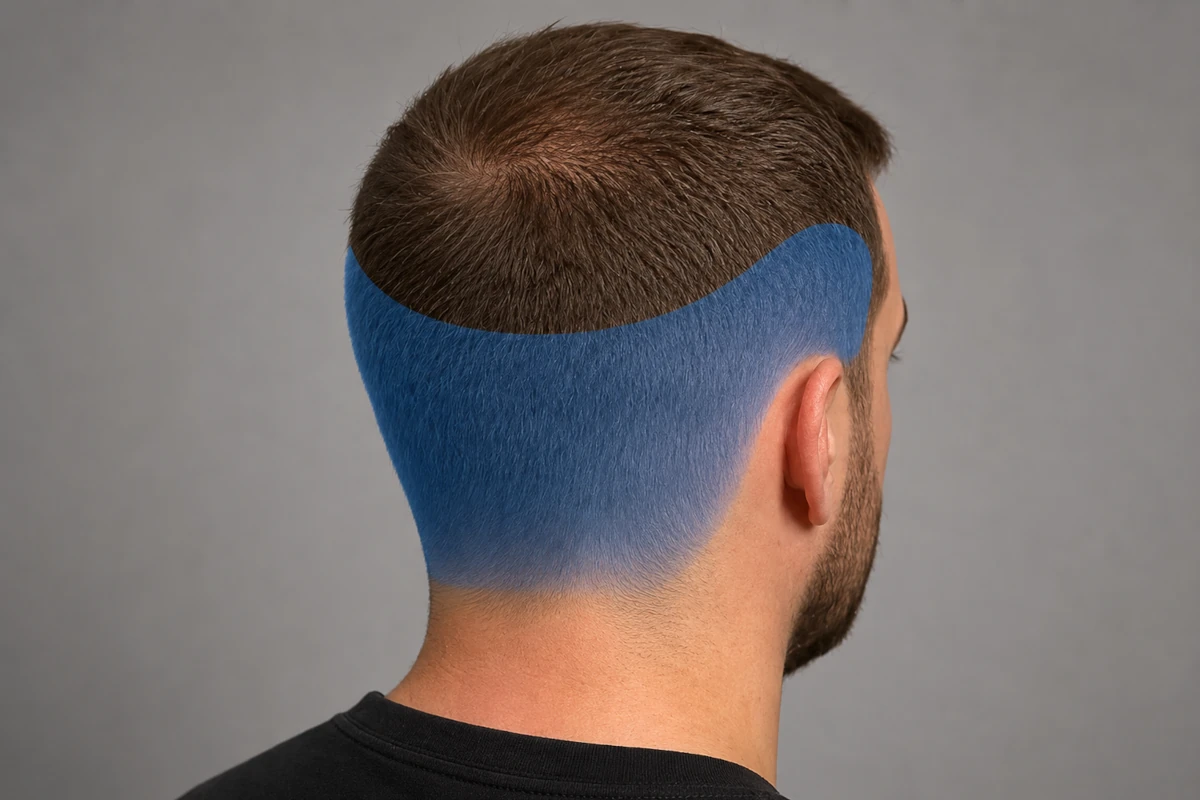
FUE means Follicular Unit Extraction. Individual follicles (grafts) are taken one by one from the donor area, usually the back and sides of the head, and moved to areas with thinning or missing hair.
Unlike the older strip method (FUT), FUE leaves no visible linear scar. This makes shorter hairstyles easier to wear and generally gives gentler healing in the donor area. Individual follicles are extracted with small micro-instruments, making the method minimally invasive compared with older techniques.
Sapphire FUE: how it works
We work with Sapphire FUE. Sapphire blades are used when appropriate for the treatment plan to create recipient channels with planned angle, direction and density. This gives the surgeon good control over how the hair will grow and how natural the result appears.
In practice, Sapphire FUE includes:
- Consultation and planning of the hairline, density and long-term sustainability.
- Extraction with 0.6–0.9 mm micro-instruments, where 0.6 mm is 33% smaller than the industry standard.
- Sorting grafts: single-hair grafts at the front, multi-hair grafts further back for volume.
- Channel creation and implantation with focus on angle, direction and a natural growth pattern.
- Aftercare and follow-up under a clear protocol.
FUE is therefore often the most efficient option when you need to cover larger areas or move many grafts in a single procedure.
What is DHI?
DHI stands for Direct Hair Implantation and mainly concerns how follicles are placed in the recipient area. With a pen-like implantation tool, often called a Choi pen, opening and placement can be done in a more integrated step.
In practice, DHI is a development of FUE, not a completely separate surgical method. Grafts are still extracted individually, but implantation is more direct. This can shorten the time grafts spend outside the body, but results still depend on planning, precision and aftercare.
DHI treatment without shaving
We offer DHI where we always avoid shaving the recipient area. The procedure is more complex and takes longer, but the aim is the same as with FUE: a natural and well-planned final result.
This approach may suit you if you:
- want to improve the hairline or temples with high precision
- have a smaller or more defined treatment area
- prioritise discretion and want to retain more of your hairstyle during healing
- are suitable for around 1 000–1 500 grafts per procedure
If you want treatment without shaving the recipient area, read more about hair transplantation without shaving.
How do the methods work, step by step?
The extraction phase is fundamentally the same. Implantation and workflow differ the most.
Shared foundation: extraction
Whether you choose Sapphire FUE or DHI treatment, grafts are individually extracted from the donor area under local anaesthesia. The team works to:
- protect the donor area
- limit microscopic scarring
- maintain high graft quality before implantation
Graft survival is affected by moisture, temperature, mechanical handling, asepsis and the time grafts spend outside the body. Technique and the team’s routine therefore matter, not just the name of the method.
The difference during implantation
| Step | Sapphire FUE | DHI |
|---|---|---|
| Recipient area | Usually shaved | Always remains unshaved |
| Channels | Often created first with sapphire blades | Placement is more direct via implantation tool/approach |
| Precision | High, with planned angle and direction | Extra control in small zones and between existing hairs |
| Workflow | Efficient for larger graft counts | Slower per graft and more resource-intensive |
| Typical focus | Coverage and density across a larger area | Precision at the hairline, temples and smaller areas |
A practical consequence is that DHI treatment often takes longer for the same number of grafts. It is therefore rarely the first choice when very large areas need reconstruction in one procedure.
Benefits and limitations
Benefits of Sapphire FUE
- Suitable for larger areas and greater graft needs
- Shorter, more efficient surgical workflow in many cases
- A well-established modern standard method
- Good coverage when planning and implantation are correct
- No visible linear scar as with older FUT
Limitations of Sapphire FUE
- The recipient area is usually shaved
- More visible preparation is required during the first healing period
- Results are never “automatic”, they depend on planning, technique and aftercare
Benefits of DHI treatment
- Always avoids shaving the recipient area
- High control over placement, angle and direction
- Especially valuable at the hairline and in smaller zones such as the crown
- The same goal of a natural final result as FUE
Limitations of DHI treatment
- More time-consuming and complex
- Normally fewer grafts per procedure (approximately 1 000–1 500)
- Higher price level in Sweden compared with standard FUE
- Less suitable for efficiently covering large areas
When is FUE most suitable?
Choose Sapphire FUE first if you:
- have more extensive hair loss and need broader coverage
- need more than approximately 1 500 grafts in a single procedure
- prioritise an efficient and well-established approach for larger areas
- accept shaving the recipient area for the best working conditions
FUE is also often the right base method when the doctor assesses that long-term density and sustainable planning require more grafts than a no-shave approach can reasonably provide.
When is DHI treatment most suitable?
DHI treatment can be the right choice if you:
- mainly want to correct temples or the hairline
- have a small, well-defined area
- want maximum discretion during healing
- have a donor area strong enough for the planned graft count
- understand that the method takes longer and is priced accordingly
DHI is less suitable if hair loss is highly diffuse, the donor area is too weak, the cause of hair loss has not been sufficiently investigated, or larger areas need to be covered at once. FUE is then often the more efficient option.
Choosing the right method: consultation decides
Everything starts with a free consultation. It takes place in Stockholm (Alvik/Bromma) or remotely by video. Only then does it become clear whether Sapphire FUE, DHI treatment or a combination suits you best, and what price and aftercare mean in your case.
Want to see how a treatment journey usually works step by step? Read more about the process.
Since 2011, we have performed more than 15 000 hair transplants. Since 2014, we have offered FUE and DHI treatment at our Stockholm clinic. Treatment is performed under medical standards with licensed doctors, ISHRS membership and insurance through Säker Klinik.
Aftercare: same principles, different practical details
Regardless of method, the period after surgery is crucial to the final result. You receive clear instructions on washing, activity, healing and what to avoid during the first days and weeks.
Typical timeline:
- Days 1–10: Grafts are sensitive to pressure and friction. You will often sleep at about 45° with a neck pillow for the first nights. The donor-area dressing is usually removed on day 2.
- From day 3: Gentle washing according to the clinic’s lotion and shampoo protocol.
- Week 2 to month 3: temporary hair shedding (shock loss) is normal.
- Months 3–6: Early growth starts to become visible.
- Months 6–12: Density increases clearly.
- Around 12 months: The final result is evaluated at follow-up.
DHI treatment without shaving often requires extra care when washing, because existing hair remains longer in the recipient area. The basic principles are otherwise the same as for standard FUE.
Read the full aftercare guide for practical instructions and a timeline. For an overview of what is normal or unusual during healing, see hair transplant risks. Also read about cutting and colouring hair after a hair transplant.
When do FUE and DHI results appear?
A common misconception is that DHI “grows faster” simply because implantation differs. In practice, regrowth is primarily governed by the biological cycle of the follicle.
You can expect roughly the same process with either method:
- Transplanted hairs can shed temporarily (shock loss).
- New hairs begin appearing after a few months.
- Thickness, direction and density mature gradually.
- The aesthetic final result is usually assessed after approximately 12 months, sometimes up to 12–18 months for full maturation.
Want to understand regrowth in more detail? Read our guide to how quickly hair grows and what a graft actually is.
Prices: FUE vs DHI
Prices are mainly determined by graft count, the complexity of the method and whether the recipient area is shaved. DHI treatment without shaving is more resource-intensive and therefore more expensive than standard FUE.
Standard FUE in Sweden
| Number of grafts | Price |
|---|---|
| 1 000 | 38 000 kr |
| 1 500 | 45 000 kr |
| 2 000 | 50 000 kr |
| 2 500 | 55 000 kr |
| 3 000 | 60 000 kr |
| 3 500 | 65 000 kr |
DHI / no-shave treatment in Sweden
| Number of grafts | Price |
|---|---|
| 1 000 | 55 000 kr |
| 1 500 | 60 000 kr |
In Sweden, lunch on the day of surgery, aftercare products and support during evenings and weekends are included. Medical Finance funding may be available. Always see current packages and terms on the pricing page.
We also offer a written growth guarantee when conditions are met. The guarantee requires following aftercare instructions and is generally not offered to smokers, because nicotine impairs blood circulation in the scalp.
PRP and other complements
To support graft survival and healing, we often recommend combining hair transplantation with PRP treatment. For hair transplantation, we recommend 6 PRP treatments across different phases of the procedure, offered at cost price.
For those who want to optimise recovery further, OxyHelp/HBOT is also available as a complement.
Frequently asked questions
Tags
Related information
Explore more about our treatments and services
Firo Esmer
CEO, Akacia Medical
Firo Esmer is CEO and founder of Akacia Medical and writes about hair transplantation, hair loss and treatment planning based on the clinic's experience and patient journey.
References
- 1.Rassman WR, Bernstein RM, McClellan R, Jones R, Worton E, Uyttendaele H. Follicular unit extraction: minimally invasive surgery for hair transplantation. Dermatol Surg. 2002;28(8):720-728.
- 2.Sethi P, Bansal A. Direct hair transplantation: a modified follicular unit extraction technique. J Cutan Aesthet Surg. 2013;6(2):100-105.
- 3.Parsley WM, Perez-Meza D. Review of factors affecting the growth and survival of follicular grafts. J Cutan Aesthet Surg. 2010;3(2):69-75.
- 4.Harris JA. New methodology and instrumentation for follicular unit extraction: lower follicle transection rates and expanded patient candidacy. Dermatol Surg. 2006;32(1):56-61.
- 5.Rose PT. The latest innovations in hair transplantation. Facial Plast Surg. 2011;27(4):366-377.
- 6.Goldin J, Zito PM, Raggio BS. Hair Transplantation. StatPearls. Updated 2025.
- 7.Limmer BL. The density issue in hair transplantation. Dermatol Surg. 1997.
Related articles
September 13, 2026
How long does a hair transplant last?
How long does a hair transplant last? Transplanted hair is usually permanent. Surrounding hair can keep thinning – this is how the result is kept over time.
September 10, 2026
Does a hair transplant hurt?
Does a hair transplant hurt? How local anaesthesia works, what you feel during the procedure and how tenderness is handled in the first days.
September 3, 2026
Hair transplant scars – FUE, FUT and healing
How visible are scars after a hair transplant? The difference between FUE and FUT, healing in the donor area, and how older scars can be hidden.
Book a free consultation
We will review your circumstances and recommend the right next step for you.