


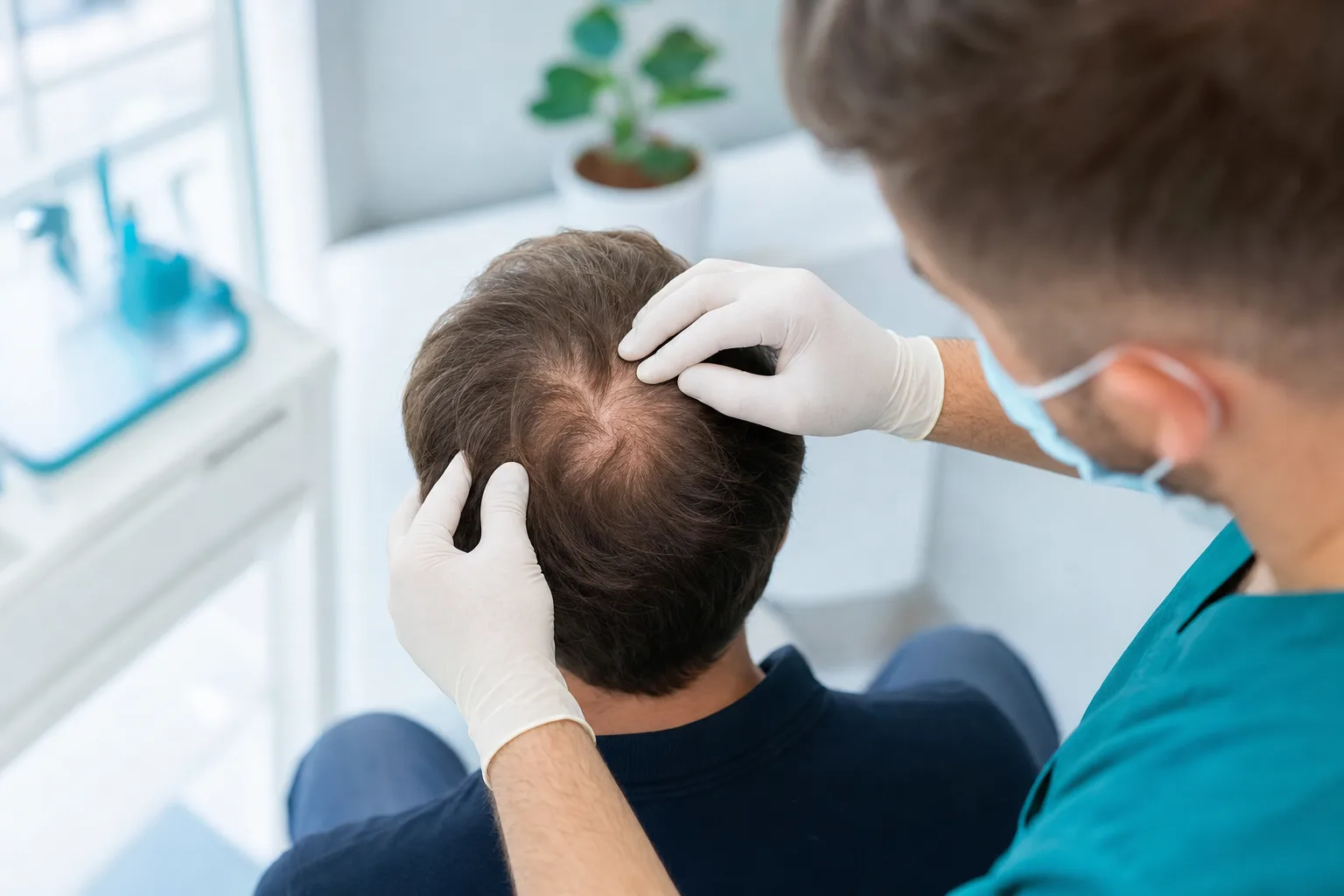
A thinning crown or hair whorl on the top of the head is one of the most common signs of hereditary hair loss. With a crown hair transplant, you can restore density, recreate a natural whorl pattern and reduce the contrast between the scalp and surrounding hair.
The number of grafts, the design of the whorl and how quickly results appear differ from, for example, the temples. The crown often requires greater density and a little more patience. Learn more about hair transplantation in Sweden.
Why do the crown and whorl thin?
In men, follicles on the top of the head are often affected early because they are sensitive to DHT (dihydrotestosterone). It usually starts as a small sparse area around the whorl and can develop into a clear bald patch. On the Norwood scale, this includes stage III vertex (early crown hair loss) and later, larger crown loss at stages IV–V.
Common signs:
- light shines through on the crown, especially in strong daylight
- the whorl is more visible and harder to conceal with styling
- contrast between the sides and crown increases
- a buzzcut or short hairstyle makes thinning more apparent
For women, thinning on the crown more often appears as diffuse thinning according to the Ludwig scale, rather than a defined bald patch. This requires a specific assessment. Learn more about hair transplantation for women.
How many grafts are needed for the crown and whorl?
Short answer: on the crown, 500 grafts is only enough for very limited density work – a small thinning spot around the whorl, on the order of a few square centimetres. Most people who notice their crown in daylight need 800–1,200 grafts or more. The exact number is always determined at a free consultation.
Graft numbers depend on:
- The size of the area: slight density work around the whorl or a larger bald zone
- Desired density: the crown often needs higher density for the same visual effect
- Donor-area capacity: how much can safely be extracted from the back and sides
- The overall plan: whether the front or temples will also be treated now or later, especially if you are under 25
As a rule of thumb, we use multi-hair grafts on the crown for volume. In cases where the crown is treated separately, around 1 200 grafts may be enough for focused density work, while a larger bald area requires more.
Example table: graft requirements for the crown
| Extent of crown loss | Description | Estimated graft count |
|---|---|---|
| Very limited thinning | Small spot at the whorl | around 500 grafts |
| Mild thinning | Early thinning around the whorl | 800–1 200 grafts |
| Moderate crown loss | Clear sparse area visible in daylight | 1 200–2 000 grafts |
| Large bald patch | Significant hair loss on the top of the head spreading forwards | 2 000–2 500+ grafts |
When crown loss is combined with frontal recession, the total requirement increases. Under our Norwood scale guidelines, for example, around 3 000 grafts are needed for stage 3a (front + early crown) and around 3 500 grafts for stage 4 (front + bald crown patch). The temples and front are then usually planned as part of the same overall treatment. Every plan is individual.
Read more about how grafts are calculated and why the donor area has a limit.
Whorl design: direction, angle and natural flow
A successful hair whorl transplant is as much about direction as graft count. Hair on the crown grows in a fan-shaped pattern out from the centre of the whorl. If direction is wrong, it quickly shows, even with good density.
How we create a natural whorl pattern
- We identify your natural whorl and direction of growth
- Grafts are placed in circular or radial flows out from the centre
- Angle and depth are adapted so hair lies flat and naturally
- The transition to the mid-scalp and sides is blended to avoid an “island” effect
Graft selection on the crown
Unlike the hairline, where single-hair grafts create a soft front, the crown usually uses double- and multi-hair grafts for volume and coverage. This provides better camouflage against the scalp when light falls from above.
Why the crown requires special planning
The top of the scalp often has a poorer blood supply than the temples and hairline. This has two practical consequences:
- Delayed growth onset: results may appear later than at the front
- Greater density needs: the same graft count does not always provide the same visible density as it does in the temples
We therefore set realistic expectations at the consultation: early growth is often visible after 3–6 months, more density after 6–12 months, and the final assessment after around 12 months (sometimes 12–18 months for full maturation). Learn more about how quickly hair grows after hair transplantation.
Choosing a method for the crown: FUE or DHI?
Sapphire FUE is usually the first choice when reconstructing the crown. It is well suited to larger areas, higher graft counts (up to approximately 3 500 per procedure) and an efficient surgical workflow. Sapphire blades are used when appropriate to create channels at the correct angle and direction. Learn more about the FUE method.
DHI treatment may suit smaller, more defined density work, for example when you want to add density to a limited area and always avoid shaving the recipient area. Capacity is normally around 1 000–1 500 grafts per procedure, and treatment takes more time. See our guide to hair transplantation without shaving.
DHI is not automatically better than FUE. The end goal is the same: a natural and lasting result. Compare the methods in our FUE vs DHI guide.
What does crown hair transplantation cost?
We have transparent prices. In Sweden, aftercare products, lunch on the day of surgery and support during healing are included. A written growth guarantee is offered when the conditions are met.
As many crown treatments fall within approximately 1 000–2 500 grafts, the table provides a useful price guide. See current packages and financing on the hair transplant pricing page.
Guide prices in Sweden (standard FUE)
| Number of grafts | Price |
|---|---|
| 1 000 | 38 000 kr |
| 1 500 | 45 000 kr |
| 2 000 | 50 000 kr |
| 2 500 | 55 000 kr |
| 3 000 | 60 000 kr |
| 3 500 | 65 000 kr |
Want to know exactly how many grafts your crown requires?
Everything starts with a free consultation in Stockholm (Alvik/Bromma) or remotely by video. You then receive a fixed price proposal. The process describes what happens before, during and after surgery day.
Aftercare and results on the crown
Aftercare follows the same basic protocol as other hair transplantation: gentle washing, avoiding friction and following the clinic’s instructions. Read the full aftercare guide.
Timeline for the crown:
- Days 1–10: healing and scabs
- Week 2 to month 3: temporary shedding (shock loss) is normal
- Months 3–6: early growth starts to appear, and may be slightly slower than at the front, see how quickly hair grows
- Months 6–12: density increases clearly
- Around 12 months: the final result is assessed
For unusual symptoms during healing, see our article on hair transplant risks.
To protect remaining hair around the crown, we often recommend complementary treatment with finasteride and/or PRP, especially when hair loss is still active.
Want to see real results? Browse our before and after photos, where you can filter by crown.
Frequently asked questions
Tags
Related information
Explore more about our treatments and services

Firo Esmer
CEO, Akacia Medical
Firo Esmer is CEO and founder of Akacia Medical and writes about hair transplantation, hair loss and treatment planning based on the clinic's experience and patient journey.
References
- 1.Sinclair R. Male pattern androgenetic alopecia. BMJ. 1998;317(7162):865-869.
- 2.Rassman WR, Bernstein RM, McClellan R, Jones R, Worton E, Uyttendaele H. Follicular unit extraction: minimally invasive surgery for hair transplantation. Dermatol Surg. 2002;28(8):720-728.
- 3.Limmer BL. The density issue in hair transplantation. Dermatol Surg. 1997.
- 4.Parsley WM, Perez-Meza D. Review of factors affecting the growth and survival of follicular grafts. J Cutan Aesthet Surg. 2010;3(2):69-75.
- 5.Goldin J, Zito PM, Raggio BS. Hair Transplantation. StatPearls. Updated 2025.
- 6.Kaufman KD et al. Finasteride in the treatment of men with androgenetic alopecia. J Am Acad Dermatol. 1998.
Related articles
September 13, 2026
How long does a hair transplant last?
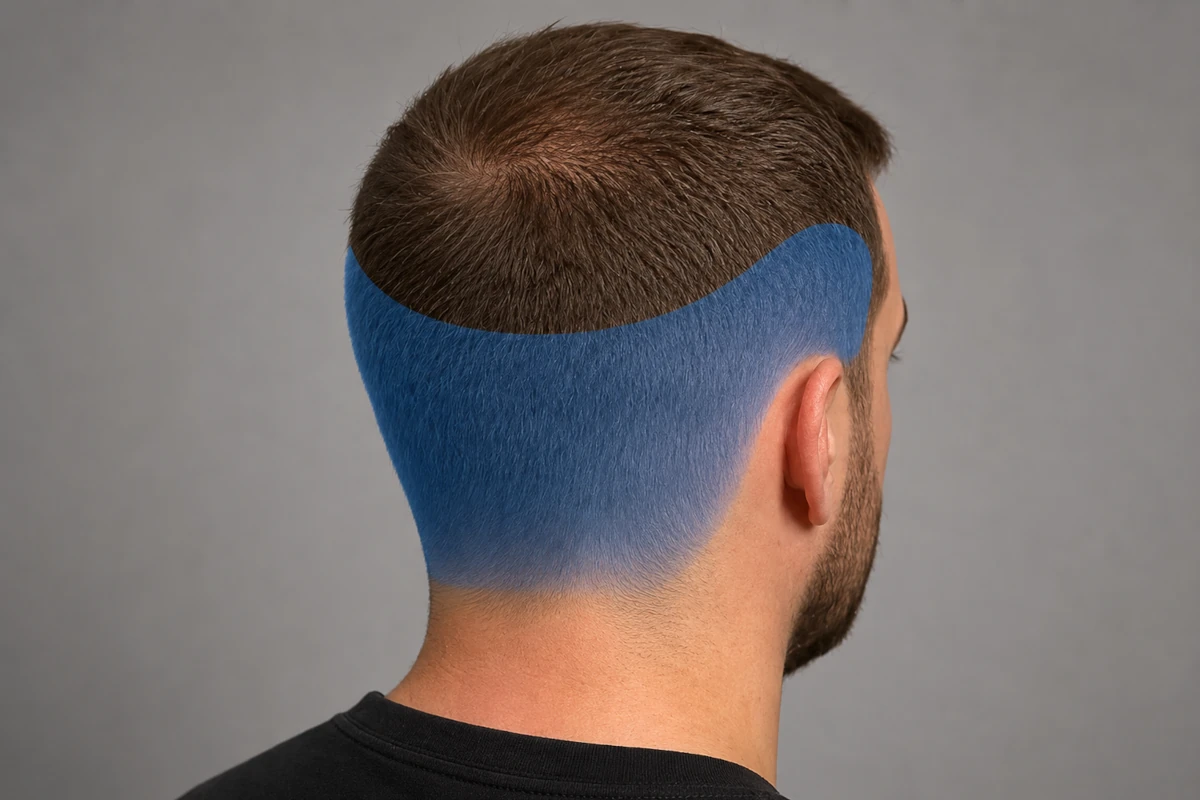
How long does a hair transplant last? Transplanted hair is usually permanent. Surrounding hair can keep thinning – this is how the result is kept over time.
September 10, 2026
Does a hair transplant hurt?
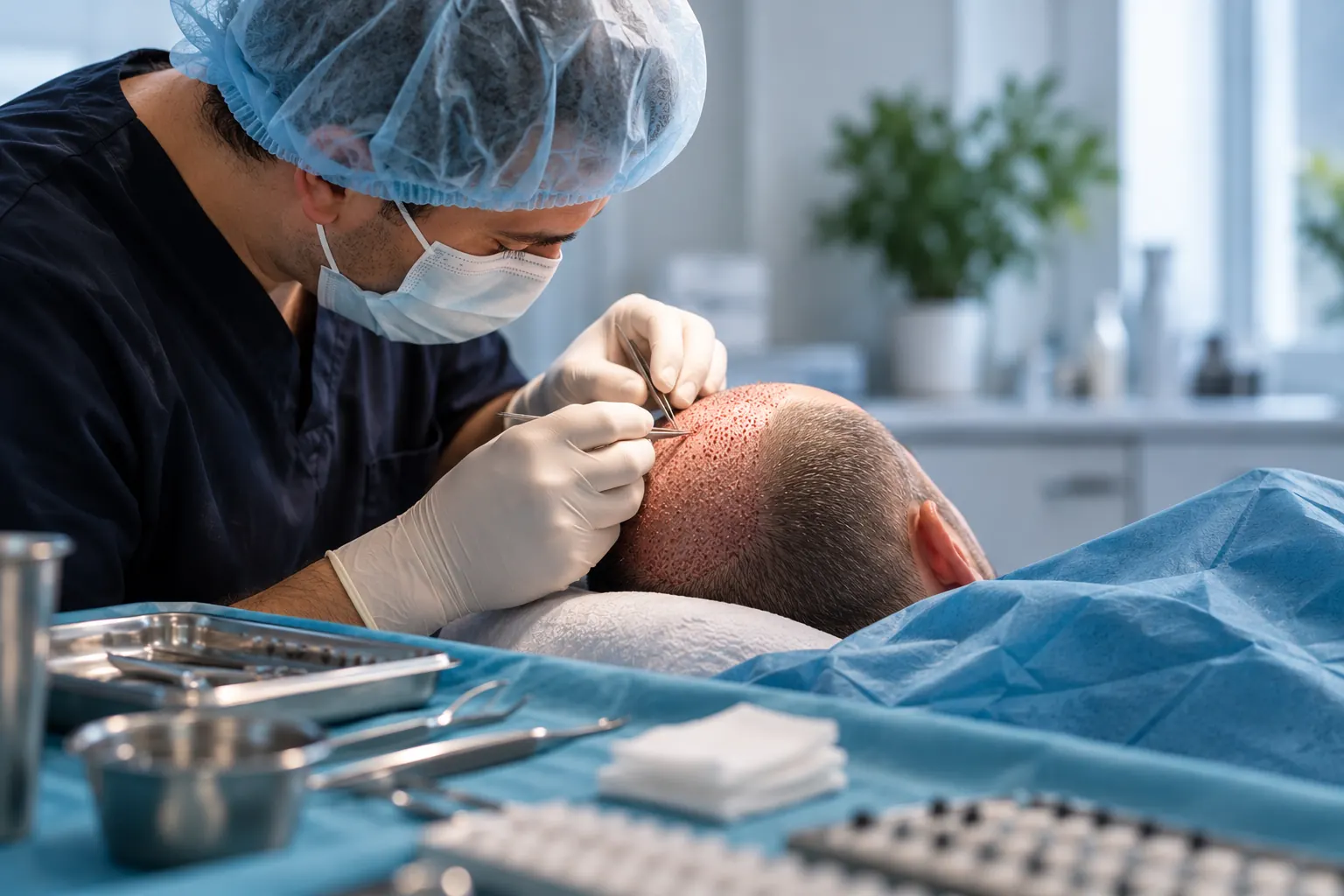
Does a hair transplant hurt? How local anaesthesia works, what you feel during the procedure and how tenderness is handled in the first days.
September 3, 2026
Hair transplant scars – FUE, FUT and healing
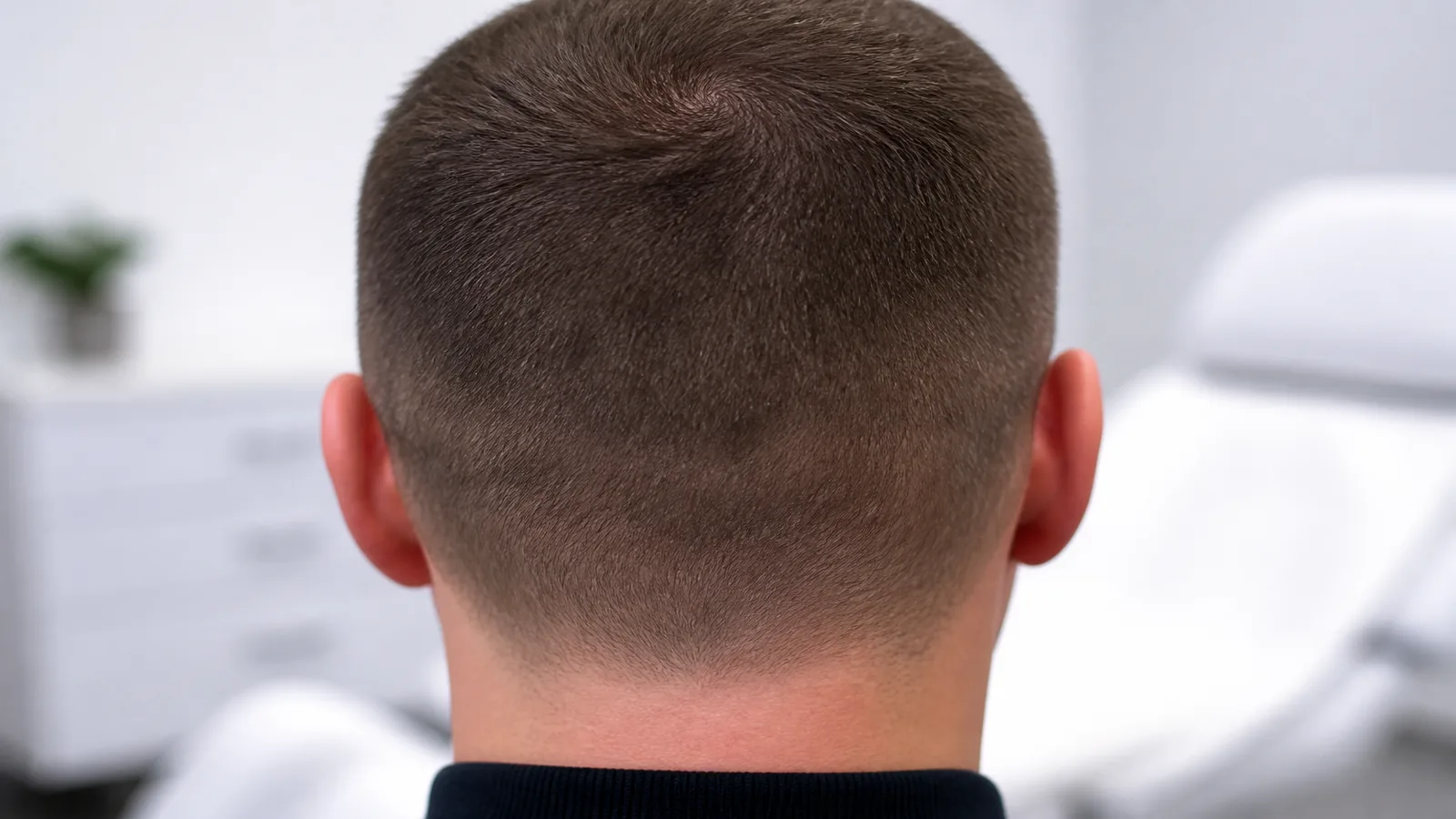
How visible are scars after a hair transplant? The difference between FUE and FUT, healing in the donor area, and how older scars can be hidden.
Book a free consultation
We will review your circumstances and recommend the right next step for you.