

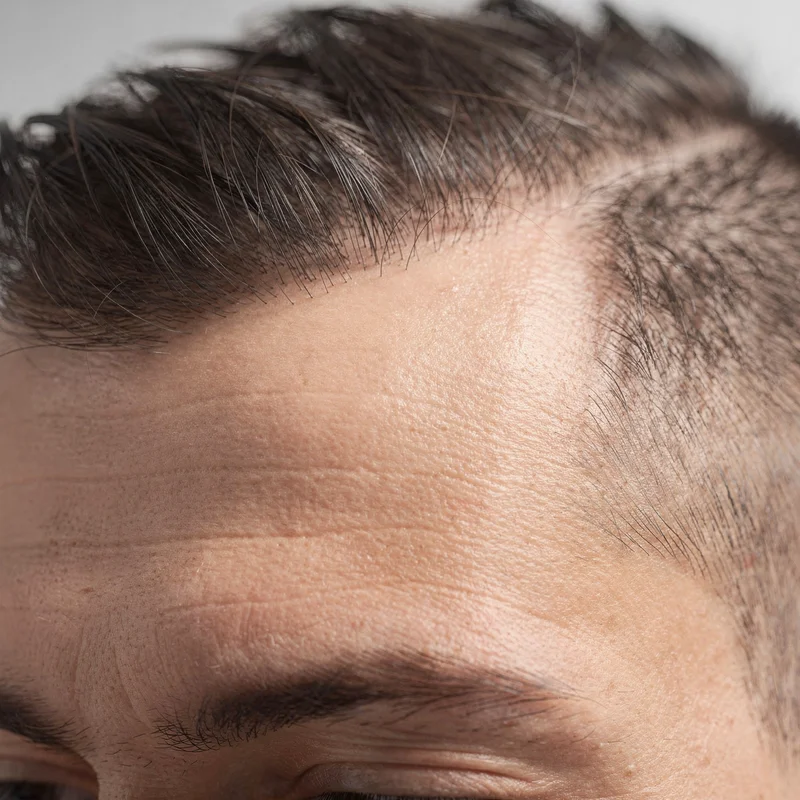
The frontal hairline is one of the most prominent aesthetic structures in the male face. The shape, height and density of the hairline frame the face and have a decisive impact on perceived age, facial symmetry and personal style. Changes in this area, receding temples or general thinning, often affect self-confidence negatively.
It is common for men to experience a bad hairline when the first signs of hair loss appear, which often leads to an active search for ways to fix a hairline. Before you consider hairline surgery or hairline transplantation, it is important to understand what type of hairline you have, not all variations are signs of active hair loss.
Hairline and psychological wellbeing
Statistical analyses highlight the psychological burden that hair loss can place on younger men. According to a comprehensive survey conducted by YouGov, 59 percent of men aged 18 to 24 experience noticeable anxiety about losing their hair. In the 25 to 34 age group, roughly half of the men surveyed (51 percent) report that a receding hairline is a source of fear. This concern tends to decrease with age; among men over 65, only 14 percent express fear of becoming bald.
The high prevalence of hair loss related anxiety among younger men underlines the need for accurate clinical diagnosis. Many men misinterpret physiological age related changes in the scalp as signs of early, progressive baldness, which often leads to unnecessary psychological stress and incorrect treatment decisions. Distinguishing normal genetic traits from progressive androgenetic alopecia is therefore a crucial first step.
Seven types of hairline in men
There are several distinct physiological types of hairlines in men. By analysing the specific pattern of the hairline, it is possible to distinguish normal genetic traits from progressive androgenetic alopecia, which is essential for determining whether hairline surgery is indicated.
1. Straight hairline
A completely straight hairline is characterised by an even, horizontal line across the forehead without pronounced indentations at the temples. This shape is often considered aesthetically to be a good hairline and is most common during youth. Only a few men retain a completely straight hairline intact throughout life, as physiological changes usually shift or reshape the hairline over the years.
Some men have a congenital high hairline that is completely straight, which can give the impression of a large forehead without this being ongoing hair loss.
2. M-shaped hairline
An M-shaped hairline (or M-shaped hairline pattern) shows a mild to moderate recession at the temples, creating a contour that resembles the letter M. In some cases this shape can be congenital and completely stable over time, but for the majority of men it is one of the earliest signs of early hair loss progression from male hair loss.
3. Widow's peak
A widow's peak is characterised by a distinct, triangular point in the centre of the forehead pointing downward toward the eyebrows. This is a genetically determined trait that is often confused with an emerging receding hairline. The difference is that a true widow's peak is a stable anatomical variation that often remains unchanged throughout life, unlike the progressive hair loss at the temples.
4. Receding hairline
A receding hairline is the classic and most widespread sign of male hair loss (androgenetic alopecia). The process is characterised by progressive thinning that begins at the temples and leads to two deep recessions on either side of the forehead. As hair loss advances, many men experience an unattractive or bad hairline, which markedly changes the proportions of the face. Without treatment, the process often continues until only a ring of hair remains on the back and sides of the head.
5. Mature hairline
A mature hairline develops naturally during the transition from adolescence to adulthood, usually between the ages of 17 and 30. The process involves the hairline moving approximately one to two centimetres upward from the low position of youth and stabilising there. This is a normal physiological maturation process and should not be confused with progressive hair loss, as the mature hairline remains stable for a long time and gives a masculine, age appropriate appearance.
6. Uneven hairline
An uneven hairline is defined by asymmetry, where the hair on one side of the forehead has receded further back than on the other. The unevenness does not necessarily depend on hair loss, but can be entirely genetically determined. However, it can make the hair difficult to style symmetrically. In some cases, the asymmetry can be a sign that hair loss has started at a more aggressive pace on one side of the scalp.
7. Cowlick
A cowlick in the frontal hairline means that a smaller group of hairs grows in a completely different direction from the surrounding hair. This is a congenital, genetic trait that can create temporary asymmetry and make the hairline difficult to control when styling. A cowlick can sometimes be misinterpreted as local thinning or unevenness, but the density and health of the hair follicles are usually completely unaffected.
Scandinavian hairline
Within the Nordic population, a Scandinavian hairline is sometimes discussed, which is often characterised by fine, lighter hairs in the very front transition zone. This places extremely high demands on precision in any eventual reconstruction to maintain a natural appearance.
Overview: hairline types compared
| Hairline type | Visual characteristics | Primary cause | Clinical progression and action |
|---|---|---|---|
| Straight hairline | Horizontal, symmetrical line without temple recessions | Genetics, youth | Stable during youth; can be surgically recreated for congenital high hairline |
| M-shaped hairline | Temples receded forming an M shape | Genetics or early androgenetic alopecia | May remain stable or progress; requires diagnostic monitoring |
| Widow's peak | Downward pointing triangular point in centre of forehead | Dominant hereditary trait | Permanent and stable; rarely requires clinical intervention |
| Receding hairline | Progressive recession and thinning at the temples | Androgenetic alopecia (DHT sensitivity) | Continuous recession; treated with medication or hair transplantation |
| Mature hairline | Symmetrical upward shift of 1 to 2 cm | Normal physiological age related change | Stabilises after maturation; considered a normal condition |
| Uneven hairline | Clear asymmetry between right and left side | Genetics, asymmetric alopecia or mechanical stress | Can be surgically corrected to restore symmetry |
| Cowlick | Local group of hairs with deviating growth direction | Genetics (congenital trait) | Completely stable; best concealed with adapted cutting and styling |
Non-surgical treatments for a receding hairline
For individuals experiencing an emerging receding hairline or localised thinning, several non-surgical options are available. These aim to stimulate existing hair follicles, increase hair diameter and slow the ongoing process of hair loss.
Scalp massage and mechanical stimulation
Mechanical stimulation of the scalp has shown measurable effects on hair thickness in clinical studies. In a controlled study where healthy men massaged the scalp for four minutes daily over 24 weeks, a statistically significant increase in hair diameter was measured (from 0.085±0.003 mm to 0.092±0.001 mm). Finite element analysis showed that massage transfers mechanical stretching forces to the dermal papilla cells in the subcutaneous tissue.
In a retrospective survey study among 327 participants with diagnosed androgenetic alopecia who performed daily scalp massage, 68.9 percent reported stabilisation or regrowth. On average, 36.3 hours of accumulated massage over a mean of 7.4 months was required for measurable results. Scalp massage should however not be seen as primary monotherapy for more advanced hair loss.
Minoxidil for the hairline
Many who notice early signs of hair loss wonder whether minoxidil can support hair growth at the hairline. Minoxidil works by increasing blood flow and nutrient supply to the hair follicles. Pharmacologically, minoxidil shortens the resting phase of the hair follicle (telogen phase) and prolongs the active growth phase (anagen phase).
Research published in the Journal of the American Academy of Dermatology shows that low dose oral minoxidil can be an effective alternative for men with hereditary hair loss. In a clinical study where men were treated with oral minoxidil (2.5 mg or 5 mg daily) for at least six months, 90.2 percent showed clinical improvement. Of the patients treated with oral minoxidil as monotherapy, none experienced deterioration, and 37.5 percent showed marked improvement equivalent to a full grade on the Hamilton-Norwood scale. A separate multicentre safety study of low dose oral minoxidil reported hypertrichosis (increased body hair) as the most common side effect.
Read more about finasteride and medical options for hair loss.
Finasteride
Finasteride is a clinically proven pharmacological treatment that selectively blocks the enzyme 5-alpha reductase, lowering levels of dihydrotestosterone (DHT). DHT is a central driver of gradual follicle miniaturisation in male pattern hair loss.
It is important to understand that pharmacological treatments are only effective as long as they are administered continuously. If treatment is discontinued, hair loss returns to its natural course within a few months. Furthermore, medication can only preserve and strengthen existing hair follicles, it cannot recreate hair on skin surfaces where the follicles have completely atrophied.
Surgical hair reconstruction at Akacia Medical
For men who want a permanent solution for a high hairline, deep temple recessions or an uneven hairline, hairline transplantation is the most effective option. Akacia Medical is one of the most experienced specialist clinics in the Nordics for hair transplantation, with over 15,000 successful procedures performed since the clinic opened in 2011.
Hairline hair transplantation is often the optimal choice for permanently correcting asymmetries and restoring youthful fullness with a natural result.
FUE, extraction of individual follicular units
FUE (Follicular Unit Extraction) involves extracting individual follicular unit grafts one by one from the back of the head (donor area) with a precision instrument. The follicles are checked under a microscope and transplanted into the thinning areas of the hairline. The FUE method is linear scar free, offers minimal healing time and is performed under local anaesthesia.
DHI, direct implantation
DHI (Direct Hair Implantation) is a highly precise advancement where the extracted follicles are placed directly into the recipient area by opening channels with a sapphire blade. DHI allows the surgeon to control the implantation angle, depth and direction of each individual hair with extreme precision, ideal for recreating the naturally irregular but dense transition that characterises a natural male hairline.
Scope and guarantee
The size of the procedure that can be performed is determined by the quality and density of the donor area. In a maximum procedure, Akacia Medical transplants up to 3,500 grafts in a single session. Read more about what a graft is and how graft need is estimated. Such a procedure usually takes between seven and eight hours and is performed under complete local anaesthesia.
If the patient has more extensive hair loss, a second session is planned at the earliest six months later. Akacia Medical provides a written guarantee: grafts that do not grow as expected can be replaced at no extra cost, provided that at least 12 months have passed since the procedure and the aftercare instructions have been followed.
A decisive factor when choosing a clinic is transparent hairline transplantation pricing. Akacia Medical offers fixed prices with no hidden fees. The procedure price includes local anaesthesia, meals on the day of surgery, aftercare products and support throughout the healing process. Current prices for FUE, DHI and packages in Sweden and Istanbul are collected on our pricing page, where you can also see approximate monthly cost with instalment plans.
Book a free consultation for a personal quote based on your hair loss and desired hairline.
Comparison of treatment options for the hairline
| Treatment method | Permanence | Clinical evidence | Advantages | Limitations |
|---|---|---|---|---|
| Standardised scalp massage | Temporary; requires continuous maintenance | Moderate; clinically proven increase in hair thickness | Free of charge, no pharmacological side effects | Requires significant time investment (36+ hours). Cannot recreate completely lost hair |
| Minoxidil / Finasteride | Temporary; effect ceases when stopped | Strongest evidence in early to moderate androgenetic alopecia | Effective for slowing active hair loss and preserving hair at the temples | Risk of side effects. Cannot regrow hair on completely bald areas |
| Hair transplantation (FUE/DHI) | Permanent; transplanted follicles are DHT resistant | Very high; established surgical method with written guarantee | Only way to permanently lower a high hairline or restore recessions | Higher initial cost. Requires sufficiently dense donor area |
Hairline in women
Women can also experience changes in the hairline, for example with diffuse hair loss or after hormonal changes. A female hairline often develops differently from that in men, thinning usually occurs diffusely across the crown with the hairline retained rather than clear temple recessions. Read more about hair transplantation for women.
Conclusions and clinical recommendations
When a man experiences changes in his hairline, careful differential diagnosis is the single most important step. Distinguishing a normal mature hairline from emerging androgenetic alopecia prevents incorrect treatment decisions and reduces the psychological stress that is so widespread among younger men.
For men with confirmed progressive hair loss, a combined treatment strategy should be considered:
- Stabilisation: Pharmacological treatments such as finasteride or low dose oral minoxidil can slow miniaturisation of the hair follicles and protect existing hair.
- Mechanical stimulation: Complementary methods such as scalp massage or PRP treatment can optimise the scalp environment and increase hair fullness.
- Permanent restoration: In areas where the hairline has receded permanently and the follicles have atrophied, hair transplantation with FUE or DHI technique is the only way to reconstruct a dense and natural hairline.
Akacia Medical offers free consultations in Stockholm and Gothenburg, or via digital video call. During the consultation, a specialist examines the scalp, evaluates the capacity of the donor area and designs a tailored treatment plan based on your unique conditions and aesthetic goals.
Next steps
- Book a free consultation
- Read about a receding hairline
- See before and after results
- Compare prices and packages
When the hairline needs permanent reconstruction, a hair transplant is often the solution. We perform hair transplant Stockholm procedures and hair transplant in Sweden.
This text is for informational purposes only. For medical advice or diagnosis, consult a qualified professional.
Tags
Related information
Explore more about our treatments and services
Firo Esmer
CEO, Akacia Medical
Firo Esmer is CEO and founder of Akacia Medical and writes about hair transplantation, hair loss and treatment planning based on the clinic's experience and patient journey.
References
- 1.YouGov. Most young people are "terrified" of going bald. Survey of 32,601 adults in the USA, October 2019, October 2020.
- 2.Koyama T et al. Standardized scalp massage results in increased hair thickness by inducing stretching forces to dermal papilla cells in the subcutaneous tissue. Eplasty. 2016.
- 3.English RS, Barazesh JM. Self-assessments of standardized scalp massages for androgenic alopecia: survey results. Dermatol Ther (Heidelb). 2019;9(1):167, 178.
- 4.Jiménez-Cauhe J et al. Effectiveness and safety of low-dose oral minoxidil in male androgenetic alopecia. J Am Acad Dermatol. 2019;81(2):648, 649.
- 5.Vañó-Galván S et al. Safety of low-dose oral minoxidil for hair loss: a multicenter study of 1404 patients. J Am Acad Dermatol. 2021.
- 6.Sinclair R. Male pattern androgenetic alopecia. BMJ. 1998;317(7162):865, 869.
- 7.Kaufman KD et al. Finasteride in the treatment of men with androgenetic alopecia. J Am Acad Dermatol. 1998.
Related articles

September 21, 2026
Hair loss treatments – what actually works
Which hair loss treatments have evidence? Comparison of finasteride, minoxidil, oral minoxidil, PRP and hair transplantation.

September 19, 2026
DHT and hair loss – the hormone behind thinning
DHT is formed from testosterone and can shrink sensitive follicles. How the hormone works, what can be treated, and when a transplant is needed.

September 17, 2026
Minoxidil for hair loss – topical and oral
Guide to minoxidil for hair loss: 2% and 5%, oral minoxidil in Sweden, use in women, timeline and side effects.
Book a free consultation
We will review your circumstances and recommend the right next step for you.