

What is a graft in a hair transplant? In short: a small group of follicles moved as one unit. Here we explain what that means, and above all how many grafts you may need for a natural result.
Most men develop hereditary hair loss at some point. Research suggests that up to 80% may be affected during their lifetime. Our hair loss hub covers causes and treatment options in more depth. Two questions drive planning: what a graft actually is, and how many are needed based on your pattern of loss, your goals and how much donor hair is available. Not sure where to start? A free consultation is a good first step.
What is a graft?
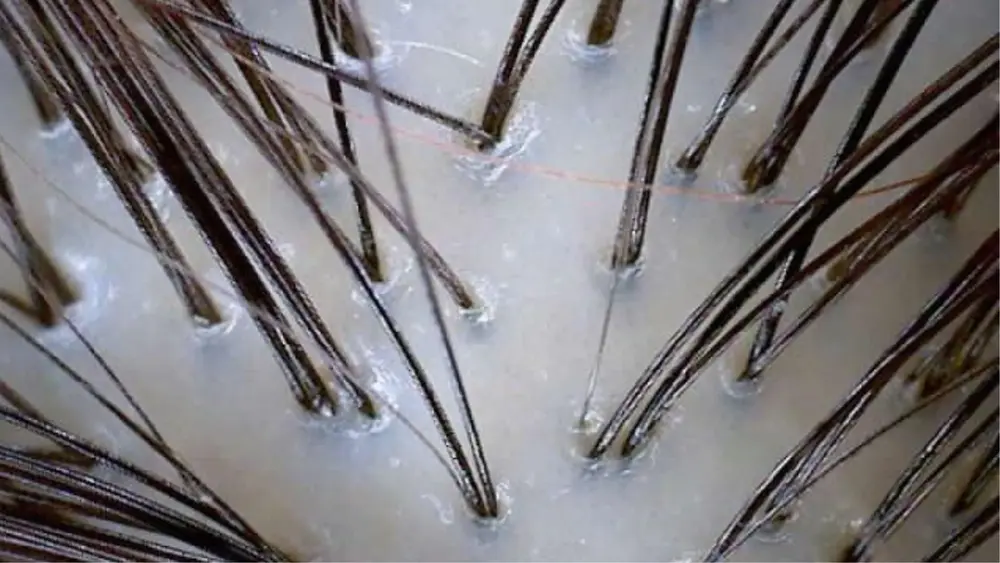
A graft, also called a follicular unit, can consist of a single hair or several hairs that grow together in a natural group in the scalp.
A graft usually contains one to four hairs, so graft count and hair count are not the same. The proportion of single-, double- and multi-hair grafts varies between patients and is measured in the donor area before treatment.
Grafts must be extracted and placed intact. Splitting them during surgery sharply lowers survival rates.
Surgeons sort grafts by size:
- Single-hair grafts at the front of the hairline for a soft transition
- Multi-hair grafts further back on mid-scalp and crown for volume
How the procedure works
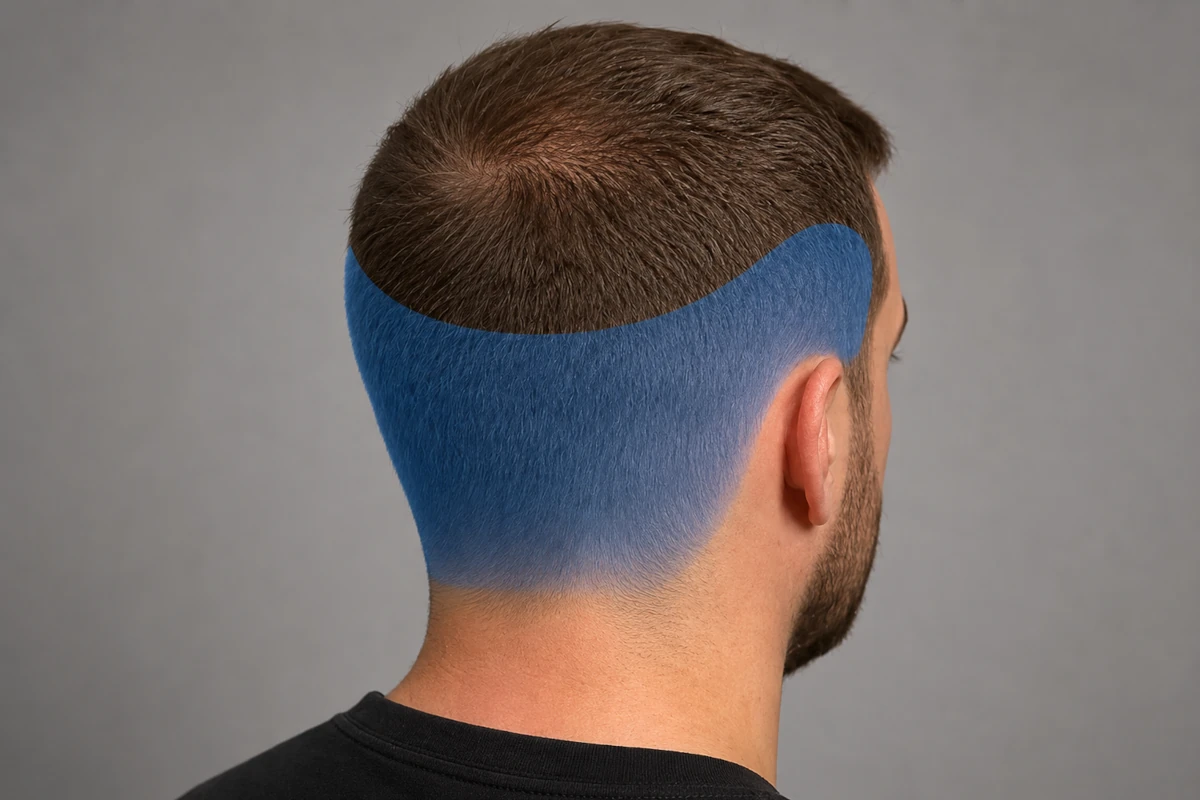
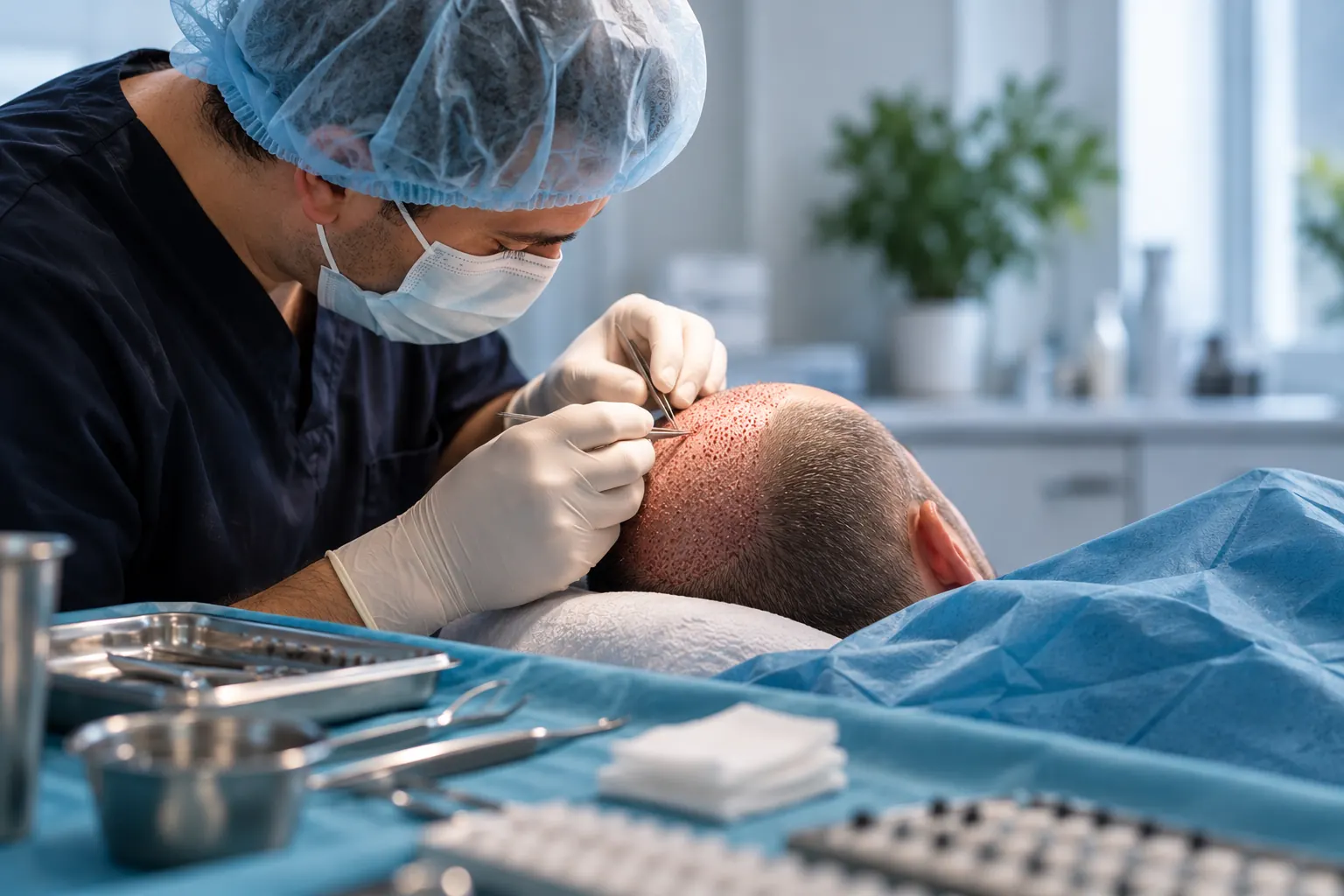
In a hair transplant using the FUE method, grafts are taken from the donor area at the back and sides with a micro-instrument called a punch. Hair there is usually less affected by androgenetic alopecia than hair on the crown; this is called a “non-DHT-affected area”.
They are then placed in the recipient area where hair has thinned. Fine units at the hairline, thicker ones behind for coverage. See our before and after photos for real-world examples.
How many grafts do you need?
The goal is hair that looks full, not operated. You often need less density than you started with.
Healthy scalp averages around 200 hairs/cm², but the eye rarely notices thinning until density drops below half that. This is cosmetic density — around 65–140 hairs/cm² often looks full enough:
Dcosmetic ≈ 0.5 × Dnatural
Very dense placement requires careful medical planning because tissue blood supply and graft survival must be considered. Density is therefore planned around the skin, hair type and treatment area.
Norwood and graft planning
Male hair loss is usually graded with the Norwood scale, which describes seven stages of progressive loss. Stage I is a full head of hair. Stages II–III show temple recession; stage III vertex adds early crown thinning. Stages IV–V merge frontal and crown loss, and stages VI–VII leave mainly a rim at the sides and back.

Guidelines by Norwood stage:
| Norwood stage | Typical treatment area | Typical graft count |
|---|---|---|
| Stage 2 | Mild recession at the hairline and temples | 500–800 |
| Stage 2a | Central hairline reconstruction | 500–1,000 |
| Stage 3 | Pronounced temple recession and early frontal recession | approx. 2,500 |
| Stage 3a | Frontal recession combined with early crown loss | approx. 3,000 |
| Stage 4 | Marked frontal loss and a bald area on the crown | approx. 3,500 |
| Stage 4a | Extensive loss across the full frontal band | approx. 3,500 |
| Stage 5–7 | Advanced loss – typically planned in two procedures | Procedure 1: approx. 3,500 · Procedure 2: approx. 2,500–3,000 |
The table is a rule of thumb. Real needs depend on donor density, hair quality and how large an area must be filled. The exact number requires individual assessment.
When planning an FUE hair transplant, we often divide the recipient area into six zones. The diagram shows approximate graft needs per zone – a complement to the Norwood table above.

The Ludwig scale for women
Female hair loss often looks different from men's. The hairline may stay intact while hair thins diffusely over the mid-scalp, especially at the parting. That is why we use the Ludwig scale instead of Norwood:
- Grade I: Mild thinning, usually with the frontal hairline preserved
- Grade II: More pronounced thinning over the top of the head and a wider parting
- Grade III: Pronounced thinning over larger parts of the scalp

Graft needs are harder to estimate than with Norwood because women are rarely fully bald. In early stages, medical treatment or PRP is often enough. Transplantation may be suitable in selected zones when diffuse thinning does not respond to other treatment.
Donor area limits
A transplant redistributes existing follicles; it does not create new ones. The safe donor area – the permanent zone at the back and sides where hair is usually resistant to DHT – is the source of all grafts.
Usable donor-area size and density vary between patients. In a study of 580 men, average density was 78.2 follicular units per cm², but that result is not a universal limit for every patient.

The proportion that can be extracted safely depends on density, hair calibre, skin characteristics, donor-area size, previous surgery and expected future hair loss. Excessive or uneven extraction can cause visible thinning and scarring, so no universal maximum or lifetime capacity applies to every patient. Read more about how many treatments are realistic in how many hair transplants you can have.
Very high graft counts in one session require particularly careful assessment and may increase the risk of overharvesting.
The donor area has a limit. At Akacia Medical we always put donor health first, count every graft and stand behind our guarantees.
Do grafts grow back in the donor area?
No. Moved follicles do not regrow where they were taken; they establish in the recipient zone. Extraction is spread out to keep the donor area even.
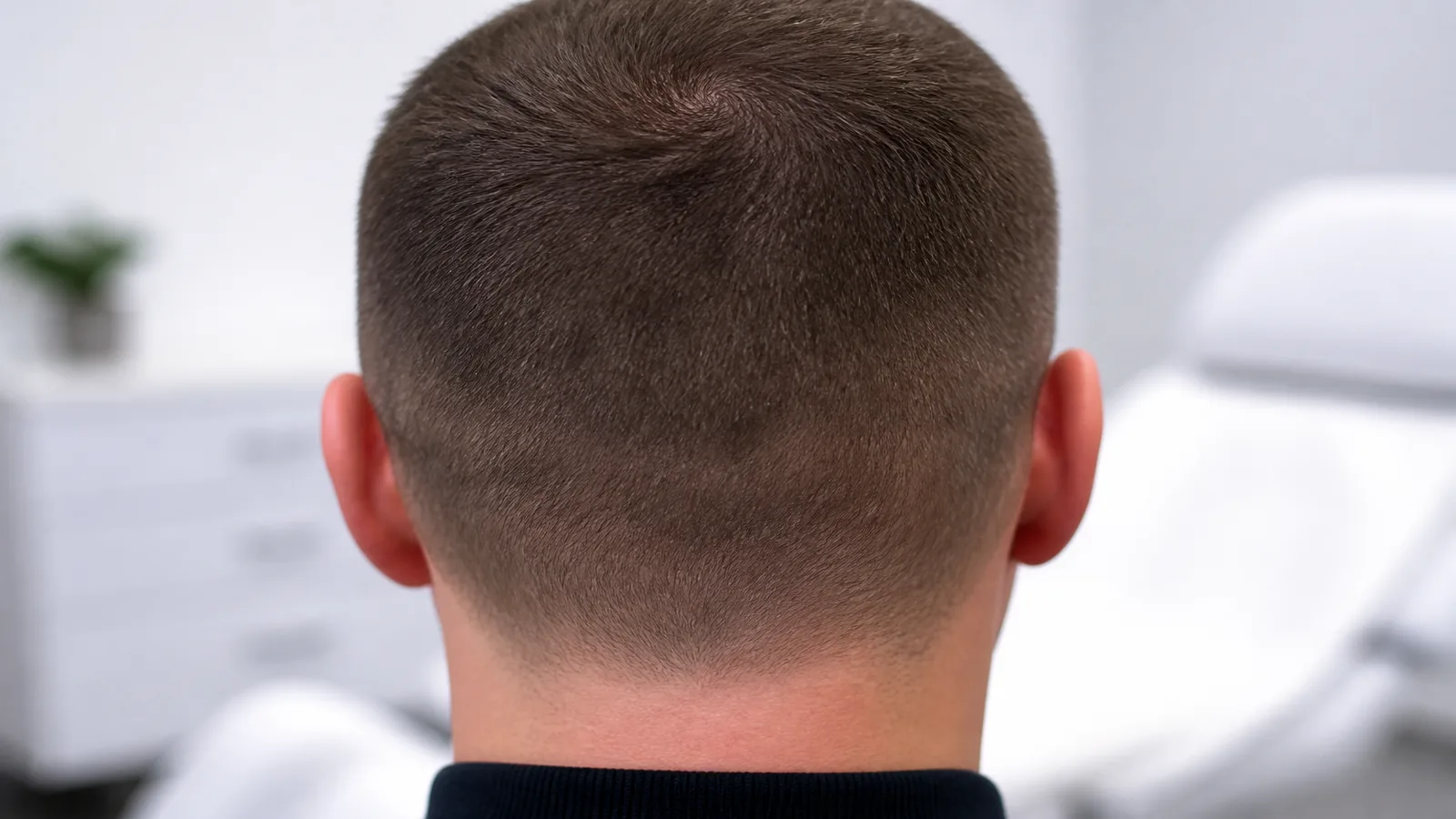
With very fine donor hair, the back may look slightly thinner when cropped short, but the difference is usually subtle.
What else affects graft needs?
Beyond Norwood stage, four factors affect how many grafts you need:
- Thickness: thick hair covers better, fine hair needs more grafts for the same look.
- Structure: curly and wavy hair adds volume and hides the scalp, straight hair often needs higher density.
- Hair/skin contrast: dark hair on light skin shows thinning more clearly, light hair on light skin masks gaps better.
- Future loss: in younger men we plan for ongoing hair loss. We place the hairline slightly higher so that the result suits the patient even as they age. We always leave the donor area in good condition so that the patient has the option to have further hair transplants in the future.
Can you reduce graft needs?
The best step before surgery is to protect the hair you still have. With early hair loss, evidence-based treatments such as finasteride or minoxidil can slow miniaturization and preserve follicles, which may reduce how large an area needs transplanting. We offer PRP treatment as a complement, especially to strengthen weak follicles or support healing after transplant.
Lifestyle matters too. Smoking can reduce scalp blood flow and worsen androgenetic alopecia. A balanced diet with enough protein, iron and vitamins supports healthier follicles. That does not replace transplant on bald zones, but preserving more native hair can mean fewer grafts later.
How we estimate graft needs: See our pricing page for current options. Every graft is counted, backed by a written growth guarantee with refunds if fewer grafts are implanted than agreed.
Miniaturization and PRP
Follicles can produce thinner hairs over time and eventually stop, especially with hereditary hair loss. That affects both native hair and how a transplant ages.
We often offer PRP treatment (Platelet-Rich Plasma): your own plasma with growth factors injected into the scalp. It may support healing after transplant and strengthen weak follicles.
How we work
We have performed over 15,000 hair transplants since 2011 and offered FUE hair transplantation and DHI at our Stockholm clinic in Alvik/Bromma since 2014.
- 0.6 mm punches: our smallest punches are 0.6 mm wide and are selected according to graft and hair characteristics for precise extraction.
- Sapphire FUE: sapphire blades are used when appropriate for the treatment plan to create channels with the intended angle, direction and density.
- DHI: for temples or smaller zones we use a DHI method – grafts are placed directly into the channels. Selected cases without shaving the full recipient area.
- Guarantee: a written growth guarantee on all transplants. Grafts that fail to grow as planned are replaced. Fewer grafts than agreed are refunded according to the agreed plan.
Want details on FUE, DHI, beard transplantation or eyebrow transplantation? See our pricing page or book a free consultation at our Stockholm location.
Next steps
No table replaces an individual assessment. Donor area, hair type, Norwood stage and future loss all need to be weighed together.
Considering a hair transplant or PRP treatment for hair loss? Book a free consultation in Stockholm. We review your situation and recommend the approach that fits your hair, age and goals.
- Book a free consultation
- Read about the FUE method
- Read about the DHI method
- See before and after results
- See our pricing page
- Read more hair articles
This text is for informational purposes only. For medical advice or diagnosis, consult a qualified professional.
Frequently asked questions
Tags
Related information
Explore more about our treatments and services
Firo Esmer
CEO, Akacia Medical
Firo Esmer is CEO and founder of Akacia Medical and writes about hair transplantation, hair loss and treatment planning based on the clinic's experience and patient journey.
References
- 1.Ellis JA, Stebbing M, Harrap SB. Polymorphism of the androgen receptor gene is associated with male pattern baldness. J Invest Dermatol. 2001.
- 2.Jiménez F, Ruifernández JM. Distribution of human hair in follicular units: a mathematical model for estimating donor size. Dermatol Surg. 1999.
- 3.Chouhan K et al. Assessment of safe donor zone of scalp and beard for follicular unit extraction in Indian men: a study of 580 cases. J Cutan Aesthet Surg. 2019.
- 4.Limmer BL. The density issue in hair transplantation. Dermatol Surg. 1997.
- 5.Anastassakis K. Androgenetic Alopecia From A to Z: Vol. 3, Hair Restoration Surgery, Alternative Treatments, and Hair Care. Springer. 2023.
- 6.Kumaresan M, Mysore V. Controversies in hair transplantation. J Cutan Aesthet Surg. 2018.
- 7.Dinh QQ, Sinclair R. Female pattern hair loss: current treatment concepts. Clin Interv Aging. 2007.
Related articles
September 13, 2026
How long does a hair transplant last?
How long does a hair transplant last? Transplanted hair is usually permanent. Surrounding hair can keep thinning – this is how the result is kept over time.
September 10, 2026
Does a hair transplant hurt?
Does a hair transplant hurt? How local anaesthesia works, what you feel during the procedure and how tenderness is handled in the first days.
September 3, 2026
Hair transplant scars – FUE, FUT and healing
How visible are scars after a hair transplant? The difference between FUE and FUT, healing in the donor area, and how older scars can be hidden.
Book a free consultation
We will review your circumstances and recommend the right next step for you.