

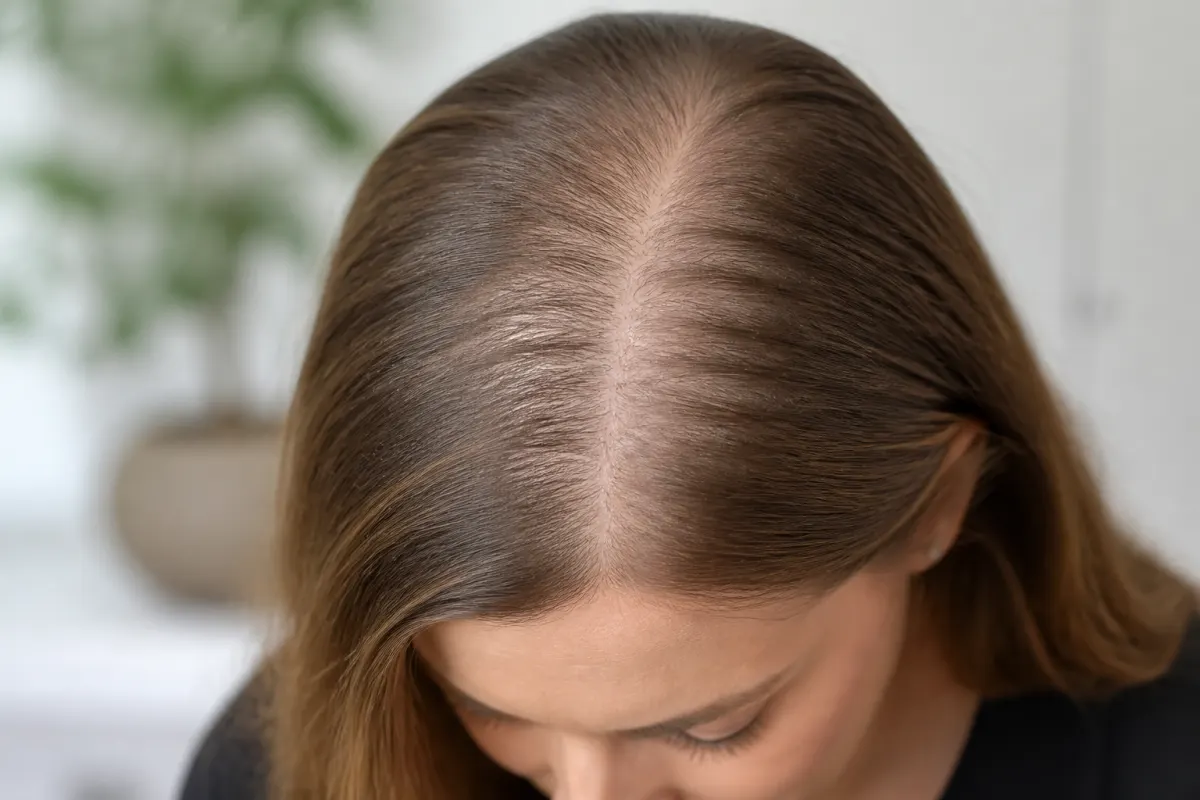
Diffuse hair loss means the hair thins evenly over large parts of the scalp, without the clear bald patches you see in patchy hair loss or the classic pattern of hereditary hair loss.
The most common underlying condition is telogen effluvium, where more follicles than usual enter the resting phase at the same time. It is often temporary, but you need to understand the cause before choosing treatment.
This guide explains what diffuse hair loss can feel like, what may trigger it, how it is assessed and which options may be relevant, from lifestyle changes and PRP to hair transplantation when thinning has become permanent.
What is diffuse hair loss?
With diffuse hair loss, density decreases more evenly across all or large parts of the scalp. At first it can be hard to see. You notice it more often as hair feeling flatter, a ponytail becoming thinner, or the scalp showing more clearly in the mirror and in photos.
It differs from:
- Hereditary hair loss: temples, a thin hairline or a sparse crown in a more predictable pattern
- Alopecia areata: sudden, well-defined bald patches
- Traction alopecia: thinning where the hair has been pulled tightly for a long time
In women, diffuse thinning can also be part of female pattern hair loss. Read more on the page about hair transplantation for women.
How it ties into the hair cycle
Every hair goes through a growth phase (anagen), a short transition (catagen) and a resting phase (telogen). Normally most follicles are growing. In telogen effluvium an unusually large share shifts into the resting phase. When that phase ends a few months later, many hairs shed at once. That is why shedding often appears two to three months after the event that started it.
More on growth and the resting phase is in the article on how fast hair grows.
Acute and chronic course
- Acute telogen effluvium: usually under six months, typically after a clear trigger. Many recover once the cause is gone.
- Chronic telogen effluvium: lasts longer than six months, sometimes in waves. Then it is especially important to look for remaining factors such as deficiencies, thyroid effects or overlapping hereditary hair loss.
Symptoms you may recognise
Common signs:
- markedly increased daily hair shedding when washing and brushing
- hairs with a white, club-like root (so-called club hair)
- hair feels thinner and less full
- the scalp shows more, especially in the parting
- sometimes tenderness, burning or discomfort in the scalp (trichodynia)
Normally most people shed about 50 to 100 hairs per day. With active diffuse shedding it can be considerably more. That does not automatically mean the follicles are destroyed, but it is a signal to take seriously.
Common causes
Diffuse hair loss is usually a response to something else in the body. Common triggers:
Stress, illness and major life changes
High fever, surgery, infection, heavy psychological strain or hair loss from stress can disrupt the cycle. Shedding often comes with a delay, which makes it easy to miss the connection.
Nutritional deficiencies and rapid weight loss
Iron deficiency, inadequate protein intake and rapid weight loss are recognised triggers. Other nutritional deficiencies, such as zinc or vitamin D, should be assessed in the context of symptoms, diet and medical history rather than assumed to be the cause.
Hormones
Both low and high thyroid function can cause diffuse shedding. After pregnancy, postpartum effluvium is common: during pregnancy more hairs stay in growth, and after birth many people shed more for a few months.
Medication
Some medicines can contribute, for example certain blood pressure drugs, anticoagulants, retinoids, some antidepressants or changes around the contraceptive pill. That does not mean you should stop anything on your own, but it should be mentioned at the consultation.
Assessment: how the cause is found
A good assessment is about distinguishing diffuse shedding from other conditions and finding what can be influenced.
It may include:
- History focused on the past one to six months: illness, stress, diet, medicines, pregnancy, heredity.
- Scalp examination, preferably with a microcamera/trichoscopy, to see density, diameter and signs of miniaturisation.
- Hair pull test in several zones when shedding is active.
- Blood tests when needed, for example blood count, ferritin, thyroid tests, zinc, vitamin D and B12.
In unclear cases further medical investigation may be needed. The goal is not to “guess treatment”, but to avoid the wrong path, for example surgery while follicles can still recover medically.
Treatment that is usually relevant
1. Address the cause
The most important step. When stress, deficiency, hormonal imbalance or medication effects are handled correctly, many see shedding calm down. Acute telogen effluvium often needs patience: regrowth shows gradually in the months that follow.
2. Supportive treatment
In prolonged or overlapping shedding, medical treatment may become relevant, for example minoxidil in selected cases. The choice depends on your picture, not a generic checklist.
3. PRP treatment
PRP may be considered as an adjunct when diffuse hair loss persists, but it does not replace assessment and treatment of the underlying cause. Evidence specifically for chronic telogen effluvium is still limited: a small randomised pilot trial involving 30 women reported promising results after four monthly treatments, but its short follow-up and small sample do not establish a standard protocol. At our clinic, a standalone PRP course normally starts with three treatments followed by an evaluation, as described on our PRP page.
4. Hair transplantation when thinning is permanent
Surgery is not a first-line treatment for active telogen effluvium. FUE or DHI should only be considered once hair loss is stable, the donor area is unaffected and there is a clearly defined, permanent area to treat, for example with overlapping hereditary hair loss. Women with diffuse thinning require a particularly careful assessment of donor density.
Myths that create unnecessary worry
- “Shampoo causes the hair loss.” Hairs that loosen in the shower have usually already entered the resting phase. Mild, regular washing is good for the scalp.
- “Hats cause diffuse hair loss.” Ordinary hats and caps do not cause telogen effluvium. Extremely tight hairstyles can, however, cause traction alopecia.
- “Diffuse hair loss is always permanent.” Acute telogen effluvium does not normally damage stem cells. When the cause is corrected, density can return gradually.
When should you book a consultation?
If you have noticed even thinning, heavy shedding that persists, or you are wondering whether hair transplantation could be the right path, book a free consultation. With us in Stockholm, or by video, we go through history, scalp and donor area, and give you an honest assessment of whether transplantation, PRP or another route suits you best.
Next steps
Considering hair transplantation after diffuse hair loss? Start with a free consultation. You get a clear recommendation based on your situation.
- Book a free consultation
- Read about telogen effluvium
- Read about hair loss from stress
- Read about PRP treatment
- Read about hair transplantation for women
- See more articles about hair
This text is for informational purposes only. For medical advice or diagnosis, consult a qualified professional.
Frequently asked questions
Tags
Related information
Explore more about our treatments and services

Firo Esmer
CEO, Akacia Medical
Firo Esmer is CEO and founder of Akacia Medical and writes about hair transplantation, hair loss and treatment planning based on the clinic's experience and patient journey.
References
- 1.Asghar F, Shamim N, Farooque U, Sheikh H, Aqeel R. Telogen Effluvium: A Review of the Literature. Cureus. 2020.
- 2.Grover C, Khurana A. Telogen effluvium. Indian J Dermatol Venereol Leprol. 2013.
- 3.Shrivastava SB. Diffuse hair loss in an adult female: approach to diagnosis and management. Indian J Dermatol Venereol Leprol. 2009.
- 4.Hughes EC, Syed HA, Saleh D. Telogen Effluvium. StatPearls. Updated 2024.
- 5.Harrison S, Sinclair R. Telogen effluvium. Clin Exp Dermatol. 2002.
- 6.Rebora A. Telogen effluvium: a comprehensive review. Clin Cosmet Investig Dermatol. 2019.
- 7.Ezz El-Dawla R, Abdelhaleem M, Abdelhamed A. Evaluation of the safety and efficacy of platelet-rich plasma in chronic telogen effluvium: a randomised, controlled, double-blind pilot trial. Indian J Dermatol Venereol Leprol. 2023.
Related articles

September 21, 2026
Hair loss treatments – what actually works
Which hair loss treatments have evidence? Comparison of finasteride, minoxidil, oral minoxidil, PRP and hair transplantation.

September 19, 2026
DHT and hair loss – the hormone behind thinning
DHT is formed from testosterone and can shrink sensitive follicles. How the hormone works, what can be treated, and when a transplant is needed.

September 17, 2026
Minoxidil for hair loss – topical and oral
Guide to minoxidil for hair loss: 2% and 5%, oral minoxidil in Sweden, use in women, timeline and side effects.
Book a free consultation
We will review your circumstances and recommend the right next step for you.