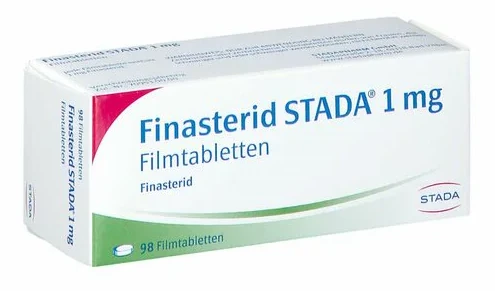
Androgenetic alopecia, or hereditary/male pattern hair loss, affects the majority of men sooner or later. The hair follicles on the crown and along the hairline gradually miniaturise until they stop producing visible hairs.
Finasteride is the most studied oral medication for slowing male pattern hair loss and stimulating new hair growth. At Akacia Medical it is a central part of individually tailored treatment plans, often in combination with PRP and hair transplantation.
On this page we cover how it works, dosing, scientific results, side effects and how finasteride fits in before and after surgery, factually and based on the evidence.
- Prescription-only in Sweden
- 1 mg daily for hair loss
- Medical follow-up recommended
How does finasteride work biologically?
Hair loss in men is strongly linked to dihydrotestosterone (DHT). Free testosterone is converted by the enzyme 5α-reductase type II, which is particularly active in the scalp and the prostate.
In people with a hereditary sensitivity, DHT binds to the androgen receptors of the hair follicles. The follicle shrinks, the anagen phase shortens and the hair becomes progressively thinner until only vellus hair remains.
Finasteride selectively inhibits type II 5α-reductase and blocks the conversion to DHT. A daily dose of 1 mg lowers serum DHT by around 68 % and scalp DHT by up to 64 to 70 %, removing the hormonal pressure on the hair follicles.
- ●Stops miniaturisation of sensitive hair follicles
- ●Allows dormant follicles to return to active growth
- ●Works for as long as treatment continues
Dosing: 1 mg for hair loss vs 5 mg for the prostate
Swedish pharmacies stock finasteride in two strengths with entirely different indications. Always use the strength and dose prescribed for your purpose.
Indication
- Finasteride 1 mg
- Androgenetic alopecia (male pattern hair loss)
- Finasteride 5 mg
- Benign prostatic hyperplasia
Clinical effect
- Finasteride 1 mg
- Stabilises hair loss, increases density
- Finasteride 5 mg
- Shrinks the prostate gland, relieves urinary urgency
High-cost protection scheme
- Finasteride 1 mg
- Not covered for hair loss
- Finasteride 5 mg
- Covered for prostate treatment
Typical pharmacy price
- Finasteride 1 mg
- Approx. 780 to 791 kr / 98 tablets
- Finasteride 5 mg
- Approx. 203 kr / 100 tablets
| Parameter | Finasteride 1 mg | Finasteride 5 mg |
|---|---|---|
| Indication | Androgenetic alopecia (male pattern hair loss) | Benign prostatic hyperplasia |
| Clinical effect | Stabilises hair loss, increases density | Shrinks the prostate gland, relieves urinary urgency |
| High-cost protection scheme | Not covered for hair loss | Covered for prostate treatment |
| Typical pharmacy price | Approx. 780 to 791 kr / 98 tablets | Approx. 203 kr / 100 tablets |
Do not split 5 mg tablets to save money
The active ingredient in prostate tablets is rarely evenly distributed through the tablet core. Splitting them gives fluctuating daily doses and can disrupt results and increase the risk of side effects. Finasteride is also teratogenic, and pregnant women or women of childbearing age must not be exposed to crushed or split tablets.
Scientific efficacy: what do clinical studies show?
5-year study (1,553 men)
- ✓90 % of the finasteride group: hair loss stopped completely
- ✓65 %: objective increase in actively growing hairs
- ✓On average +38 terminal hairs in the test area vs baseline (placebo −239)
Long-term study, Japan (3,177 men)
- ✓87.1 % significant cosmetic improvement
- ✓No unexpected long-term safety risks identified
Finasteride treatment timeline
Treatment timeline
Adjustment and shedding
DHT is lowered immediately, but the hair follicles need time to adjust. Temporarily increased hair loss (shedding) is normal as old telogen hairs are pushed out. Do not stop treatment during this phase.
Finasteride and beard growth
The scalp and the beard respond differently to DHT. On the head, DHT damages the hair follicles, so blocking it with finasteride can improve hair density.
Beard and body hair are stimulated by androgens, especially DHT. Finasteride does not stimulate beard growth; some people may notice marginally slower growth. For a fuller beard, topical treatments or a beard transplant are recommended instead.
Who can be treated with finasteride?
Men with androgenetic alopecia
Finasteride 1 mg is approved for early to moderate male pattern hair loss under medical supervision.
Women
Finasteride 1 mg is contraindicated in female pattern hair loss and is teratogenic to male foetuses. Akacia Medical offers other options, such as PRP or hair transplantation.
Transgender patients
May in some cases be prescribed as part of gender-affirming care, always in consultation with the responsible endocrinologist.
Children and adolescents under 18
Should not use finasteride, as normal DHT levels are needed for physical and sexual maturation.
Combination with PRP
Finasteride lowers DHT and protects the hair follicles hormonally. PRP delivers growth factors that can activate dormant follicles. Together they tackle hair loss through complementary mechanisms, which we tailor to your situation.
Finasteride 1 mg
- Share of surgeons (ISHRS)
- 69.1 %
- Purpose
- Stabilise hair loss, protect existing hair
PRP
- Share of surgeons (ISHRS)
- 48.4 %
- Purpose
- Regenerative therapy, strengthen hair follicles
Dutasteride (off-label)
- Share of surgeons (ISHRS)
- 12.2 %
- Purpose
- Stronger DHT blockade when the effect is insufficient
| Treatment | Share of surgeons (ISHRS) | Purpose |
|---|---|---|
| Finasteride 1 mg | 69.1 % | Stabilise hair loss, protect existing hair |
| PRP | 48.4 % | Regenerative therapy, strengthen hair follicles |
| Dutasteride (off-label) | 12.2 % | Stronger DHT blockade when the effect is insufficient |
Finasteride with hair transplantation (FUE)
Transplanted hair follicles from the donor area are usually DHT-resistant and keep growing for life. The remaining natural hair in the recipient area retains its sensitivity. Without medication it can continue to thin, resulting in inverse alopecia: dense transplanted hair surrounded by thinning.
Finasteride protects the existing hair around the transplant and helps maintain an even, natural volume over time.
Studies show a lower risk of shock loss if finasteride is started no later than four weeks before the procedure and continued for at least 48 weeks afterwards.
Side effects and safety profile
Sexual side effects are uncommon according to large-scale trials. We present transparent figures so that you can make an informed decision.
Reduced libido
approx. 1.8 % (placebo 1.3 %)
Erectile dysfunction
approx. 1.3 to 2.1 %
Ejaculation disorder
approx. 1.2 %
For most people who experience sexual side effects, the symptoms are temporary and often subside during ongoing treatment or within two weeks of stopping.
The EMA and the Swedish Medical Products Agency have updated the product information regarding mood changes and depression. Stop treatment and contact a doctor if you develop new low mood or severe anxiety.
Finasteride lowers PSA by 30 to 50 %. Always tell your doctor about the medication before a prostate examination.
Reducing risks
- ●Regular physical activity can help counteract mild sexual side effects.
- ●Topical finasteride (spray/gel) gives lower systemic exposure if needed.
- ●Never exceed 1 mg per day. A higher dose increases risk without any additional benefit for the hair.
Alternatives to finasteride
PRP treatment
A natural injection treatment using growth factors from your own blood, well suited to those who want to avoid hormonal medication.
Read more →Dutasteride
Inhibits both type I and type II 5α-reductase (off-label for hair loss in Sweden). Stronger DHT reduction but a somewhat higher side-effect profile.
Saw Palmetto and others
Some plant extracts show mild 5α-reductase inhibition in smaller studies, but the effect is weaker than finasteride.
How treatment starts at Akacia Medical
Free consultation
We assess your hair loss, hair follicle quality and medical history.
Prescription when indicated
A licensed doctor can issue an electronic prescription for finasteride 1 mg to the pharmacy of your choice.
Ongoing follow-up
Digital photo documentation and assessment of density and wellbeing throughout treatment.
Want to know whether finasteride is right for you?
Book a free consultation. We advise you on your hair loss and on whether combining it with PRP or hair transplantation may be an option.
Scientific sources
- [1]Kaufman KD et al. Long-term finasteride treatment. J Am Acad Dermatol. 1998.
- [2]Yanagi T et al. Long-term finasteride in Japanese men. J Dermatol. 2011.
- [3]Indian J Urol, finasteride and sexual function. 2010.
- [4]Topical finasteride systematic review. PMC6609098.
- [5]Finasteride after hair transplantation. Dermatol Surg. 2003.
- [6]Läkemedelsverket, humörbiverkningar finasterid/dutasterid.
- [7]FDA finasteride label (1 mg).