

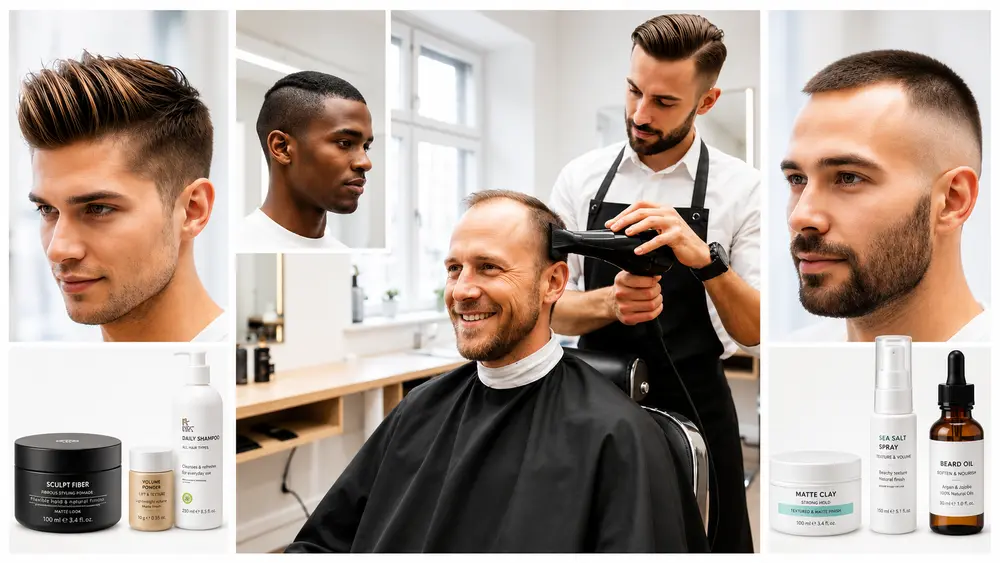
Hair loss is common and affects many men, not only appearance but also self-confidence. A thoughtful hairstyle for thin hair is often the first step toward feeling more comfortable in daily life, while you explore whether medical treatment or hair transplantation may be appropriate. A free consultation before hair transplantation gives you a clear picture of which options suit you.
The right cut can reduce the impression of a receding hairline, deep temples, or sparseness on the crown. By understanding how your hair looks in different light and angles, and choosing techniques that create volume or even out contrast, you can achieve a more balanced look. When hair loss is more extensive, Akacia Medical at our hair transplantation clinic in Stockholm offers permanent options with modern hair surgery and PRP treatment, after an individual assessment on site or via video consultation.
Quick tips for thin hair
- Short, structured cuts are usually best when hair thins, because they reduce contrast between hair and scalp.
- Forward-combed and side-parted styles can conceal temples if enough density remains at the front.
- Avoid comb-overs, heavy long styles, and tight updos that pull on the hair follicles.
- Styling with volume, texture, and the right products can give an immediate lift before you decide on treatment.
- In bald areas where follicles have stopped producing hair, hair transplantation can provide permanent density, while PRP can support remaining hair and healing as part of a broader treatment plan.
Why the right hairstyle matters
When hair becomes thinner, how the face is perceived changes. Full hair frames the face evenly. With thinning, the scalp shows more clearly, especially when the contrast between dark hair and light skin is strong.
A good hairstyle for men with thin hair is about:
- Reducing contrast between bald areas and remaining strands.
- Creating volume where there is sufficient density.
- Directing attention toward the face’s strong features instead of sparse zones.
It is the same logic clinics use when planning a natural hairline: proportion, direction, and density should work together.
Best hairstyles for men with thin hair
The choice depends on where hair loss occurs, for example at the temples, on the crown, or diffusely across the whole head, as well as hair texture and face shape. Below are proven options, grouped by length and style.
Short and structured cuts
Short hairstyles are usually the safest choice with thinning hair. Shorter strands are not weighed down as much, so hair does not lie flat against the scalp.
1. High fade
The sides and nape are cut short with a gradual transition high toward the temples. The thin area at the temples blends with the skin, so a high hairline appears less prominent. Works well in early stages of hereditary hair loss.
Styling: dry hair, light fiber wax or matte paste for structure on top.
2. Buzz cut
An even, short length (for example 3 to 6 mm) evens out the difference between a sparse crown and the sides. The style is easy to maintain and gives a clean, masculine look when the crown has started to thin.
Styling: minimal, possibly volume powder if you keep slightly more length on top.
3. Crew cut (classic military cut)
Short sides combined with slightly longer hair on top that can be styled lightly upward or forward. Contrast at the sides highlights the top without exposing sparse areas.
Styling: light volume spray in damp hair, blow-dry upward.
4. Short and messy
If you still have some density, irregular short layers and texture give a natural, youthful impression. Sparse patches are less obvious when hair does not lie in the same direction.
Styling: sea salt spray and finger-drying.
Medium-length and forward-combed styles
If you want to keep more length, some styles use the way hair falls to cover temples, provided the front is not too sparse.
5. Forward-combed with texture
Hair on the crown is allowed to grow slightly longer and combed forward. This often conceals deep temple recessions effectively and softens facial proportions. Combine with shorter sides for balance.
Styling: light wax or fiber, avoid heavy oils.
6. Classic side part (side-swept part)
Hair is parted at the side and swept over areas with lower density, from the fuller side. Gives a sophisticated profile, but do not comb it too flat, or the scalp shows again.
Styling: medium-hold wax.
7. Quiff with volume at the fringe
Volume is concentrated at the forehead so attention is drawn forward. The style requires sufficient density at the front, otherwise the fringe can look thin.
Styling: blow-dry upward with volume product at the roots.
Clinic tip from Akacia Medical: Bring clear photos in daylight to your barber or consultation, temples and crown look different depending on lighting. This makes it easier to choose a cut and assess whether hair transplantation should be discussed.
Overview: which hairstyle suits your hair loss?
The table summarizes recommendations for common patterns. Always adapt to your own hair picture and advice from your barber or trichologist.
| Hair loss pattern | Recommended style | Why it works | Avoid |
|---|---|---|---|
| High hairline and temple recession | High fade or forward-combed with texture | Evens out temples or masks an M-shaped hairline | Slicked-back styles, tight top knot |
| Sparse crown | Buzz cut or crew cut | Reduces contrast with the scalp | Comb-over, slicked styles |
| Diffuse thinning | Short and messy or buzzed | Creates texture and an impression of fullness | Long, heavy straight hair |
| Asymmetric thinning on one side | Side part | Covers with hair from the denser side | Center part, long straight hair |
Hairstyles to avoid
The wrong approach can reinforce the impression of thinning. We often see these styles in patients seeking advice when hair loss is already visible:
Comb-over
Combing long hair from the sides over a sparse crown usually highlights hair loss rather than hiding it, especially in wind or strong light.
Long, heavy straight hair
Length weighs fine strands down against the scalp. The scalp shows more clearly and hair can look stringy.
Top knot, man bun, and other tight updos
Hair pulled tightly backward stresses the follicles and can contribute to traction alopecia over time. Temples and the hairline are also exposed.
Horseshoe with bald crown
A thick ring of hair around a fully sparse crown creates strong visual imbalance. An even buzz cut or shave usually gives a more modern, cohesive appearance.
Why hair becomes thin
The most common cause of thinning hair in men is hereditary hair loss (androgenetic alopecia). The hormone DHT (dihydrotestosterone) can cause follicles at the temples and crown to gradually produce thinner, shorter strands until growth stops.
Follicles at the nape and sides are usually more resistant, which is why these areas are used as the donor zone in FUE hair transplantation.
Hair type also matters: straight, fine hair lies flat and shows thinning faster than wavy or curly hair with natural volume. Read more about different forms of hair loss and when to seek help.
Styling and products that add fullness
Before you consider surgery, the right routine can make a noticeable difference:
- Blow-dry with lift: Apply volume product to damp hair, tilt your head forward, and blow-dry with a brush against the direction of the strands.
- Sea salt spray: Adds texture so strands do not separate and expose the scalp.
- Volume powder: Applied at the roots in dry hair for hold and less shine on the scalp.
- Hair fibers: Keratin fibers that attach to existing strands and give temporary density until the next wash (use with caution and realistic expectations).
Remember: Cosmetic solutions do not replace a medical assessment. If hair loss increases rapidly, appears in patches, or is accompanied by scalp irritation, book a consultation before investing in advanced styling.
Permanent hair restoration at Akacia Medical
When follicles in an area have stopped producing hair, cutting and products can only do so much. Hair transplantation may then be the most sustainable way to regain your own hair in that area.
Akacia Medical has since 2011 helped thousands of patients with hair transplantation and advanced hair care at our clinic in Alvik, Stockholm. Our licensed physicians and experienced practitioners work with methods aimed at a natural hairline, high graft quality, and gentle healing.
Sapphire FUE
Follicles are extracted individually from the donor zone and implanted in the recipient area. With fine tools and sapphire blades for channel opening, direction, depth, and angle can be adapted to your natural growth pattern. Well suited to larger areas such as temples and crown.
DHI treatment
We offer DHI where follicles are placed with extra careful control of direction and density. The recipient area can be left unshaven when appropriate. The method is more time-consuming than standard FUE and suits when precision is especially important, for example at the hairline or in smaller zones. Your physician will assess whether FUE or a DHI approach suits you best.
PRP as a complement
PRP treatment uses your own growth factors to support hair quality, slow thinning, or improve healing after transplantation. At the clinic we work with PRP systems from Arthrex and RegenLab and often recommend PRP as part of aftercare.
FUE or DHI, what suits you?
| Criterion | Sapphire FUE | DHI method |
|---|---|---|
| Typical indications | Larger sparse areas, high graft volume | Hairline, temples, precision density |
| Shaving recipient zone | Often necessary | Can in selected cases be minimized |
| Workflow | Channel opening and implantation in stages | Careful direct placement of grafts |
| Healing | Fast with fine instruments | Gentle, but often more time-consuming |
| Guarantee | Written guarantee according to terms | Written guarantee according to terms |
An individual plan is drawn up at a free consultation in Stockholm, or by phone and video consultation. There we assess the stage of hair loss, donor area capacity, and whether FUE, DHI treatment, PRP, or a combination is most suitable.
Prices and financing
Cost depends on the number of grafts, method, and whether the procedure is in Sweden or via our package in Istanbul. Current prices, examples of monthly cost with Medical Finance, and package contents are on the Prices page.
Typical ranges for FUE in Sweden (updated on the pricing page):
| Treatment | Grafts (approx.) | Indication |
|---|---|---|
| Smaller procedure | around 1,000 | Limited temple recession |
| Medium | around 1,500 to 2,000 | Temples and mildly lowered hairline |
| Extensive | around 2,500 to 3,500 | Front, crown, and advanced hair loss |
PRP is offered as a single treatment or course, see prices for current levels.
Summary
Hairstyles for men with thin hair can give immediate confidence in daily life: short, structured cuts and thoughtful styling often reduce contrast with the scalp. Avoid solutions that weigh hair down, pull on follicles, or highlight sparse zones.
When hair loss is permanent in an area, the next step is to explore medical and surgical options. At Akacia Medical you receive a medical assessment, a clear treatment plan, and a written guarantee on hair transplantation according to our terms.
When a haircut is no longer enough, a hair transplant can restore lasting density. Explore hair transplant Stockholm and hair transplant in Sweden.
Next steps
- Book a free consultation
- Read about hair loss and causes
- Compare prices and packages
- See before and after results
Sources and further reading
- MedlinePlus Genetics: Androgenetic alopecia
- DermNet: Traction alopecia
- Platelet-rich plasma for the treatment of alopecia: systematic review and meta-analysis
This text is for informational purposes only. For medical advice or diagnosis, consult a qualified professional.
Tags
Related information
Explore more about our treatments and services
Firo Esmer
CEO, Akacia Medical
Firo Esmer is CEO and founder of Akacia Medical and writes about hair transplantation, hair loss and treatment planning based on the clinic's experience and patient journey.
Related articles

September 21, 2026
Hair loss treatments – what actually works
Which hair loss treatments have evidence? Comparison of finasteride, minoxidil, oral minoxidil, PRP and hair transplantation.

September 19, 2026
DHT and hair loss – the hormone behind thinning
DHT is formed from testosterone and can shrink sensitive follicles. How the hormone works, what can be treated, and when a transplant is needed.

September 17, 2026
Minoxidil for hair loss – topical and oral
Guide to minoxidil for hair loss: 2% and 5%, oral minoxidil in Sweden, use in women, timeline and side effects.
Book a free consultation
We will review your circumstances and recommend the right next step for you.