

What is a hair transplant for men?
A hair transplant for men moves follicles from the back of the head into the temples, along the hairline or onto the crown. The aim is a natural male frame and density that lasts, because donor hair is usually more resistant to DHT.
Do you want to read more about methods, price, aftercare and results? Start with hair transplant in Swedenand hair transplant.
How it differs from women
Male hair loss usually follows a clear pattern with receding temples and a thinner crown. Women more often have diffuse thinning. That is why we draw a more defined hairline in men and plan for further loss – so the result still looks natural in a few years.
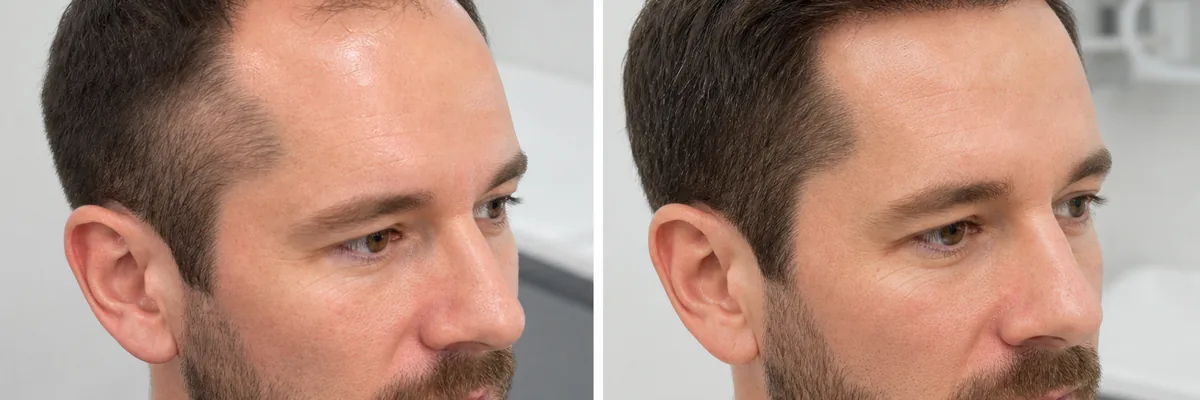
Hair transplant for men: a receding hairline before and a more natural hairline after treatment
Results for men
See how we plan the hairline, temples and crown so the density looks natural – not pluggy or too low.
Common causes of hair loss in men
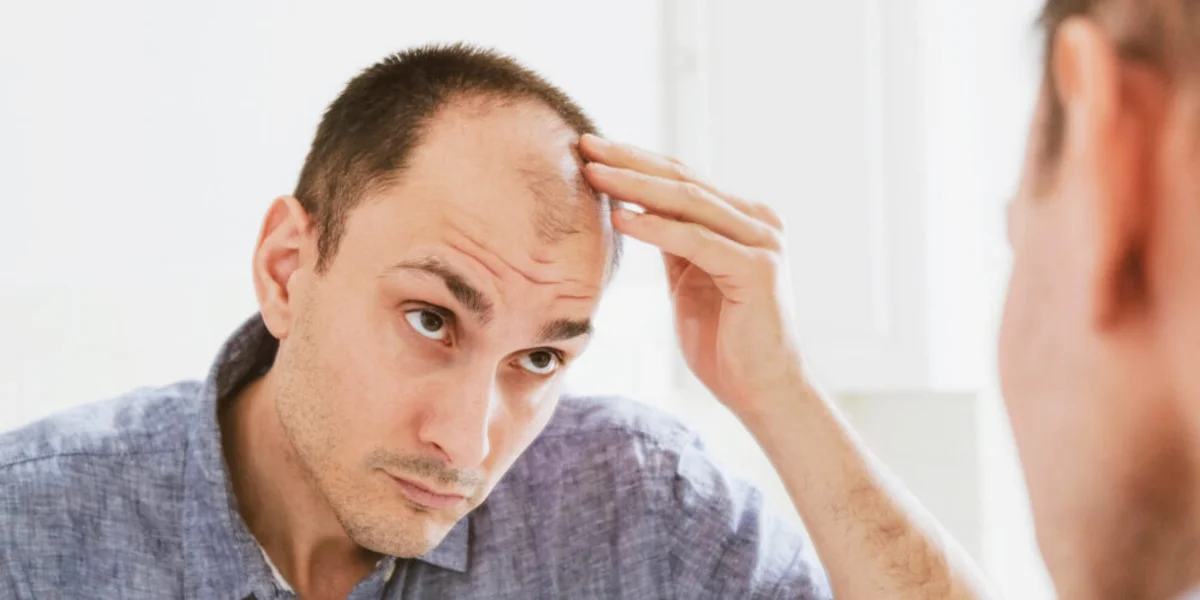
The most common cause is hereditary male hair loss, androgenetic alopecia. Follicles in the hairline and crown are sensitive to DHT and shrink over time. That is why many men first notice temples or a thinner crown. Read more about hair loss in men.
Common examples:
- •Hereditary male hair loss (androgenetic alopecia)
- •Receding hairline and temples
- •Thinner crown or a bald spot in the vertex
- •Stress, illness or medication that speeds up thinning
A transplant restores density where follicles are already weakened. To protect remaining hair, medical treatment such as finasteride can be a complement. Read more about finasteride.
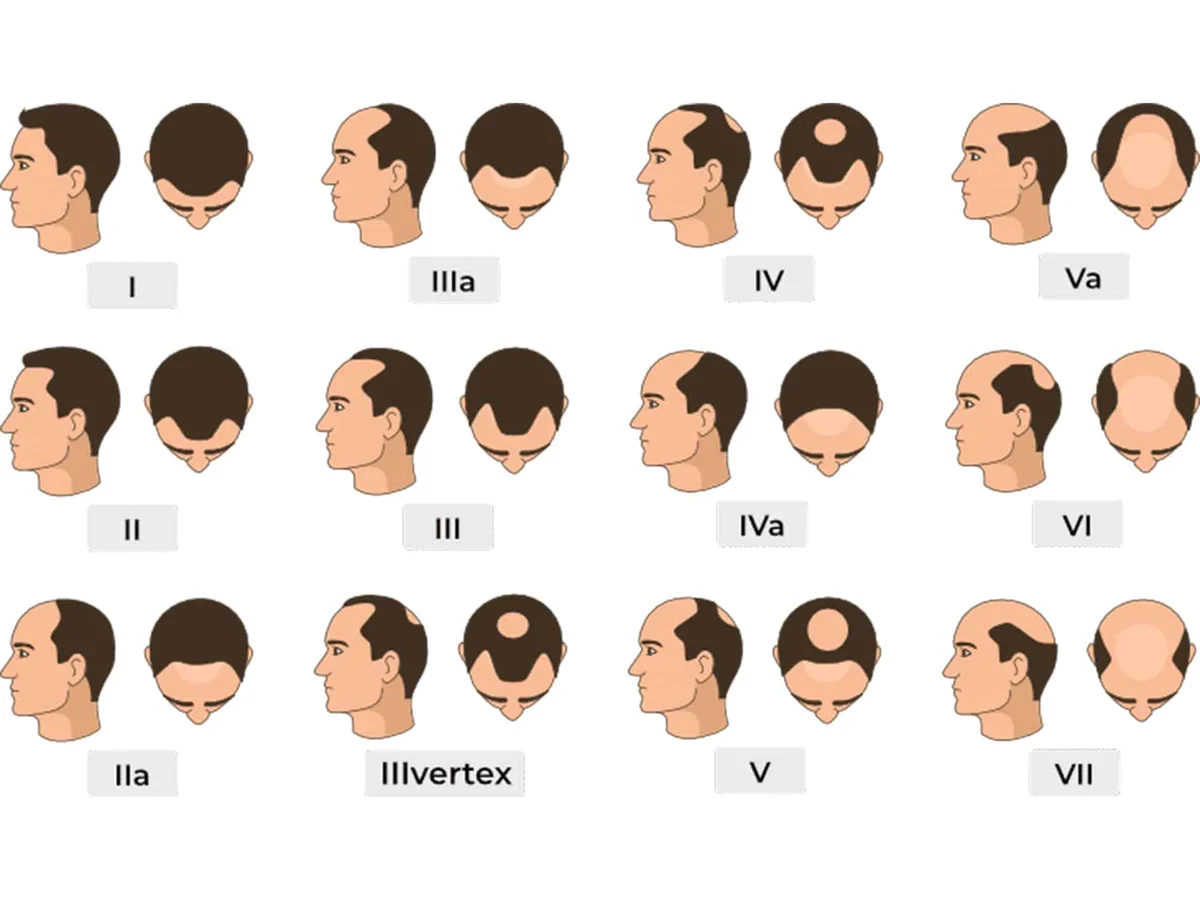
The Norwood scale and male hair loss
Male hair loss is classified with the Norwood–Hamilton scale. Unlike the Ludwig scale in women, it describes receding temples, a lower hairline and a bald crown – the pattern we use when planning a hair transplant for men. Read more about hair loss.
Early temples
Receding temples and a clearer M-shape. Here we often plan a natural hairline with a moderate number of grafts.
Hairline and crown
Both the hairline and the crown are affected. Treatment needs more donor hair and a plan for how density should be shared.
Extensive hair loss
Large bald areas. A transplant can still add a frame and density, but the donor area sets the limit for what is realistic.
Hairline, temples and crown
The most common reason for a hair transplant in men is a receding hairline. A line that is too low or too straight looks unnatural. We therefore draw a hairline that fits age, forehead and how the loss may continue.
Areas we often treat
- •Temples and recesses – restore a soft, masculine frame.
- •The frontal hairline – density without placing the line too low.
- •Crown and whorl – direction and density where the scalp shows most.
Read more about a receding hairlineHair transplant in the crown
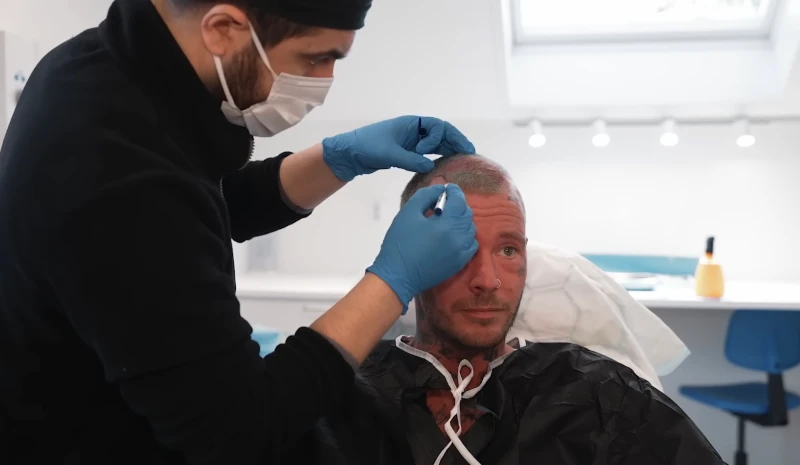
Everything starts with a free consultation
The first step is a free consultation. We review your pattern, donor hair and goals – and explain what is realistic before recommending a hair transplant for men.
You can book a free consultation in Stockholm (Bromma), in Gothenburg or by video call. Read more about the consultation.
Methods we offer
Sapphire FUE
Follicles are taken out one by one. In men, FUE is the most common method when temples and crown need more grafts.
At Akacia Medical we use instruments with genuine sapphire blades to create micro-channels. That gives cleaner incisions, less tissue trauma and the chance to place follicles at a natural growth angle. Read more about the FUE method.
DHI
DHI gives extra control over angle and direction, which is valuable in the hairline. Unshaven DHI can be an option if you want to keep more length in the recipient area.
Which method suits you is decided at the consultation, based on hairline, density and how large an area should be treated. We do not offer FUT. Read more about the DHI method.
Not sure which method suits you best? Read our comparison of FUE and DHI.
Arthrex PRP for faster healing
To give newly transplanted follicles good growth conditions, PRP can be part of healing. The patient’s own blood is centrifuged to extract growth factors that support healing and microcirculation. Read more about PRP treatment.
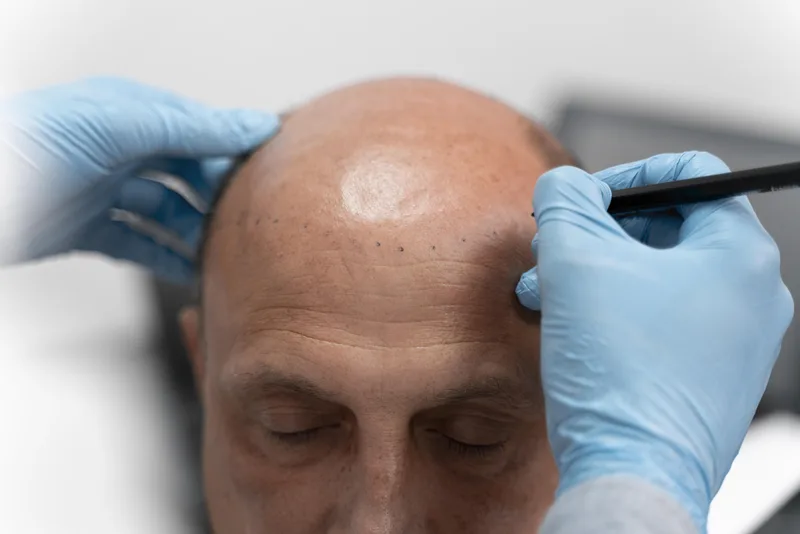
The hairline is drawn before the procedure so temples and density follow a natural male pattern.
Who is a suitable candidate?
For a hair transplant in men you need enough donor hair at the back of the head, a treatable pattern and realistic expectations of density.
- ✓Enough hair density in the donor area
- ✓A clear treatable area (temples, hairline or crown)
- ✓Realistic expectations and a plan for future hair loss
When is a transplant not suitable?
If hair loss is still progressing quickly, especially in younger men, it can be better to wait or start with medical treatment. When donor hair is very limited, an honest plan matters more than promising full density.
Medical contraindications
A hair transplant is surgery. Some conditions mean the procedure should not go ahead, or that we need to wait:
Alopecia areata
An autoimmune disease where the body attacks hair follicles. Transplanted hair is rejected in the same way.
Unstable hair loss
If hair loss is still progressing quickly, especially in younger men, it can be better to wait or combine with medical treatment first.
Insufficient donor hair
With very extensive hair loss the back of the head is not always enough. Then an honest plan matters more than promising full density.
Scarring alopecia
Inflammatory, scarring skin diseases can destroy follicles. Surgery in an active phase rarely gives a lasting result.
Healing after a hair transplant for men
The result develops gradually. Here we describe the usual course – from the first days to the final result.
- 1Day 1–3
Initial healing
Scabs form and some swelling or redness can occur. The follicles need rest and must not be touched, scratched or rubbed.
Tip: Sleep on your back with your head elevated, avoid caps and physical strain.
- 2Day 3–10
Gentle hair washing
Scabs start to dry and fall off gradually. Hair must not be washed in the first days – then follow the clinic’s instructions with special shampoo.
- 3Week 3–5
Shock loss
The transplanted hairs shed as the follicles enter a resting phase. This is normal – the follicles stay in the skin.
Tip: Avoid hair dye and strong styling products during this phase.
- 4Month 2–3
Early growth
The follicles wake up and start producing new, fine hairs. PRP treatments may be recommended to support the growth environment.
- 5Month 6–12
Visible growth
Clear growth begins and density increases gradually. Continued follow-up with the clinic is recommended.
- Month 12–18
Final result
The final, permanent result is in place. Hair can be cut, coloured and styled as usual.
After treatment
After a hair transplant for men it is normal that some transplanted hairs shed at first. The new follicles usually start producing hair after a few months. Clear growth is often seen between 6 and 12 months. Read more about aftercare.
Risks and side effects
As with any surgery there is a risk of temporary swelling, redness, tenderness or discomfort. Careful planning, clear instructions and experienced practitioners keep the risk of complications low.
Hair transplant for men – transparent prices
The price depends on the number of follicles (grafts) and the method. Men often need more grafts than women, especially when both temples and crown should be covered. The exact cost is set at a free consultation.
Price in Sweden
Price
50 000 kr
Monthly cost 24 months: 2 162 kr
Credit example from Medical Finance (calculated 2026-07-01): For a loan of SEK 60,000 at 0% credit interest, with a repayment period of 2 years (24 repayments), an administration fee of SEK 55/month and a setup fee of SEK 575, the annual percentage rate (APR) is 3.05%. The total amount to repay is SEK 61,895, i.e. SEK 2,579/month. The monthly costs are calculated on the same terms. Amounts above SEK 60,000 carry interest at an individual rate, currently 0–12.65%.
Package price in Istanbul
Through Akacia Medical’s partner programme in Istanbul, treatment can be done at a package price. The package includes flights, hotel, local transport, medication and aftercare products.
40 000 kr
2 000 Number of hair follicles · FUE
Sweden compared with Turkey →What is included
- ✓Lunch on the day of surgery
- ✓Personal support around the clock during healing
- ✓Aftercare package with special shampoo and lotion
- ✓Flexible financing via Medical Finance
Hair transplant for men in Stockholm
Our clinic is at Runda Vägen 15 in Bromma (Alvik). Free consultation, hair transplant with FUE or DHI, PRP and follow-up all take place here.
For male hair loss we plan the hairline, temples and crown from your Norwood pattern – so the result still looks natural as the loss continues.
Digital consultation
A free consultation is offered in Stockholm, in Gothenburg or by video call. That makes it easy to get started wherever you live in Sweden.
During the consultation we review your history and hair-loss pattern and explain which options may be realistic – before recommending a hair transplant for men.
Sweden compared with TurkeyISHRS membership
Dr Mohammed Abas is a full member of ISHRS, the international organisation for hair restoration surgery.
About us →Written growth guarantee
We offer a written guarantee on our transplants. Read more about what is included and how follow-up works.
Our guarantees →Swedish patient insurance
The clinic is registered with IVO and insured via Säker Klinik – so you have clear medical security in Sweden.
About the clinic →Frequently asked questions about hair transplant for men
What is a hair transplant for men?+
A hair transplant for men moves DHT-resistant follicles from the back of the head to the temples, hairline or crown. The aim is a natural, permanent result that follows the male hair-loss pattern.
How does a hair transplant for men differ from one for women?+
In men, hair loss is usually patterned with temples and a thinner crown. We therefore plan the hairline, future loss and donor hair differently than for the diffuse thinning that is more common in women.
What does a hair transplant for men cost?+
The price depends on the number of follicles and the method. FUE in Sweden starts from SEK 38,000. Men often need more grafts than women because temples and crown can require more coverage. The exact cost is set at a free consultation.
Do you have to shave the head for a hair transplant for men?+
With classic FUE the donor area is usually shaved, and often the recipient area as well, so follicles can be placed precisely. Unshaven DHI can be an option if you want to keep more length in the recipient area.
Who is a suitable candidate for a hair transplant for men?+
You need enough donor hair at the back of the head, a treatable pattern and realistic expectations. At the consultation we assess Norwood grade, age and whether medical treatment should complement the procedure.
Which method is best for men – FUE or DHI?+
Both methods extract follicles one by one. FUE is most common for larger areas such as temples and crown. DHI can suit cases where density and angle in the hairline matter extra. We do not offer FUT.
Do I need finasteride after a hair transplant for men?+
Hair transplanted from the back of the head is usually more resistant to DHT. Remaining native hair can still thin, though. Finasteride or other medical treatment can therefore be a complement – that is decided individually.
When is the result visible after a hair transplant for men?+
The transplanted hairs often shed in the first weeks. New growth is usually seen after a few months, a clearer change after 3–6 months, and the final result around 12 months.
Next step
Book a free consultation and we will go through your situation and recommend the right plan for a hair transplant for men.