

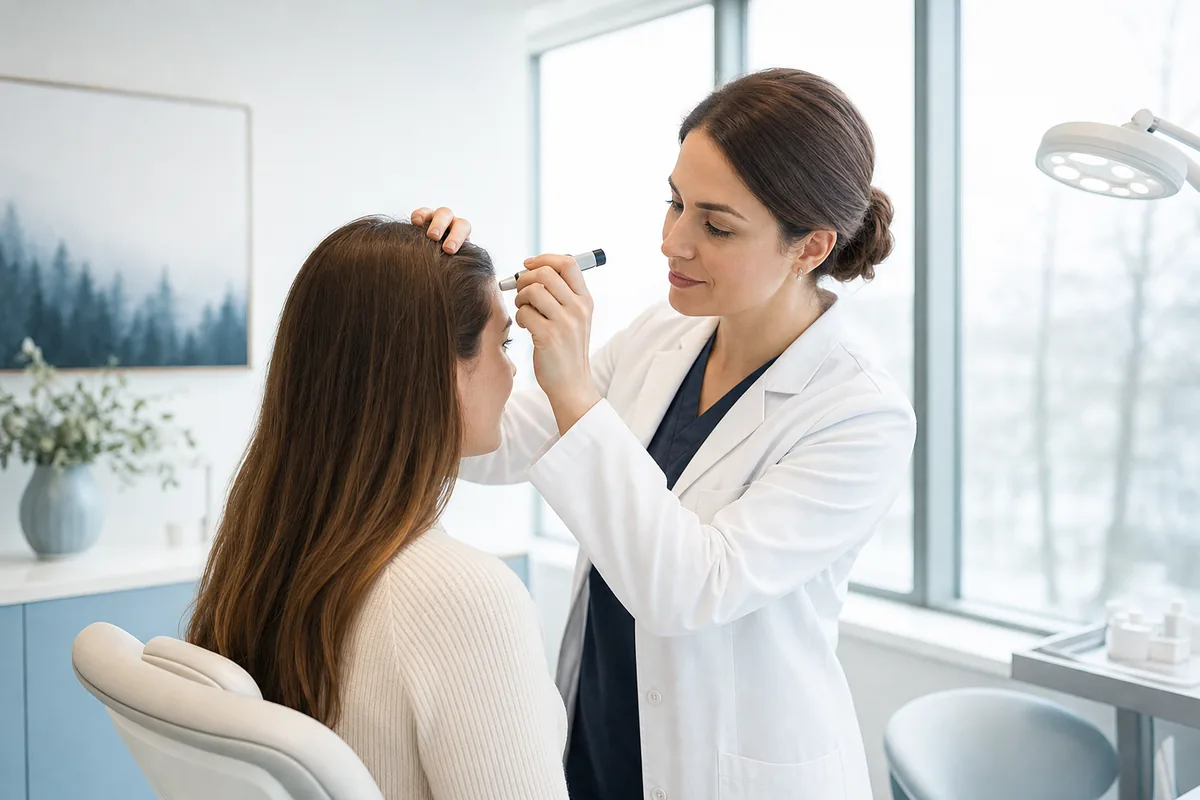
Hair transplant without shaving is an option for people who want to restore density or adjust the hairline without shaving the whole head. In short, the recipient area remains unshaved, and follicles are placed with high precision between existing hairs. With hair transplantation at Akacia Medical, this is performed as a DHI, with the same medical standard and the same goal of a natural end result as Sapphire FUE.
In this guide, we explain how the method works in practice, who it suits, how it differs from standard FUE, what aftercare involves, and what the treatment costs.
Discreet hair restoration without visible shaving
Shaving your hair before surgery can feel like a major social or professional barrier. This is especially true for women with long hair and professionals in public-facing roles who want treatment without making the procedure obvious during healing.
By preserving existing hair in the recipient area, your own hairstyle provides immediate camouflage. Since 2011, Akacia Medical has built extensive experience with these high-precision procedures under strict medical standards, with licensed doctors and ISHRS membership.
What does this method mean in practice?
Hair transplant without shaving can create confusion because different clinics label techniques differently. The method is often associated with DHI (Direct Hair Implantation). Akacia Medical emphasizes clinical transparency: DHI is not a completely separate method, but a specific implantation workflow and tool choice.
What we perform is an advanced variant of FUE (Follicular Unit Extraction) without shaving the recipient area:
- Individual follicles (grafts) are extracted from the donor area in the neck or sides using microscopic precision instruments.
- Grafts are placed directly in thinning areas, without trimming or shaving surrounding hair.
- Channel creation and implantation are performed by highly experienced surgeons, giving the surgeon greater control over placement, angle and growth direction.
The goal is a result that blends with your natural hair, both aesthetically and in growth pattern. Read more about method differences on our page about DHI treatment.
The process step by step
Hair transplant without shaving places high demands on surgical precision. Because the surgeon works between existing long hairs, this method is more time-consuming than a traditional fully shaved procedure.
1. Consultation and medical assessment
Before surgery, we perform a free consultation at our Stockholm clinic (Alvik/Bromma), or digitally by video. We assess hair-loss pattern, donor density and hair quality. The medical team determines whether you have the biological conditions for a no-shave procedure, or whether Sapphire FUE is the better choice for your goals.
2. Donor area preparation and extraction
The donor area is prepared by trimming only very limited narrow zones that are easily covered by surrounding hair. The procedure is done under local anesthesia. Follicles are extracted individually with micro punches of 0.6 to 0.9 mm, where 0.6 mm is 33% smaller than common industry standard. Smaller tools can mean smaller microscopic scars, faster healing and gentler recovery in the donor area.
3. Graft sorting
Extracted follicles are stored in a cooled, nutrient-rich solution to support high survival. The team sorts grafts under microscope: single-hair grafts are used at the hairline for a soft transition, while double and multi-hair grafts are used further back for volume and density. Read more about what a graft is and how graft count is planned.
4. Direct implantation by experienced surgeons
Sorted follicles are implanted directly into the recipient area by experienced surgeons. The surgeon moves carefully between existing hairs to avoid damage to neighboring healthy follicles. Each graft is placed with precise angle and direction to match natural growth.
The full process is explained in more detail on our process page, including what happens on treatment day and during follow-up.
Who is suitable for a hair transplant without shaving?
Clinically, the method is best for specific hair-loss patterns and smaller, clearly defined treatment zones. It is not optimal for patients with very large bald areas where high graft numbers are required.
Suitable candidates:
- Women with diffuse hair loss (Ludwig scale) who need more density without changing their visible hairstyle.
- Men with receding hairlines, correction of deep temples or a minor lowering of the hairline with high precision and discretion.
- Smaller densification procedures on crown or mid-scalp where existing hair can remain untouched.
For more advanced hair loss (higher Norwood stages) and a need for more than around 1 500 grafts in one session, Sapphire FUE is usually recommended. In larger procedures, a shaved area gives the surgeon better conditions to place grafts densely without competing for the same blood supply.
FUE without shaving compared with Sapphire FUE
| Technical parameter | FUE without shaving (DHI) | Standard Sapphire FUE |
|---|---|---|
| Shaving of recipient area | No, the area remains unshaved | Yes, recipient area is shaved |
| Shaving of donor area | Partial, small hidden micro-zones | Yes, back and sides are shaved |
| Implantation tool | Sapphire blades for channels, then placement | Sapphire blades for channels, then placement |
| Maximum graft capacity | Normally up to around 1 500 per session | Up to around 3 500 per session |
| Time required | Longer per graft | Faster, standardized workflow |
| Price level in Sweden | From 55 000 kr (1 000 grafts) | From 38 000 kr (1 000 grafts) |
| Aesthetic end result | Equivalent when correctly performed | Equivalent when correctly performed |
Both methods can provide natural results when planning, technique and aftercare are correct. The choice is made individually during consultation.
Aftercare and healing
Aftercare is largely similar to standard FUE, but with extra hygiene challenges because existing hair remains long in the recipient area. Careful washing is essential to keep the scalp clean and reduce bacterial build-up around transplanted follicles.
Day 1-10: Newly transplanted follicles are sensitive to pressure and friction. Sleep in a semi-upright position (about 45 degrees) with a neck pillow. Bandage over the donor area is removed on day 2.
Day 3-10: Hair washing starts on day 3 using clinic lotion and special shampoo. Apply gently, pat lightly and rinse with lukewarm water at low pressure. Repeat daily through day 10.
Month 1-12: Shock loss (temporary shedding) from week 2 to month 3 is normal. Early growth is often visible in month 3-6, and significant density in month 6-12. Final result is evaluated at follow-up after around 12 months.
Read the full aftercare guide with video and timeline, and more on washing and products in shampoo after a hair transplant. For an overview of risks and what is normal during healing, see our article on hair transplant risks.
PRP and OxyHelp as complements
To support graft survival and accelerate healing, Akacia Medical recommends combining surgery with PRP treatment. For hair transplantation, we recommend 6 PRP treatments distributed across different phases, offered at cost price.
For patients who want to optimize recovery further, OxyHelp/HBOT is available, hyperbaric oxygen therapy that can improve oxygenation in healing tissue.
Pricing and what is included
Hair transplant without shaving is priced according to the additional time and precision required. The method is more resource-intensive than standard FUE.
Prices in Sweden (DHI / without shaving):
| Number of grafts | Price |
|---|---|
| 1 000 | 55 000 kr |
| 1 500 | 60 000 kr |
Comparison: standard FUE in Sweden:
| Number of grafts | Price |
|---|---|
| 1 000 | 38 000 kr |
| 1 500 | 45 000 kr |
| 2 000 | 50 000 kr |
| 2 500 | 55 000 kr |
| 3 000 | 60 000 kr |
| 3 500 | 65 000 kr |
Istanbul package (DHI): 1 000 grafts from 46 000 kr, 1 500 grafts from 50 000 kr. Packages include surgery, flights, hotel, local transport, medication and aftercare products, with Swedish-speaking staff from Akacia Medical.
In Sweden, lunch on treatment day, aftercare products and support evenings and weekends are included. Financing via Medical Finance may be available. See all current packages on the pricing page.
Safety, guarantee and clinic choice
Akacia Medical provides a written growth guarantee for performed hair transplants. Grafts that do not grow as planned can be replaced when guarantee terms are met. The guarantee requires that aftercare instructions are followed, and is generally not provided to smokers or snus users because nicotine negatively affects scalp circulation.
With over 15 000 surgeries completed since 2011, ISHRS membership and insurance through Säker Klinik, Akacia Medical offers a safe Swedish medical environment where each treatment plan is tailored individually.
Frequently asked questions
Tags
Related information
Explore more about our treatments and services
Firo Esmer
CEO, Akacia Medical
Firo Esmer is CEO and founder of Akacia Medical and writes about hair transplantation, hair loss and treatment planning based on the clinic's experience and patient journey.
References
- 1.Goldin J, Zito PM, Raggio BS. Hair Transplantation. StatPearls. Updated 2025.
- 2.Kerure AS, Patwardhan N. Complications in Hair Transplantation. J Cutan Aesthet Surg. 2018.
- 3.Garg AK, Garg S. Complications of Hair Transplant Procedures—Causes and Management. Indian J Plast Surg. 2021.
- 4.Hetz SP, Martin J, Pototschnig H. Patient Satisfaction and Clinical Effects of Platelet-Rich Plasma on Pattern Hair Loss. Cureus. 2022.
- 5.Hyperbaric oxygen therapy for treating acute surgical and traumatic wounds. Cochrane Database Syst Rev.
Related articles
September 21, 2026
Hair loss treatments – what actually works
Which hair loss treatments have evidence? Comparison of finasteride, minoxidil, oral minoxidil, PRP and hair transplantation.

September 19, 2026
DHT and hair loss – the hormone behind thinning
DHT is formed from testosterone and can shrink sensitive follicles. How the hormone works, what can be treated, and when a transplant is needed.

September 17, 2026
Minoxidil for hair loss – topical and oral
Guide to minoxidil for hair loss: 2% and 5%, oral minoxidil in Sweden, use in women, timeline and side effects.
Book a free consultation
We will review your circumstances and recommend the right next step for you.