

What is female hair transplantation?
Hair transplantation for women is a treatment where we take hair from an area with good density, usually the back of the head, and implant it where the hair is thinner or sparser. The goal is to recreate a natural frame and improve density in a gentle way.
Do you want to read more about methods, price, aftercare and results? Start with hair transplantand hair transplant in Sweden.
Difference compared to men
Hair loss in women often differs from men’s. Instead of clear receding lines or a bald crown, diffuse thinning is more common. We therefore start with a thorough consultation to advise whether hair transplantation could be suitable.
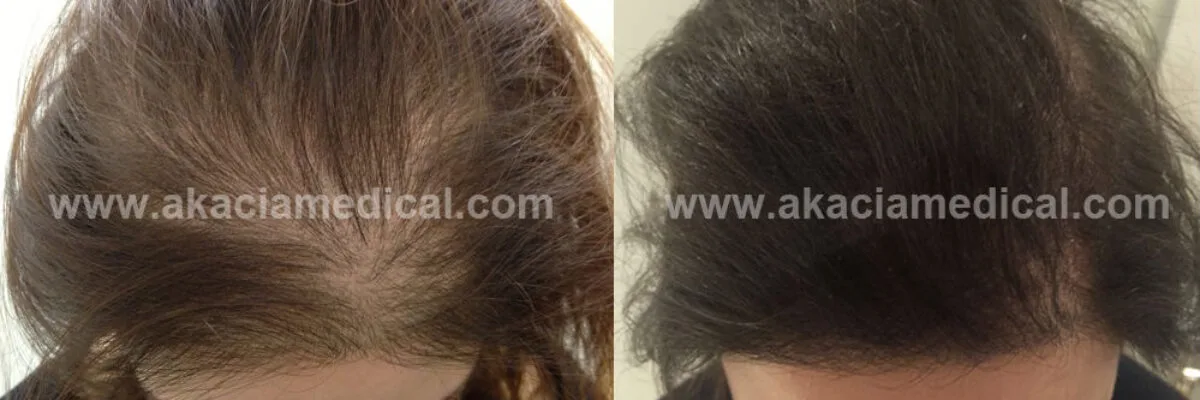
Here you can see before and after pictures of a hair transplant performed on a woman.
Before-and-after results for women
See how planning, density and hairline design can look in documented female hair transplantation results.
Common causes of hair loss in women
Women often lose hair for different reasons than men. That is why we review your history and pattern during consultation and explain what may be realistic before any treatment decision. Read more about different causes of hair loss.
Common examples:
- •Hormonal changes
- •Genetic hair loss
- •Illness, stress, or medication
- •Trauma or scarring
The goal is to identify the root cause, determine whether transplantation is the right course of action, and create a safe plan that provides long-term, natural results. See common conditions and triggering factors.

The Ludwig scale and diffuse thinning
Female hair loss (androgenetic alopecia in women) is medically categorised using the Ludwig scale. Unlike male pattern hair loss following the Norwood scale, female hair loss is often characterised by diffuse thinning across the crown while the frontal hairline remains intact. Read more about hair loss.
Because female hair loss usually means a general reduction in density, surgical procedures are typically planned as density improvement. New follicles are placed between existing hairs without damaging the existing follicles. See before-and-after results.
Ludwig grade I
Mild thinning that begins to show around the parting.
Ludwig grade II
Clearly reduced density where the scalp becomes more visible through the hair.
Ludwig grade III
Extensive thinning across the crown. Complete baldness is extremely rare in women.
Hair extensions, weaves and traction alopecia
Traction alopecia is common in women who wear extensions, weaves or tight hairstyles for long periods. It is not the same as hereditary hair loss, here, repeated pulling on the hair and scalp is the main problem.
Common reasons damage develops
- •Incorrect or overly tight application (glue, braids, clips) that constantly pulls in the same area.
- •Extensions that are too heavy and load the strands beyond what they can bear.
- •Long-term use without breaks, so the scalp rarely gets relief from tension and weight.
Prevention and scalp-friendly habits
Alternate extensions with periods when your hair can rest, choose gentler methods and have extensions fitted and maintained by trained professionals. Avoid continuously tight braids and styles that pull at the hairline and temples.
Read more about traction alopeciaPRP after extension-related damage

Warning guide: hairstyles and styling that often cause traction
If you often feel tenderness, notice red bumps, or see thinning at the hairline, it may be a sign of overload. Common risk factors include:
- •Tight ponytails and updos (especially high placement) that pull at the temples and hairline.
- •Tight braids/cornrows and styles that tension the same zone for long periods.
- •Heavy extensions/weaves or overly tight fitting (clips, glue, braided base).
If addressed early and the cause is removed, hair can often recover. With long-term tension, follicles can be permanently damaged.
Everything starts with a free consultation
The first step is to book a free consultation. We review your situation, your goals and explain which options may be realistic – before recommending hair transplantation.
You can book a free consultation in Stockholm (Bromma), in Gothenburg or via video call. Read more about the consultation.
Methods we offer
Sapphire FUE
Hair follicles are extracted individually for gentle and precise transplantation.
At Akacia Medical, instruments with genuine sapphire blades are used to create micro-channels. Sapphire blades give cleaner incisions, reduced tissue trauma and allow follicles to be placed with higher density at a natural growth angle. Read more about the FUE method.
Unshaved DHI
At Akacia Medical, we offer a tailored DHI approach where we do not shave the recipient area. The procedure is more technically demanding and takes longer, but the final result is the same as with FUE.
In the donor area at the nape, only a smaller, strategically placed rectangle is shaved and hidden by surrounding long hair. Implantation is done by opening channels with a sapphire blade, giving full control over each hair's angle and direction. Read more about the DHI method.
Not sure which method suits you best? Read our comparison of FUE and DHI.
Arthrex PRP for accelerated healing
To give newly transplanted follicles optimal growth conditions, PRP treatments are integrated into the healing process. Akacia Medical uses Arthrex test systems – the patient's own blood is centrifuged to extract a high concentration of growth factors that stimulate healing and microcirculation. Read more about PRP treatment.
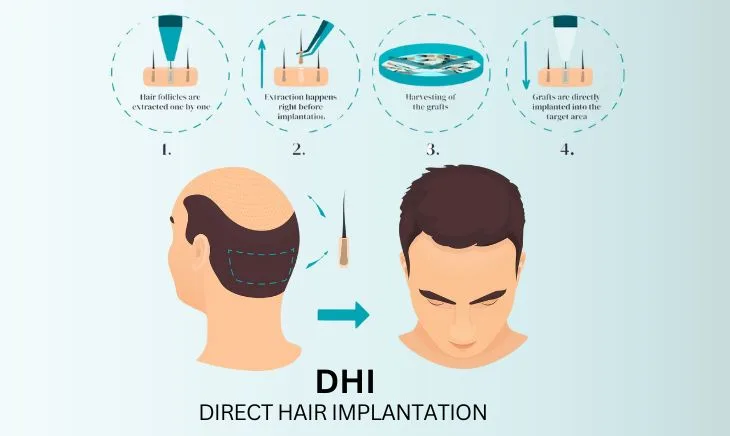
The same DHI method adapted for women: the recipient area is left unshaved, follicles are implanted by opening channels with a sapphire blade, and the small donor area at the nape can be hidden under existing hair.
Who is a suitable candidate?
To be a suitable candidate, you need sufficient donor hair at the back of your head and a stable hair situation where we can clearly plan the treatment area.
- ✓Sufficient hair density in the donor area
- ✓Clear treatable zone
- ✓Realistic expectations
When is transplantation inappropriate?
In cases of diffuse hair loss across the entire head, transplantation may be less suitable. In such cases, other treatment approaches are often a better first step.
Medical contraindications
A hair transplant is a surgical procedure and not everyone is a suitable candidate. Certain medical conditions mean the procedure should not be performed:
Alopecia areata
Autoimmune disease where the body attacks hair follicles. Transplanted hair will be rejected in the same way.
Telogen effluvium
Diffuse and often temporary hair loss caused by stress, hormonal changes or medication. Should be treated medically, not surgically.
Trichotillomania
Compulsive behaviour where the person pulls out their own hairs. Surgery is ineffective while the pattern persists.
Lichen planopilaris
Inflammatory scarring skin disease that permanently destroys follicles. Grafts die if surgery is performed during active disease.
Healing process after hair transplant for women
Results develop gradually over time and require patience. Here we describe the normal course – from the first critical days to the final result.
After a hair transplant, it is normal for some of the transplanted hairs to fall out initially. The new hair follicles usually start producing new hair after a few months. Significant growth is often seen between 6 and 12 months, and the final result develops gradually up to around 12 months.
- 1Day 1–3
Initial healing
Scabs form and some swelling or redness may occur. Follicles need rest and must not be touched, scratched or rubbed.
Tip: Sleep on your back with your head elevated, avoid caps and physical exertion.
- 2Day 3–10
Gentle hair washing
Scabs begin to dry and fall off gradually. Hair must not be washed during the first days – then according to clinic instructions with special shampoo.
- 3Week 3–5
Shock loss
Transplanted hairs shed as follicles enter resting phase. This is normal – follicles remain in the skin.
Tip: Avoid hair colouring and strong styling products during this phase.
- 4Month 2–3
Early growth
Follicles wake up and begin producing new fine hairs. PRP treatments may be recommended to optimise the growth environment.
- 5Month 6–12
Visible growth
Clear growth begins and hair density increases gradually. Continued follow-up with the clinic is recommended.
- Month 12–18
Final result
The final, permanent result has been achieved. Hair can be cut, coloured and styled as usual.
After treatment
After a hair transplant, it is normal for some of the transplanted hairs to fall out initially. The new hair follicles usually start producing new hair after a few months. Significant growth is often seen between 6 and 12 months, and the final result develops gradually up to around 12 months. Read more about aftercare.
Risks and side effects
As with all surgical procedures, there is a risk of temporary swelling, redness, tenderness, or discomfort. Through careful planning, clear instructions, and experienced practitioners, we minimize the risk of complications.
Hair transplant for women – transparent price list
Price depends on number of grafts and chosen method. Female procedures are often planned as density improvement with fewer grafts than male hair loss. Exact cost is determined at a free consultation.
Package price in Istanbul
Through Akacia Medical's partnership programme in Istanbul, treatment can be performed at a package price. The package includes flights, hotel, local transport, medication and aftercare products.
34 000 kr
1 500 Number of hair follicles · FUE
Sweden compared with Turkey →What is included
- ✓Lunch on the day of surgery
- ✓Personal 24/7 support during healing
- ✓Aftercare package with special shampoo and lotion
- ✓Flexible financing via Medical Finance
Hair transplant for women in Stockholm
Our clinic is at Runda Vägen 15 in Bromma (Alvik). Free consultation, hair transplant with FUE or DHI, PRP and follow-up are all provided here.
For female hair loss, the procedure is often planned as density improvement – new follicles are placed between existing hairs for a natural result.
Digital consultation
Free consultation is offered in Stockholm, in Gothenburg or via video call. This makes it easy to get started wherever you live in Sweden.
During the consultation we review your history, hair loss pattern and explain which options may be realistic – before recommending hair transplantation.
Sweden compared with TurkeyISHRS membership
Dr Mohammed Abas is a Full Member of ISHRS, an international medical organization for education, ethics and quality in hair restoration surgery.
About us →Written growth guarantee
We offer a written guarantee on our transplants. Read more about what is included and how follow-up works.
Our guarantees →Swedish patient insurance
The clinic is registered with IVO and insured via Säker Klinik – giving you clear medical security in Sweden.
About the clinic →Frequently asked questions about hair transplants for women
How does hair transplantation for women differ from men?+
The technique is often the same, FUE or DHI, but the hairline design and planning for future hair loss patterns differ to create a natural female result.
Do women have to shave the whole head?+
No. In many cases the procedure can be performed by shaving only a smaller area at the back of the head, the donor area, which is then covered by the surrounding hair.
What does hair transplantation for women cost?+
Price depends on number of grafts and chosen method (FUE or DHI). Treatment in Sweden starts from 38,000 SEK for FUE. Exact cost is determined at a free consultation.
Can hair extensions cause permanent hair loss?+
Yes, with long-term mechanical traction, hair follicles can be damaged enough that they stop producing hair permanently.
How do you treat bald patches caused by extensions?+
The first step is to remove the cause (the extensions). Then hair growth can be stimulated with PRP treatments. If the follicle is completely gone, a hair transplant may be necessary.
Is hair transplantation for women as extensive as it is for men?+
It is often less extensive because women usually have diffuse thinning rather than completely bald areas. Treatment is always planned individually.
How do I know if I am a suitable candidate?+
You need sufficient donor hair and a treatable area. During the consultation we advise on whether transplantation fits and which approach may suit you.
What methods do you offer for women?+
We offer FUE and DHI. We do not offer FUT.
Next step
Book a consultation and we will review your situation and recommend the right treatment plan.