

When can you cut and colour your hair after a hair transplant? This is a common concern. You want to look after your hair as usual, without disturbing healing or putting the result at risk.
Short answer: Wait at least one month before cutting your hair with clippers, and wait about 12 months before colouring it. This gives the grafts time to heal and the new growth time to stabilize.
Here we go through when it is fine to cut, when you should wait with colouring, and how to think about styling during recovery. More practical healing advice is available in our aftercare guide, and washing and products are covered in shampoo after a hair transplant.
Why aftercare matters for the final result
After a hair transplant with FUE or DHI, the transplanted follicles are your own. Clinical success does not depend only on the surgery itself. During the first weeks, grafts need to anchor, scabs need to shed and circulation around each transplant needs to establish. Cutting, friction or chemical treatment too early can irritate the scalp and, in the worst case, affect graft survival.
We work with gentle microsurgery and clear aftercare routines. Many patients also combine the procedure with PRP treatment to support the follicles during healing. To make the most of this phase, you need to follow the recommendations for cutting and colouring.
When can you cut your hair after a hair transplant?
Cutting should be introduced step by step. Different tools place different loads on the scalp.
First month: no cutting or shaving
During the first month you should not cut or shave your head. Grafts are still sensitive to displacement, and scabs need to shed according to washing instructions. All mechanical friction beyond recommended washing should be avoided.
This applies to both the recipient area and the more visible part of the donor area until we have given clearance.
After one month: clippers, not a razor
After about one month you can normally start cutting and shortening the hair with clippers. This is our main clinical rule:
- Use clippers with a protective guard
- Avoid pressing bare metal blades hard against the skin
- Do not use a razor against the transplanted area
Clippers shorten the hairs without the same direct skin contact as a razor. If you are unsure before the first haircut, contact us and we will go through what suits you.
Scissors and salon visits
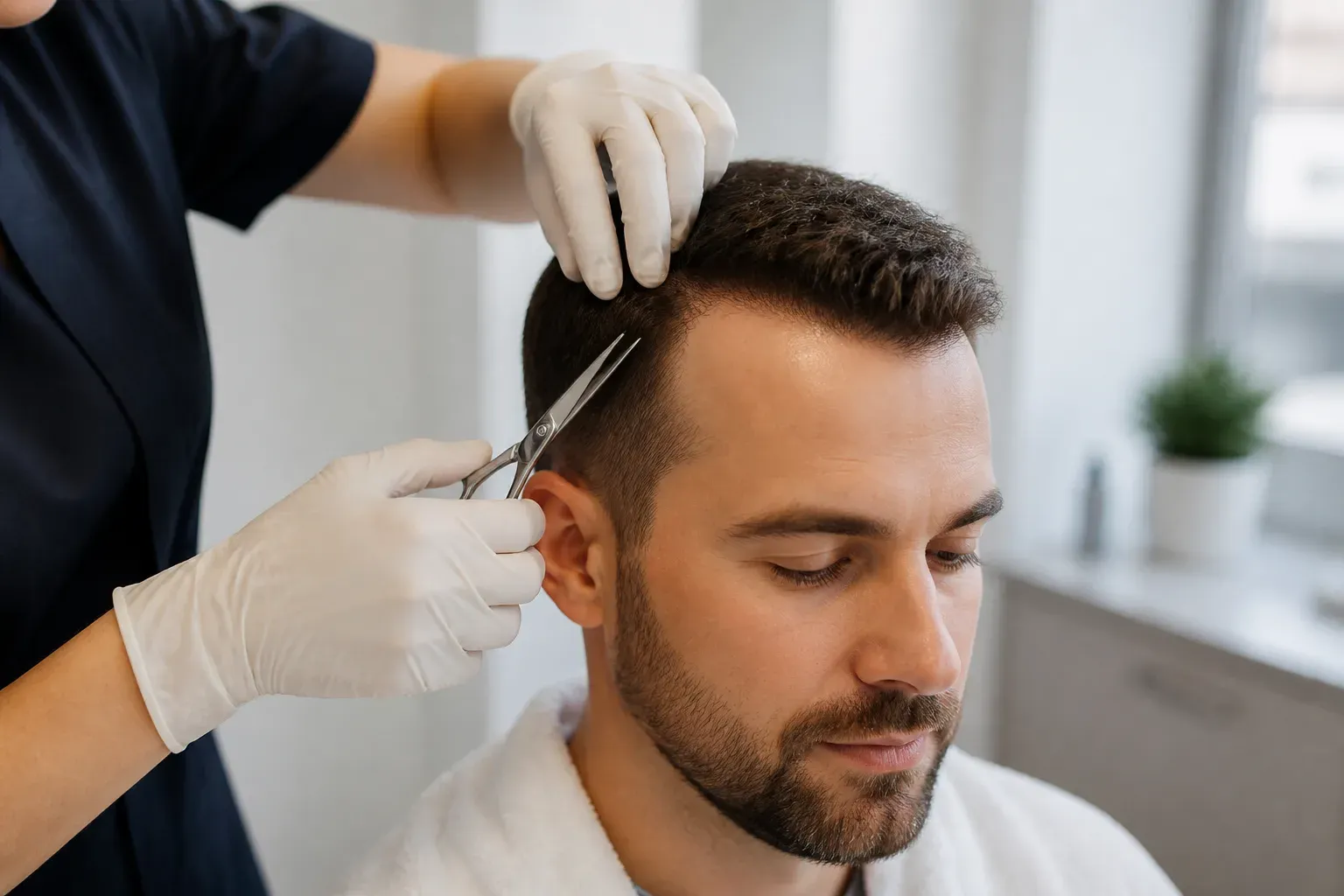
Once we have given clearance after the first month, a careful scissors cut can also be appropriate, especially if you want to even out lengths without going close to the skin. Ask the stylist to work gently, avoid strong pulling and not scrub or massage the transplanted area aggressively.
Risks of mechanical stress too early
If clippers, scissors or a razor are used too early, the risks increase of:
- displacing grafts that are not yet stable
- micro-injuries and scalp irritation
- inflammation around follicle openings
- lower final density if transplants are damaged
Patience during the first month is therefore an active part of the result, not only a restriction.
When can you colour your hair after a hair transplant?
It is important to separate cutting from chemical treatment. Being able to shorten the hair with clippers after one month does not mean it is time for colouring.
Wait about 12 months before chemical colouring
We recommend waiting about 12 months before chemical hair treatment. That includes permanent colour, bleaching/blonding and other strong chemical treatments. The reason is simple: the new hairs are fragile at first, and the scalp needs time to recover fully.
When the result has matured, often around months 12–18, hair can usually be cut, coloured and styled as normal.
Why chemical colour loads more than cutting
Hair dyes often contain agents that raise pH and open the outer layer of the hair shaft so pigment can enter. On a healing scalp and on newly grown, finer hairs, this can cause:
- irritation and contact reactions on the scalp
- unnecessary stress during shock loss and early growth
- more brittle hair if bleaching or repeated over-processing is done too early
Bleaching is particularly aggressive and should therefore not be done before the hair has matured and we consider it appropriate.
When you do colour: gentler choices
After about 12 months, and once we have given clearance, the same sound principles as for healthy hair apply:
- Prefer gentler options over strong bleaching when possible
- Do a patch test if needed, especially if you have a sensitive scalp
- Ask the colourist to avoid unnecessarily long processing time on newer, more porous hairs
- Protect the hair from UV, since both natural pigment and colour break down in the sun
Read more about how the result develops in our article on how fast hair grows and in the aftercare guide.
Donor dominance: does transplanted hair grey differently?
A common question is whether the move changes the hair’s colour or ageing. The short answer is no.
Transplanted follicles keep their genetic characteristics from the donor area, usually the nape and sides. This is called donor dominance. Therefore:
- the hair greys at the same rate as it would have in its original location
- the follicles keep their resistance to DHT, the hormonal driver behind genetic hair loss
- the result is permanent in the sense that the moved follicles continue to produce hair
If transplanted and existing hair grey at slightly different rates, gentle root colouring can later be an aesthetic option, but only once chemical treatment is allowed according to your timeline.
Summary timeline: cutting and colouring
| Period | Cutting | Colouring / chemical treatment | What happens biologically |
|---|---|---|---|
| Day 0 – month 1 | No cutting or shaving | Not allowed | Grafts anchor, scabs shed, early healing |
| After 1 month | Clippers allowed; avoid razor | Still no chemical colouring | Scalp more stable; shock loss may continue |
| Months 3–6 | Continue gentle clipper cuts | Still wait | Early growth, fine new hairs |
| Months 6–12 | Ordinary clipper cuts as needed | Wait until maturity | Density and structure improve |
| Months 12–18 | Cut and style as normal | Colouring and styling normally allowed | Final result is evaluated |
Important: Your individual plan may differ slightly depending on method, skin healing and any complementary treatments. If in doubt, our instructions always apply.
Styling products during healing
Strong gel, wax and spray do not belong on the transplanted area in the early phase. Once scabs are gone and we have given clearance, milder products can be introduced carefully and always rinsed out thoroughly so follicle openings are not blocked.
Full freedom with styling, colour and more advanced treatments comes when the result has matured, around 12 months.
Common mistakes to avoid
- Cutting or shaving during the first month
- A razor against the transplanted area
- Colouring or bleaching “because it feels healed” after a few weeks
- Aggressive massage, scrubbing or friction at the salon too early
- Skipping sun protection during the first year
If something feels wrong, such as increasing redness, pain or signs of infection, contact us. It is better to ask once too often than to stress healing unnecessarily.
Summary
In short: no cutting for the first month, then clippers but not a razor, and chemical colouring only when the hair has matured after about 12 months. Then you can usually cut, colour and style as normal.
Do you have questions about what applies to you? Read more in our aftercare guide, or book a free consultation in Stockholm.
Next steps
- Read about aftercare and healing time
- Read about shampoo and washing after transplantation
- See how fast hair grows after transplantation
- Read about risks and lifestyle factors
- See before and after results
- Book a free consultation
- See prices
- More articles about hair transplantation
This text is for informational purposes only. For medical advice or diagnosis, consult a qualified professional.
Frequently asked questions
Tags
Related information
Explore more about our treatments and services

Firo Esmer
CEO, Akacia Medical
Firo Esmer is CEO and founder of Akacia Medical and writes about hair transplantation, hair loss and treatment planning based on the clinic's experience and patient journey.
References
Related articles
September 16, 2026
Hair transplant month by month
Hair transplant month by month: what you see after 1, 3, 6 and 12 months. Shock loss, early growth and when the final result can be assessed.
September 13, 2026
How long does a hair transplant last?
How long does a hair transplant last? Transplanted hair is usually permanent. Surrounding hair can keep thinning – this is how the result is kept over time.
September 10, 2026
Does a hair transplant hurt?
Does a hair transplant hurt? How local anaesthesia works, what you feel during the procedure and how tenderness is handled in the first days.
Book a free consultation
We will review your circumstances and recommend the right next step for you.