

Does a hair transplant hurt? That is the question most people ask themselves before booking. You want to know how it feels, not just how it works.
Short answer: The hair transplant itself does not hurt. It is performed under local anaesthesia, so pain sensation in the scalp is switched off while you stay awake. What you may feel are the anaesthetic injections at the start, and a dull tenderness at the back of the head when the anaesthesia wears off in the evening.
Here we go through what you actually feel, from the first injection to the first days at home. How the day is structured step by step is covered on the page about how a hair transplant works. Medical complications belong in the guide on hair transplant risks.
Does a hair transplant hurt during the procedure?
Once the anaesthesia has taken effect you feel no pain. Sensation for touch and pressure does not disappear entirely, though. You notice that the team is working, that instruments touch your head and that there is a certain pressure, but without it hurting.
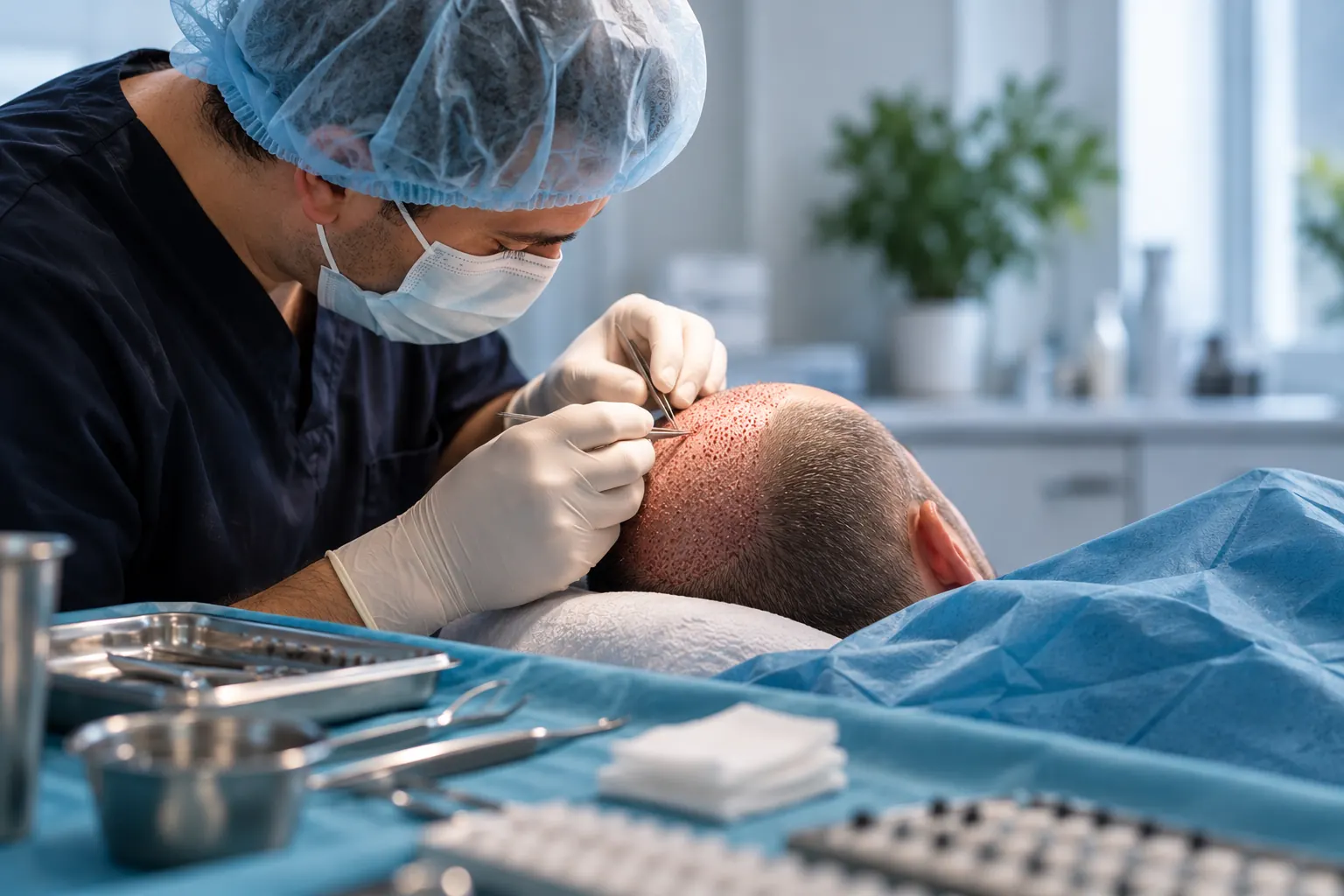
Most people describe the day as surprisingly undramatic. A procedure moving several thousand grafts usually takes 5–8 hours. During that time you can listen to music or a podcast, watch a film or doze off. The most common challenge is lying still for a long time, not pain from the scalp.
This is how patients tend to describe the different phases. The numbers are approximate, not a promise of how you will feel:
| Phase | What you feel | Approximate intensity | How long |
|---|---|---|---|
| Anaesthesia is given | Pricking, stinging, brief burning | 3–5 out of 10 | 2–5 minutes per zone |
| Tumescence (fluid under the skin) | Tightness and pressure across the scalp | 1–2 out of 10 | During the injection |
| Extraction with FUE | Vibration and touch | 0 | 2–4 hours |
| Placement of grafts | Light pressure, touch | 0 | 2–4 hours |
| Days 1–3 at home | Dull tenderness, throbbing at the back of the head | 2–3 out of 10 | 48–72 hours |
| Day 4–10 | Itching and tight scabs | 1–2 out of 10 | 5–7 days |
| Week 2–12 | Numbness or tingling | 0–1 out of 10 | Weeks to months |
Local anaesthesia, the only step that stings
The only thing you may feel during a hair transplant is the first few minutes, when the anaesthesia is given. The donor area at the back of the head and behind the ears is large, so we give the anaesthesia in stages. The aim is for the injections themselves to be felt as little as possible.
Anaesthesia in three steps
Step 1: a very thin needle first. We start with superficial anaesthesia of the skin in the donor area, using a needle as thin as an insulin needle. It numbs the skin before the more extensive anaesthesia is given.
Step 2: anaesthesia of the whole extraction area. Once the first anaesthetic has started to work, we distribute the anaesthesia gradually over the planned donor area: the back of the scalp and, if needed, the area behind the ears. These injections go into skin that is already numb. We work in stages and check continuously that the effect is sufficient.
Step 3: a check before extraction begins. Before the first graft is removed, we check that the donor area is properly numb. If you still feel tenderness or discomfort anywhere, we top up in that spot only. We do not routinely give extra anaesthesia where it is not needed.
The recipient area, where the hair is to be placed, is anaesthetised later in the day, also with thin needles. The amount and the area are always adapted to the treatment and to you.
What does the anaesthetic injection feel like?
Most people describe the first prick as quick, followed by a stinging or tight sensation in the skin for a few seconds up to about a minute. The following injections go into skin that is already numb, so they are felt distinctly less, or not at all. The whole step usually takes two to five minutes per zone.
After the first anaesthetic, a fluid is placed under the skin, tumescence, a mixture of saline, local anaesthetic and adrenaline. It expands the tissue, reduces bleeding and makes the work more precise. It does not feel like a prick, but like a tight pressure across the scalp for a short while.
Why local anaesthesia and not general anaesthetic?
A hair transplant is a superficial microsurgical procedure in the upper layers of the skin. General anaesthesia puts strain on the heart and breathing, requires an anaesthetic team and prolongs recovery. Local anaesthesia provides the pain relief needed, without you having to be put to sleep. You go home the same day.
If you feel strong anxiety about needles or about the day itself, a mild sedative can be offered on site after medical assessment. Mention it already at the consultation if you know you are afraid of needles.
During the procedure, vibration, not pain
Once the anaesthesia is in place, the scalp is switched off for pain. Then the actual work begins.
When the follicles are extracted
From the donor area at the back of the head, the follicles are picked one by one with micropunches of 0.6–0.9 mm. Smaller tools mean smaller wounds, faster healing and often less tenderness afterwards. Read more about the FUE method.
You usually lie comfortably on your front or side. What you feel is vibration and light touch, roughly like an electric toothbrush against the scalp, not pain.
When the grafts are placed
Once the follicles have been checked, the recipient area is prepared. If needed, more anaesthetic is added so the area stays pain-free. The surgeon opens microchannels at the right angle and direction and places the grafts. You sit reclined. Pressure and touch, nothing more.
DHI is anaesthetised the same way. The difference lies in how the grafts are inserted, not in how it feels.
How it feels afterwards, day by day
When you go home the anaesthesia is still working. It usually wears off after four to six hours. Sensation then starts to return, and with it a tenderness that is expected, not a sign that something has gone wrong.
The first 24 hours
As the anaesthesia fades, the back of the head usually becomes tender, throbbing or tight. Many compare it to mild sunburn or muscle soreness in the scalp. It is rarely sharp. Take the painkillers according to the prescription you were given, before the anaesthesia has worn off completely. That keeps you one step ahead.
Sleep with your head elevated and a neck pillow the first few nights. That reduces swelling and protects the new follicles from the pillow. Exactly how to sleep and wash is covered in the aftercare guide.
Day 2–4
The tenderness usually fades within a couple of days. A tight feeling may remain. The fluid used during the procedure travels downwards, so swelling in the forehead and around the eyes is common around day two to three. The swelling rarely hurts. It looks dramatic, but resolves on its own within a few days.
Day 5–10
By now the pain has usually gone. Instead comes itching. Thousands of micro-incisions are healing and forming small scabs. Itching is a sign that the skin is doing its job, not of infection.
Do not scratch with your nails. You risk pulling loose grafts that are not yet secured. The lotion and shampoo in the aftercare package soften the scabs so they can fall off without you tearing at them.
Week 2 onwards
After about ten days the scabs have been washed away and the follicles sit more securely. Many then notice reduced sensation or a tingling in parts of the scalp. Superficial sensory nerves have been microscopically affected. Sensation returns gradually, from a few weeks up to a couple of months.
When new hairs start to appear after two to four months, small superficial bumps can form around individual follicles. They can feel slightly tender and usually pass. Read more in the article about folliculitis in the scalp.
Severe, increasing pain, fever, spreading redness or yellow discharge is not normal tenderness, however. Then you contact us. The difference between expected healing and warning signs is covered under rare complications and side effects.
What affects how you experience it
Two people can sit in the same chair and describe the day differently. That depends on things like:
- Your pain threshold. The same needle prick can feel marginal to one person and more distinct to another.
- Tension. If you hold your neck and jaw tight from nervousness, sensitivity increases. Slow breathing, and speaking up when you need a break, makes a difference.
- The tools. Punches of 0.6–0.9 mm make smaller wounds than older, coarser instruments, and often less tenderness afterwards.
- How you look after the first days. Sleeping position, painkillers in time and leaving the scalp alone reduce unnecessary tenderness. You get the details in aftercare.
How to make the day more comfortable
A few simple choices go a long way:
- Clothes that button or zip, so you do not pull anything over your head on the way home.
- A proper breakfast. Stable blood sugar makes it easier to sit still and take the anaesthesia calmly.
- Painkillers as prescribed the first evening, before the anaesthesia has worn off.
- Head elevated the first few nights, with the neck pillow you are given.
- Hands away from the scalp for the first ten days. Leave the scabs alone.
If you want to see what the surgery day looks like in practice, start with the process step by step. If you still have questions about how it feels, that is exactly what we go through at a free consultation.
This text is for informational purposes only. For medical advice or diagnosis, consult a qualified professional.
Frequently asked questions
Tags
Related information
Explore more about our treatments and services

Firo Esmer
CEO, Akacia Medical
Firo Esmer is CEO and founder of Akacia Medical and writes about hair transplantation, hair loss and treatment planning based on the clinic's experience and patient journey.
References
- 1.Goldin J, Zito PM, Raggio BS. Hair Transplantation. StatPearls. Updated 2025.
- 2.Garg AK, Garg S. Complications of Hair Transplant Procedures—Causes and Management. Indian J Plast Surg. 2021.
- 3.Kerure AS, Patwardhan N. Complications in Hair Transplantation. J Cutan Aesthet Surg. 2018.
- 4.Romera de Blas C, Vega Díez D, Ricart Vayá JM, Gómez Zubiaur A. Complications in follicular unit excision hair transplantation: current evidence and practical approaches. Front Med. 2026.
- 5.Becker DE, Reed KL. Local anesthetics: review of pharmacological considerations. Anesth Prog. 2012.
Related articles
September 21, 2026
Hair loss treatments – what actually works
Which hair loss treatments have evidence? Comparison of finasteride, minoxidil, oral minoxidil, PRP and hair transplantation.

September 19, 2026
DHT and hair loss – the hormone behind thinning
DHT is formed from testosterone and can shrink sensitive follicles. How the hormone works, what can be treated, and when a transplant is needed.

September 17, 2026
Minoxidil for hair loss – topical and oral
Guide to minoxidil for hair loss: 2% and 5%, oral minoxidil in Sweden, use in women, timeline and side effects.
Book a free consultation
We will review your circumstances and recommend the right next step for you.