

Causes of a thin and patchy beard
Thin or patchy beard growth is most often caused by genetic factors. Beard density is influenced by the number of hair follicles in the face and how sensitive they are to male hormones. Some people simply have fewer facial hair follicles or follicles that produce finer hair.
In some cases, sparse beard growth can also be caused by medical conditions, hormonal imbalances, or scar tissue after injuries or burns.
A beard transplant can be used to improve or restore beard growth in areas where the hair is thin or missing. The method can also be used to create or fill out sideburns, a moustache, and eyebrows.
Planning & graft needs
How many grafts are needed for a beard transplant?
The number of grafts depends on which zones need filling and how sparse growth is today. Click a zone on the face or the buttons to see typical guidelines – exact needs are assessed at consultation.
Your appreciated summation
Mark the zones you want to fill in - the total is calculated automatically.
- 2Goatee (chin)500–700
- 5Cheek beard800–1 200 / page × 21 600–2 400
- 6Jaw line600–800 / page × 21 200–1 600
3 zones selected · the exact number is determined during a free consultation.
Important to know
Patchy hair loss in the beard can sometimes be caused by an autoimmune condition (alopecia areata barbae) rather than genetics. In that case, the condition may change over time and a medical assessment is needed before a procedure is planned. Read more on our page about hair diseases & alopecia.
If you're researching your options
Growing a fuller beard: what works in practice and when a transplant makes sense
Many people look for ways to grow a thicker beard when growth is patchy or uneven. For some it's about patience and genetics; for others a more targeted approach is needed.
Why is beard growth patchy?
- Genetic factors
- Uneven density of hair follicles
- Scarring or local skin changes
- Hormonal variation (including sensitivity to male hormones)
What actually works in practice?
The most important thing is a realistic assessment of:
- how dense your beard can grow naturally with your follicle type
- which areas lack density – cheeks, chin, moustache or sideburns
- whether you want a modest improvement or a clear visual change
There are no miracle fixes that work for everyone. Supplements and skincare may help a little at the margins, but they rarely create new follicles. For some, styling and time are enough; when follicles are missing in an area, beard transplantation is often the most predictable route to more even coverage.
When is beard transplantation a relevant option?
Beard transplantation can be right when you want to:
- fill in sparse areas or gaps
- create clearer lines and shape
- improve density in the moustache or sideburns
The technique involves moving hair follicles from a donor area to regions where natural density is missing.
Cost depends on scope and goals. See our current beard transplant pricing and before and after results to set realistic expectations.
PRP for beard – an option before transplantation
If you have follicles that produce beard hair but want to stimulate density and hair quality, PRP (platelet-rich plasma) can be an option. PRP does not usually create new follicles, but it can support existing growth.
PRP may be relevant if you want to:
- stimulate existing follicles and improve hair quality
- complement other measures when density is uneven but not completely missing
- get a medical assessment before deciding on transplantation
Read more about PRP treatment and how it may fit your goals.
Before a beard transplant
A beard transplant can be used to fill in areas with sparse beard growth or where beard hair is completely missing. Before treatment, a consultation is carried out where the patient’s wishes, conditions, and general health are reviewed.
During the consultation we discuss what may be achievable, plan based on your conditions, and explain the procedure and aftercare.
On the day of the procedure, the areas where follicles will be transplanted are marked to create a natural shape and density.
How a beard transplant works
A beard transplant usually uses the FUE method, an established hair transplant technique that can produce a natural result.
The method involves extracting individual follicles from a donor area, usually the back of the head, where the follicles are generally more genetically resistant to hair loss. The follicles are then transplanted to the facial areas where beard growth is to be improved or restored.
The procedure is performed under local anaesthetic and usually takes 6–8 hours, depending on the size of the area being treated.
Treatment is always performed by our doctor Mohammed Abas and his surgical team, who have extensive experience in hair and beard transplantation.
Typical guideline numbers
- 1Moustache: about 350–500 grafts
- 2Goatee: about 500–700 grafts
- 3Sideburns: about 200–250 grafts per side
- 4Cheek beard: about 600–800 grafts per side
Read more about the FUE method or see our results.
Results of a beard transplant
The result of a beard transplant depends on several factors, including careful planning, the patient’s individual conditions, and the surgeon’s experience.
After the transplant, it is common for most of the transplanted hairs to shed within 3–5 weeks. This is a normal part of the hair follicle growth cycle. The follicles remain in the skin and usually begin producing new hairs after about 3–4 months.
The final result develops gradually and can normally be assessed after 12 months. The transplanted hairs grow permanently and can then be trimmed, shaped and shaved like the rest of the beard.
When is a beard transplant not as good?
Beard transplantation is based on hair follicles being moved from the donor area of the scalp, usually the back of the head. If the donor hair is already thin, or if you want to preserve space for a possible future hair transplant on the head, there may be too little donor hair to cover both areas safely.
The skin on the face is also thicker and has a different blood supply than the scalp, which means that the final density of a transplanted beard will normally be lower than that of the scalp - regardless of how skillfully the procedure is performed. How dense and full the result can be depends on your individual conditions and should always be discussed and assessed during a consultation, rather than promised in advance.
Beard transplant – healing, results and timeline
After a beard transplant, a predictable healing process follows. Here we describe what happens step by step – from the day of surgery to the final result after 12 months.
- 1The day of surgery
Local anesthesia and going home
The procedure is performed under local anaesthesia and usually takes 6–8 hours. You can go home the same day after treatment and receive aftercare instructions.
Expected appearance: Slight swelling, redness and visible implantation points in both donor and recipient areas.
- 2Days 2–10
Initial healing
Small scabs form where the hair follicles have been extracted and implanted. As the local anesthetic wears off, mild pain or tenderness may occur. Intensive training should be avoided according to the clinic's recommendations.
Expected appearance: The scabs are massaged away on day 10 after surgery. You can return to work from day 10.
- 3Weeks 3–5
Temporary hair loss (shock loss)
It is common for most of the transplanted hairs to fall out within 3-5 weeks. This is a normal part of the hair follicle growth cycle – the hair follicles remain in the skin.
Expected appearance: The face may temporarily look like it did before the transplant, which requires patience.
- 4Month 3–4
Early regrowth
The hair follicles usually start producing new hairs after about 3-4 months. The result develops gradually and is influenced by planning, your conditions and the surgeon's experience.
Expected appearance: A thinner, wispy beard begins to appear in the treated areas.
- Month 12
Final result
The final result develops gradually and can normally be assessed after 12 months. The transplanted hairs grow permanently and can then be trimmed, shaped and shaved like the rest of the beard.
Expected appearance: Dense and more coherent beard growth with natural direction and shape.
Beard transplant price – transparent price list
The price depends on the number of grafts and scope. Below are our official prices in Sweden. Exact cost and setup are confirmed after a free consultation.
Price per graft count
| Number of hair follicles | Price |
|---|---|
| 1 500 | 45 000 kr |
| 2 500 | 55 000 kr |
| 3 500 | 65 000 kr |
Credit example from Medical Finance (calculated 2026-07-01): For a loan of SEK 60,000 at 0% credit interest, with a repayment period of 2 years (24 repayments), an administration fee of SEK 55/month and a setup fee of SEK 575, the annual percentage rate (APR) is 3.05%. The total amount to repay is SEK 61,895, i.e. SEK 2,579/month. The monthly costs are calculated on the same terms. Amounts above SEK 60,000 carry interest at an individual rate, currently 0–12.65%.
Financing via Medical Finance may allow you to spread the cost over time. Current terms and application are on the Medical Finance website. Medical Finance
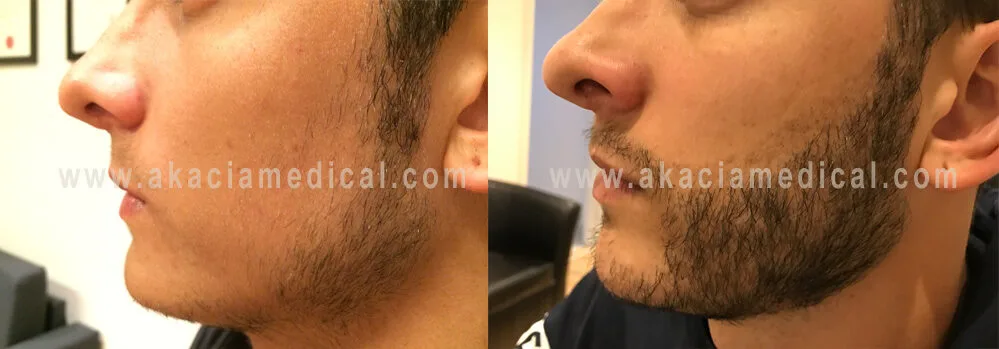
Beard transplant before and after – results
Results develop gradually over 12 months. Below is an example after beard transplantation. More patient cases are on our hair transplant before and after page.
Beard transplantation in Stockholm
Our clinic is at Runda Vägen 15 in Bromma (Alvik). Free consultation, beard transplantation with the FUE method, PRP and follow-up all take place under the same roof.
Before a beard transplant, a consultation reviews your wishes, conditions and general health. On the day of surgery, areas for transplantation are marked to create natural shape and density.
Beard transplantation Gothenburg – consultation & follow-up
We offer free consultations in Stockholm and Gothenburg, or via video call. This makes it easy to get a medical assessment wherever you live in Sweden.
Treatment is performed by our doctor Mohammed Abas and his surgical team, who have extensive experience in hair and beard transplantation. After the procedure, you receive clear aftercare instructions and can contact the clinic with questions during healing.
Sweden compared with TurkeyISHRS membership
Dr Mohammed Abas is a Full Member of ISHRS, an international medical organization for education, ethics and quality in hair restoration surgery.
About us →Written growth guarantee
We offer a written guarantee on our transplants. Read more about what is included and how follow-up works.
Our guarantees →Swedish patient insurance
The clinic is registered with IVO and insured via Säker Klinik – giving you clear medical security in Sweden.
About the clinic →Aftercare after a beard transplant
After the procedure, you receive instructions on how to care for the area during healing. You can go home the same day after treatment.
Most patients can return to work 10 days after surgery, depending on the type of work and individual healing conditions.
When the local anaesthetic wears off, mild pain or tenderness may occur. If needed, over-the-counter pain relief can be used as recommended by the doctor.
Small scabs form in both the donor area and the transplant area where the follicles have been extracted and implanted. These usually fall off within 7–10 days.
Intense exercise and strenuous physical activity should be avoided during the first weeks after the procedure in accordance with the clinic’s recommendations.
For more information about the treatment, you can view our current price list for beard transplantation.
Information about beard growth
Beard hair grows on average about 0.3–0.5 millimetres per day, which corresponds to roughly 1 centimetre per month. Growth rate varies between individuals and is mainly affected by genetics, hormones, age, and overall health.
Although genetics play a major role, a healthy lifestyle can contribute to better conditions for hair growth.
Factors that can contribute to a healthy beard
- ✓Regular cleansing and moisturising of the skin
- ✓A balanced diet
- ✓Regular exercise
- ✓Adequate sleep
- ✓Stress management
Choosing a beard style that suits your face shape and natural beard growth can also affect how full the beard appears. A barber or beard stylist can help you find a suitable style.