

Hair transplant scars are one of the questions we hear most often before treatment. You want to know whether the back of the head will look operated on, and whether an older scar can be hidden.
Short answer: Modern hair transplantation with FUE leaves small pinpoint marks in the donor area. They are usually hard to see when extraction is evenly spread and the hair is a few millimetres long. An older linear FUT scar is different. It shows more easily with short hair and can often be camouflaged, but that needs its own assessment.
Here we explain how the scars look, what separates the methods, and what is possible if you already have a visible mark.
How visible will the scars be?
Any surgery that goes through the skin leaves some scar tissue. The scalp usually heals quickly, but the marks do not disappear completely. What decides whether they show is their size, how tightly the extractions sit, and how you wear your hair.
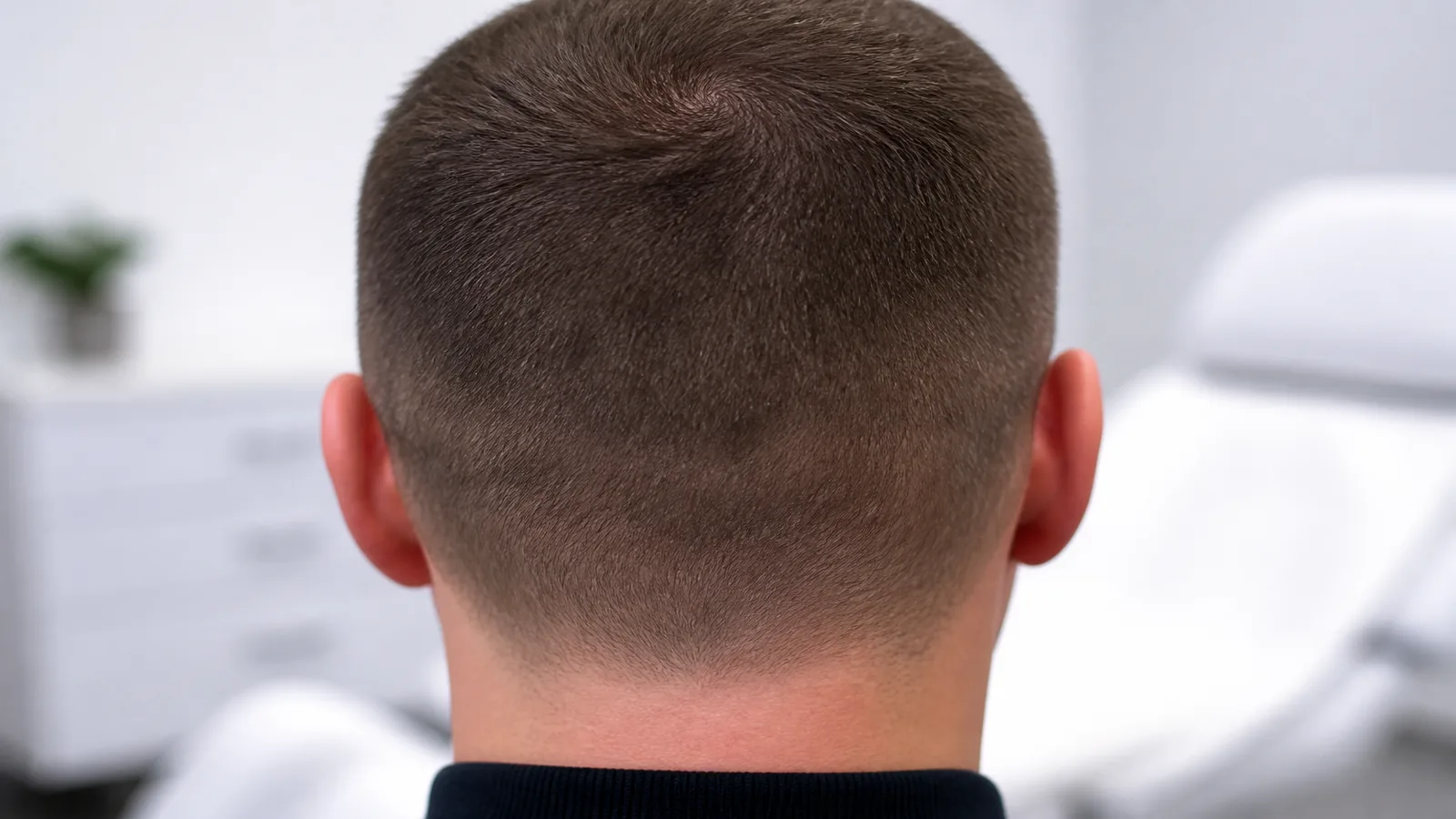
With FUE each graft is removed individually with a micropunch. We use punches of 0.6–0.9 mm, matched to the size of the follicle. That leaves small, scattered pinpoint scars in the nape. With a normal hairstyle they are hidden by the surrounding hair.
FUT, the older strip method, is different. A strip of skin is removed and the wound is sutured. What remains is a linear scar from ear to ear. Akacia Medical does not perform FUT. We cover the difference here because many people who come to us already have that kind of scar from an earlier procedure.
If you want to understand the full treatment, not only the skin in the nape, start on the hair transplant page.
FUE: small pinpoint scars in the donor area
After FUE the extraction sites heal as open micro-wounds. They are first covered by small scabs. When the scabs shed, the skin can stay pink for a while. The marks then fade. In close-up they can look like pale dots, sometimes called white dots, because the scar tissue lacks the same pigment as the surrounding skin.
What makes FUE discreet is the spread. When follicles are taken evenly across the permanent zone in the nape and sides, a few millimetres of hair length is usually enough to hide the marks. If you shave the back of the head completely, the dots can show, especially in strong light.
Two things affect visibility more than the method name itself:
- Punch size. Smaller instruments leave smaller marks. 0.6 mm is clearly smaller than older standard tools of around 1 mm.
- How extraction is spread. Too many grafts in one zone give a patchy, moth-eaten look. Then you see uneven density, not just single dots.
The latter is a common reason patients come to us after an earlier procedure. It is not only about scars, but about how the donor area was used. Read more on failed hair transplant.
DHI extracts follicles in the same way as FUE. The difference is how they are placed. Scars in the nape are therefore practically the same.
FUT: the linear scar
FUT leaves a continuous scar band. Even when the wound has healed neatly, the line often shows if the hair is cut short. The skin can feel tight, and some people have reduced sensation in the nape for a longer time.
If you have that kind of scar from another clinic, we look at width, position and how much donor hair remains. Sometimes the line can be softened by placing new follicles in the scar tissue. Sometimes tricho pigmentation is a better first step, especially if the nape has already been heavily used.
A failed hair transplant is rarely only a scar. There is often uneven density, a hairline that does not match, or a donor area that has been over-harvested. The scar question is part of that assessment, not the whole story.
When the donor area looks patchy
The donor area is a limited resource. If too many follicles are taken from too small a surface, the micro-wounds merge. Then you get visible thinning, not only discreet dots.
We therefore plan extraction with a margin and keep a maximum session around 3,500 grafts. The aim is for the nape to still look natural if you later need another treatment. More on that is in how many hair transplants you can have.
The recipient area: the right depth for the follicles
In the hairline and on the crown, new follicles need to sit at the right depth. If the follicles are placed too shallow, it can affect how many of them actually grow. If the follicles are placed too deep, it can also affect how many of them actually grow. Both are uncommon when channels are matched to graft length, but they occur after poorly performed procedures.
Such problems are not fixed with aftercare. They need a new assessment of what can be corrected. We cover that on failed hair transplant, together with other common issues such as low density and an asymmetrical hairline.
General risks and side effects – swelling, itching, infection – do not belong here. This text is about how the skin looks once it has healed.
When does the scar mature?
The skin surface heals quickly. For the first days the scabs stay in place. After they shed, the skin is often red or pink. That is new vessels, not a permanent red scar.
The redness usually fades over the first months. During the same period some of the transplanted hairs shed, known as shock loss. The follicles remain. Read more about the timeline in how fast hair grows.
The scar tissue itself keeps softening for longer. We usually assess the final look of both density and skin after about 12 months. Practical advice on washing, sleep and exercise is in the aftercare guide, not here.
Smoking and snus reduce blood flow and can slow healing. Sun on new skin can darken marks. Protect the nape and follow the plan you take home.
If you already have a visible scar
If you have a linear FUT scar, visible pinpoint scars or a patchy nape after an earlier procedure, the look can often be improved. Which route fits depends on the skin, not only on what you want first.
New follicles in the scar. If the tissue has enough circulation, FUE can be used to break up a visible line. Survival in scar tissue is less certain than in healthy skin, so we never promise a set number of hairs in the scar itself. We assess that in person.
Tricho pigmentation. Small pigment dots in the skin can reduce the contrast between a pale scar and the surrounding hair. It is not surgery and can fit when the donor area is not enough, or as a complement. The pigment fades over time and can be topped up. Read more on tricho pigmentation. PRP can support healing, but it does not remove scar tissue.
Start with a free consultation. Then we can see what is realistic, and what is better left alone.
Next steps
Are you considering a hair transplant and want to know how your nape and hairline may look afterwards?
- Book a free consultation
- Read about the FUE method
- Read about aftercare
- If something went wrong at an earlier procedure
- Tricho pigmentation for scars
- More articles
This text is for informational purposes only. For medical advice or diagnosis, consult a qualified professional.
Frequently asked questions
Tags
Related information
Explore more about our treatments and services

Firo Esmer
CEO, Akacia Medical
Firo Esmer is CEO and founder of Akacia Medical and writes about hair transplantation, hair loss and treatment planning based on the clinic's experience and patient journey.
References
- 1.Kerure AS, Patwardhan N. Complications in Hair Transplantation. J Cutan Aesthet Surg. 2018.
- 2.Garg AK, Garg S. Complications of Hair Transplant Procedures—Causes and Management. Indian J Plast Surg. 2021.
- 3.Complications in follicular unit excision hair transplantation: current evidence and practical approaches. 2025.
- 4.Goldin J, Zito PM, Raggio BS. Hair Transplantation. StatPearls. Updated 2025.
Related articles

September 21, 2026
Hair loss treatments – what actually works
Which hair loss treatments have evidence? Comparison of finasteride, minoxidil, oral minoxidil, PRP and hair transplantation.

September 19, 2026
DHT and hair loss – the hormone behind thinning
DHT is formed from testosterone and can shrink sensitive follicles. How the hormone works, what can be treated, and when a transplant is needed.

September 17, 2026
Minoxidil for hair loss – topical and oral
Guide to minoxidil for hair loss: 2% and 5%, oral minoxidil in Sweden, use in women, timeline and side effects.
Book a free consultation
We will review your circumstances and recommend the right next step for you.