

When can you use shampoo after a hair transplant? This is one of the most common questions after the procedure. You want to keep the scalp clean without disturbing the new grafts.
Short answer: No washing for the first 1–2 days. From day 3 you wash daily with the clinic’s lotion and shampoo, gently and without rubbing, until around day 10. After that you can gradually return to milder everyday routines.
Here we explain why washing matters, how to do it step by step, and which shampoo fits during healing. The full timeline is in our aftercare guide.
Why the right shampoo matters
After a hair transplant with FUE or DHI, the grafts sit loosely in the skin at first. They are held by moisture and a thin fibrin network. Stability increases day by day. Graft-anchoring research shows grafts are especially vulnerable in the first days, and remaining scabs extend the risk period if they are pulled off too early.
Shampooing is therefore not only about hygiene. The goal is to:
- keep the area clean
- soften scabs so they can fall off naturally
- avoid friction and harsh ingredients that irritate healing skin
When you follow the routine, you reduce unnecessary mechanical stress and irritation during the most sensitive phase.
When can you wash your hair?
We always adapt the plan to you, but the basic principle is the same.
Days 1–2: no washing
Let the micro-incisions begin to close. Sleep more upright with a neck pillow as instructed, to reduce swelling. Do not touch the recipient area unnecessarily. The bandage over the donor area is removed according to our instructions, usually on day two.
Days 3–10: daily gentle washing
This is the active phase. You use lotion and shampoo from the clinic, once a day, following the instruction video. More practical detail is in the aftercare guide.
From day 10: scabs and a more normal routine
Around day 10 most scabs have softened and started to come away. If scabs remain, a light circular massage during the wash on day 10 can help remove all of them. You can also start sleeping more normally again if we have given clearance.
Important: Your individual plan may differ slightly. If in doubt, our written instructions and the instruction video always apply.
How to wash step by step
Take the wash calmly. A few extra minutes are better than rushing.
- Wash your hands thoroughly before touching the scalp.
- Apply lotion evenly over the whole recipient area. Spread it gently by patting so that every transplanted follicle is covered. Let the lotion work for 45 minutes as instructed, so the scabs soften.
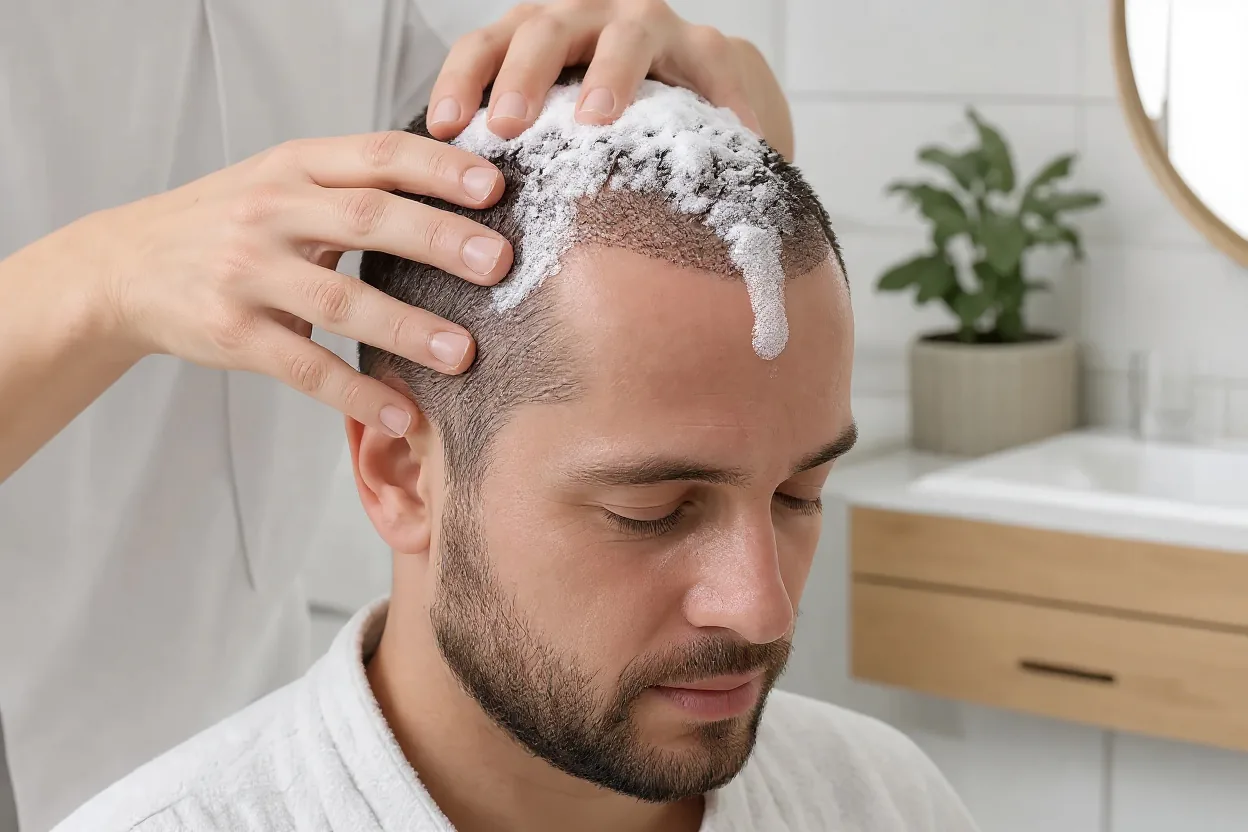
- Shampoo gently. Work up a foam in your hands. Pat the foam onto the recipient area with your fingertips in the direction of hair growth. Do not rub. The donor area may be washed a little more actively. Leave the foam on your head for 2–3 minutes.
- Rinse with lukewarm water. Do not aim a strong shower stream straight at the grafts. Prefer pouring water with a cup, or soften the stream with your hand.
- Air-dry. Do not use a towel or hairdryer on the recipient area during this phase.
Which shampoo should you use?
During early healing you should use the shampoo you receive from us. It is mildly formulated for a sensitive, recovering scalp.
Research on shampoo after hair transplantation shows that mild, well-tolerated formulas can reduce both scabs and redness compared with more irritating options. That is why we avoid strong surfactants and unnecessary additives early on.
| Ingredients / properties | Good in early aftercare | Avoid at the start | Why |
|---|---|---|---|
| Surfactants | Mild, gentle cleansers | Strong sulfates (e.g. SLS/SLES) | Harsh surfactants dry out and irritate healing skin |
| Active additives | Softening and calming agents (e.g. panthenol, bisabolol) | Acids, retinoids, menthol | Peeling agents and strong “fresh” additives can sting |
| Fragrance & preservation | Fragrance-free, gentle options | Strong perfume, alcohol | Fragrance increases the risk of irritation |
| Texture | Easy to rinse out | Heavy silicone/oil that sits on the skin | Can clog and make the scalp more irritated |
When the scabs are gone and we have given clearance, you can gradually return to a mild shampoo you tolerate. Strong styling products and hot air from a hairdryer do not belong on the recipient area. More on later hair care is in the article on cutting and colouring hair after a hair transplant.
Timeline for shampoo and washing
| Period | Washing | Technique | Keep in mind |
|---|---|---|---|
| Days 1–2 | No washing | Rest, neck pillow, follow bandage instructions | Do not touch the recipient area |
| Days 3–10 | Daily with clinic lotion + shampoo | Pat foam, rinse gently, air-dry | No scratching, no strong shower pressure |
| Days 10–14 | Continue mild washing | Light massage for remaining scabs if needed | Gradual return to a milder home routine |
| Week 3–4+ | Normal frequency with mild shampoo | Ordinary, gentle washing | Avoid strong friction and hot styling for a while |
Scabs – soften them, do not pull them off
Scabs protect the micro-incisions, but a dry scab can act like a “handle”. If you tear it off too early, the graft can come with it in the first days.
That is why lotion and mild daily washing matter so much: they soften the scabs so they can release on their own. Never pull, pick or scratch with your nails.
Folliculitis and other issues
During healing, small red spots may appear. This can be sterile folliculitis, a common and often mild reaction when new hairs start to emerge. Warm compresses and continued gentle washing are usually enough.
If you have pain, pus-filled blisters, fever or increasing redness, it may be a bacterial inflammation. Contact us straight away. Read more in the article on scalp folliculitis and on hair transplant risks.
PRP and washing
Many people combine the transplant with PRP treatment to support the follicles during healing. After a PRP injection you should normally wait at least 24 hours before washing your hair, so the injection sites can close. Always follow the plan you received from us.
Common mistakes
- Starting to wash too early, or skipping the lotion step
- Rubbing, scrubbing or tearing off scabs
- Using strong “ordinary” shampoo too early
- Aiming a hard shower stream at the recipient area
- Drying with a towel or hot hairdryer too early
- Switching to fragranced or “fresh” products with menthol/acid during healing
If something feels wrong, ask us rather once too often. That is part of safe aftercare.
Summary
In short: wait with washing on days 1–2, start gently on day 3 with the clinic’s lotion and shampoo, avoid friction and harsh products, and let scabs fall off naturally until around day 10. That gives the grafts the best possible conditions.
Want the full healing plan? See our aftercare guide, or book a free consultation in Stockholm.
Next steps
- Read about aftercare and healing time
- See how fast hair grows after transplantation
- Read about cutting and colouring hair
- Read about scalp folliculitis
- Read about risks and what is normal
- See before and after results
- Book a free consultation
- See prices
- More articles on hair transplantation
This text is for informational purposes only. For medical advice or diagnosis, consult a qualified professional.
Frequently asked questions
Tags
Related information
Explore more about our treatments and services

Firo Esmer
CEO, Akacia Medical
Firo Esmer is CEO and founder of Akacia Medical and writes about hair transplantation, hair loss and treatment planning based on the clinic's experience and patient journey.
References
- 1.Bernstein RM, Rassman WR. Graft anchoring in hair transplantation. Dermatol Surg. 2006;32(2):198-204.
- 2.Schweiger D et al. Highly efficient and compatible shampoo for use after hair transplant. Clin Cosmet Investig Dermatol. 2015;8:355-360.
- 3.Goldin J, Zito PM, Raggio BS. Hair Transplantation. StatPearls. Updated 2025.
- 4.Garg AK, Garg S. Complications of Hair Transplant Procedures—Causes and Management. Indian J Plast Surg. 2021.
- 5.Winters RD, Mitchell M. Folliculitis. StatPearls. Updated 2023.
Related articles
September 21, 2026
Hair loss treatments – what actually works
Which hair loss treatments have evidence? Comparison of finasteride, minoxidil, oral minoxidil, PRP and hair transplantation.

September 19, 2026
DHT and hair loss – the hormone behind thinning
DHT is formed from testosterone and can shrink sensitive follicles. How the hormone works, what can be treated, and when a transplant is needed.

September 17, 2026
Minoxidil for hair loss – topical and oral
Guide to minoxidil for hair loss: 2% and 5%, oral minoxidil in Sweden, use in women, timeline and side effects.
Book a free consultation
We will review your circumstances and recommend the right next step for you.