

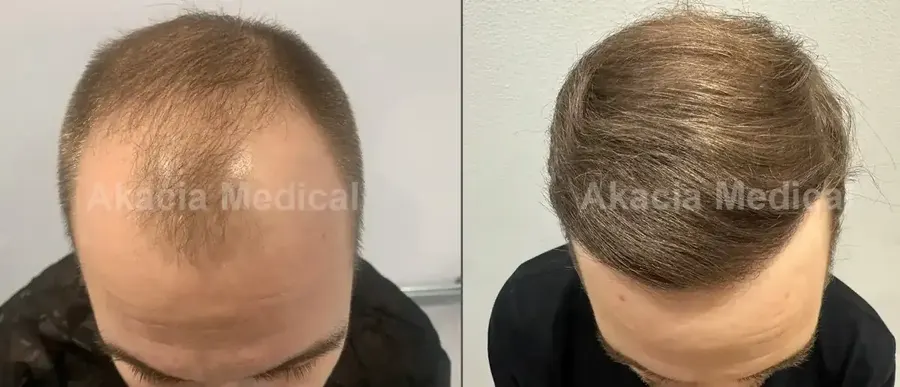
What does a hair transplant look like month by month? That is the question most people ask after surgery day: after 1 month, after 3 months, after 6 and after 12.
Short answer: The first two weeks are about healing. Then comes a thinner period when transplanted hairs shed, called shock loss. New growth usually shows from month 3. Density is clearer at month 6. The mature picture is usually assessed at 12 months, sometimes up to 18 months on the crown.
This guide owns the timeline from month 1 to 12. The first days – washing, sleep, cap and exercise – are in the aftercare guide. How fast hair grows in centimetres and how the hair cycle works is in how fast does hair grow. Real cases are in before and after.
Hair transplant month by month – overview
The timeline is a typical picture, not a promise. Age, area, graft numbers, blood supply and how you follow aftercare affect the pace. The crown often matures more slowly than the hairline.
| Time | What you usually see | What it means |
|---|---|---|
| Days 1–10 | Redness, scabs, swelling | The skin heals. Grafts settle. |
| After 1 month | Cleaner scalp, often a thinner look | Shock loss may have started. Not the final result. |
| After 2 months | Thinnest for many | Follicles rest. The hairs have shed. |
| After 3 months | First new hairs, thin and light | Early growth. Often uneven. |
| After 6 months | Clearer density and shape | Roughly halfway to the mature picture. |
| After 12 months | Stable density and direction | Standard time for assessment. |
| Months 12–18 | Further maturity, especially the crown | Final texture and calibre. |
Transplanted hairs often shed after a few days to a few months. New growth typically shows after 3–6 months. The clinic follows the result with photos until the grafts have matured, usually over 6–12 months.
Hair transplant after 1 month
A hair transplant after 1 month rarely looks like the end. The scabs are gone. You usually sleep normally again. Many have returned to work.
At the same time the area can look thinner than day 10. The short hairs that sat in the grafts have started to shed, or are about to. The follicles remain under the skin. This is early shock loss, not a sign that the transplant failed.
Redness can still show, especially on light skin. The donor area in the nape often feels calmer than the recipient area.
Practically right now: protect against strong sun, avoid a tight cap on the grafts if the skin is still tender, and wait with hard training according to your plan. The details are in aftercare.
Hair transplant after 2 months
Between months 1 and 3 the mirror often lies. After 2 months many people look their thinnest. Almost all transplanted hairs may have shed. New ones have not broken through yet.
This is sometimes called the ugly-duckling phase. It is a rest period, not a final grade. The follicles were pushed into telogen after the move and need time before new anagen growth shows.
Contact us if you get pain, fever, spreading redness or pus. That is not shock loss. The difference between expected healing and warning signs is in hair transplant risks.
Hair transplant after 3 months
A hair transplant after 3 months is the query most people search. New growth often starts here: short, thin, sometimes light hairs coming through unevenly.
Some see clear dots of new hair. Others see almost nothing. Both can be normal. Growth does not start on the same day for everyone, and the crown often lags behind the hairline.
The hairs are immature. They are not the calibre or colour you get later. Do not compare with a 12-month gallery photo. Compare with your own photo from month 1.
If you see no growth at all after 6–9 months, book a check. Under 4 months, limited visible growth is still common.
Hair transplant after 6 months
A hair transplant after 6 months is often the first time the result shows at a distance. Density is clearer. The hairline starts to hold together. You can comb and style more as usual.
You are roughly halfway. The hairs keep thickening and darkening. Gaps that bother you in June can be smaller in December. That is why we wait for the mature assessment.
Cutting is usually fine much earlier. Chemical colour you wait longer with. See cutting and colouring hair after a hair transplant.
Hair transplant after 12 months
A hair transplant after 12 months is the standard point for assessing the result. Density, direction and hairline have usually stabilised at the front and mid-scalp.
The crown can still mature. Blood supply there is often poorer, so 12–18 months is a realistic horizon. A one-year follow-up is therefore not “too late” – it is the right time to compare with the plan from the consultation.
If a graft area has not grown as promised, we go through the terms in the guarantee. Assessment is made at the earliest after at least 12 months, when the instructions have been followed.
See documented cases in before and after.
What is normal – and when to contact us
| Time | Usually normal | Contact the clinic |
|---|---|---|
| After 1–2 months | Thinner look, shock loss | Pain, fever, spreading redness, pus |
| After 3 months | Uneven, thin new growth – or almost nothing yet | Strong, increasing hair loss outside the plan |
| After 6 months | Clearer density, still immature | No visible growth at all |
| After 9–12 months | Continued maturity | Still empty fields against your plan |
Temporary shedding in or around treated areas is called shock loss. The follicles remain. New growth comes later, often noticeably from month 3.
Small bumps around new hairs can appear when growth takes off. Read more in scalp folliculitis.
How to follow your own timeline
The change is slow in the mirror and clear in photos:
- Photograph from the front, sides and crown every two to four weeks.
- Same light, same distance, same angle.
- Compare month 1 with months 3, 6 and 12 – not with someone else’s 12-month result.
- Bring the photos to follow-up.
Want to understand the hair transplant itself, the FUE and DHI methods, or book a free consultation? That is where we set a realistic timeline for your area.
This text is for informational purposes only. For medical advice or diagnosis, consult a qualified professional.
Frequently asked questions
Tags
Related information
Explore more about our treatments and services

Firo Esmer
CEO, Akacia Medical
Firo Esmer is CEO and founder of Akacia Medical and writes about hair transplantation, hair loss and treatment planning based on the clinic's experience and patient journey.
References
- 1.Goldin J, Zito PM, Raggio BS. Hair Transplantation. StatPearls. Updated 2025.
- 2.Rose PT. Hair restoration surgery: challenges and solutions. Clin Cosmet Investig Dermatol. 2015;8:361–370.
- 3.Jimenez F, Alam M, Vogel JE, Avram M. Hair transplantation: Basic overview. J Am Acad Dermatol. 2021.
- 4.Kerure AS, Patwardhan N. Complications in Hair Transplantation. J Cutan Aesthet Surg. 2018.
Related articles
September 13, 2026
How long does a hair transplant last?
How long does a hair transplant last? Transplanted hair is usually permanent. Surrounding hair can keep thinning – this is how the result is kept over time.
September 10, 2026
Does a hair transplant hurt?
Does a hair transplant hurt? How local anaesthesia works, what you feel during the procedure and how tenderness is handled in the first days.
August 14, 2026
How many hair transplants can you have?
How many hair transplants can you have? Donor area, healing and planning set the limit. Learn about treatments, timing and consultation.
Book a free consultation
We will review your circumstances and recommend the right next step for you.