What is Alopecia Areata?
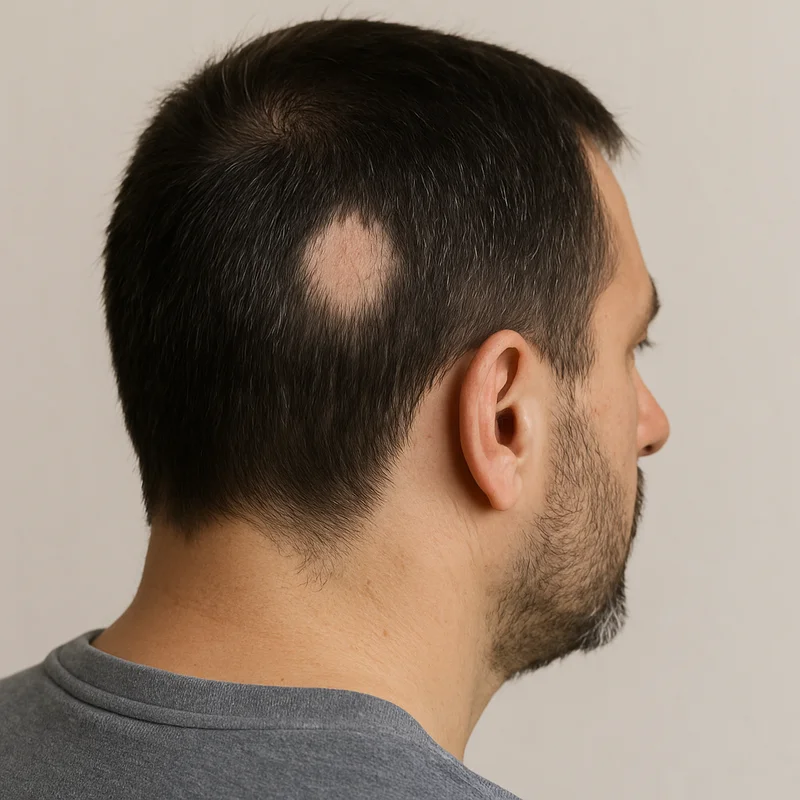
Alopecia areata is the medical term for patchy hair loss. It is an autoimmune disease in which the body’s immune system causes the hair follicles to enter a resting phase. When the follicle no longer produces new hair, the hair eventually falls out.
The number of patches can vary from a single spot to many, and in some cases the condition can progress to more extensive hair loss. The patches most often appear on the scalp and beard area, but can also occur on the eyebrows, eyelashes and other body hair.
Three stages of Alopecia Areata
- Alopecia areataPatchy hair loss.
- Alopecia totalisLoss of all scalp hair.
- Alopecia universalisTotal loss of body hair.
Causes of Alopecia Areata
Alopecia areata is an autoimmune disease in which the immune system attacks the hair follicles and causes the hair to stop producing new cells. The condition is also linked to heredity and may in some cases be triggered by severe psychological stress.
There is still no single established cause of why the condition occurs. If you want to understand more about how different conditions affect the hair, you can read more about our conditions that cause hair loss.
Symptoms
It often begins as a bald patch about the size of a coin on the scalp. The patch may grow larger, stop progressing or grow back. How long the condition lasts and how extensive it becomes varies from person to person.
In some cases the hair loss becomes permanent, but in others the follicles resume activity and new hairs grow back. A minority of around 10 percent lose all of their hair, and this more often affects children or young people. Around 60 percent develop alopecia areata before the age of 20, but it can also occur later in life.
Alopecia areata is not physically harmful in itself and is not clearly associated with a higher risk of other illnesses.
Treatment for Alopecia Areata
Unfortunately, there is currently no treatment that has proven consistently effective for alopecia areata in all cases. What is important to remember is that the hair follicles are usually not permanently damaged, but rather in a resting phase.
An effective way to reliably restart hair production is still lacking, but PRP treatment may in some cases help stimulate follicles out of the resting phase. Topical steroid treatment can also be tried, but results vary considerably.
Read more about our hair loss treatments and about how PRP treatment is used at our clinic.
Summary
Alopecia areata is an autoimmune condition that can range from a few bald patches to more extensive hair loss. The course varies greatly between individuals, which is why an individual assessment is important.
If you experience patchy hair loss, it is wise to seek professional guidance to understand the cause, what treatment options exist and what is realistic to expect.