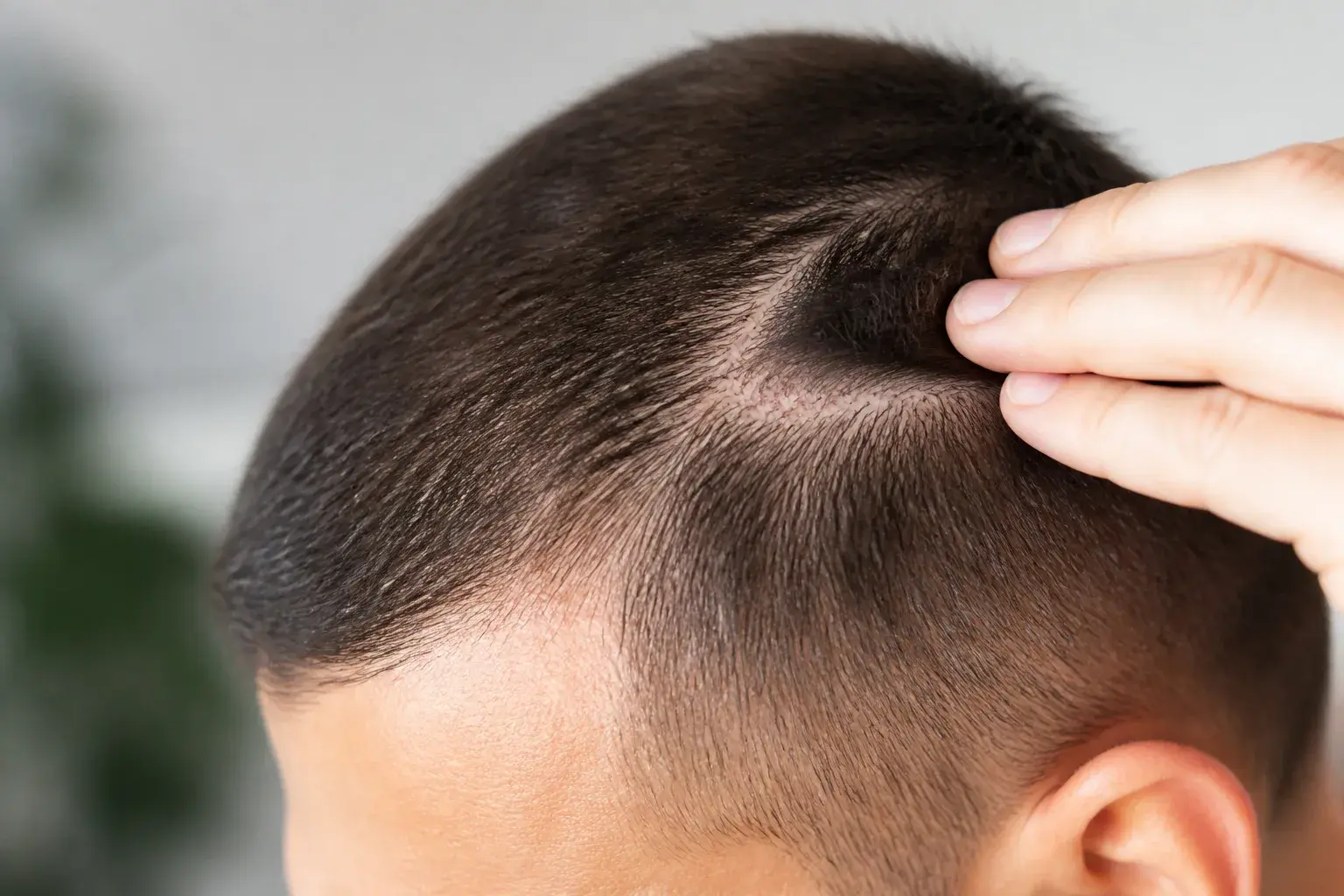
What is scarring alopecia?
Scarring alopecia is a form of permanent hair loss in which the hair follicles are destroyed and replaced by scar tissue. Once the damage has occurred, the follicles usually cannot be restored.
Scarring alopecia is not a single disease but an umbrella term for several different inflammatory and autoimmune skin conditions that can all permanently damage the hair follicle. Symptoms and progression differ between the various types, but what they have in common is that early detection and treatment are crucial to preserving as much hair as possible.
Different types of scarring alopecia
Scarring alopecia is an umbrella term for several different skin diseases that can all lead to permanent hair loss. Below are some of the most common types that a dermatologist may need to distinguish between.
Lichen planopilaris (LPP)
An inflammatory skin disease that attacks the hair follicles and often causes itching, burning and redness around the follicles before scar tissue forms. The symptoms typically appear as several small, scattered patches, mainly on the crown.
Frontal fibrosing alopecia (FFA)
Often regarded as a variant of lichen planopilaris, it is characterised by the hairline gradually receding along the forehead and temples, sometimes accompanied by thinning of the eyebrows. It most often affects women after the menopause.
Folliculitis decalvans
A chronic inflammation of the scalp with recurring, often pus-filled pustules around the hair follicles. Left untreated, the condition can gradually cause scarring and a characteristic tufted pattern of hair growth around the remaining healthy follicles.
Discoid lupus erythematosus of the scalp
An autoimmune skin disease that can cause round, scarring patches with redness, scaling and pigment changes on the scalp. It may occur as an isolated skin condition or as part of systemic lupus.
Central centrifugal cicatricial alopecia (CCCA)
A scarring condition that often begins at the crown and spreads outwards in a circular pattern. The cause is not fully understood, but the condition is seen more often in people of African hair type and has been linked to, among other things, certain hair styling practices.
Common causes of scarring alopecia
The causes vary between the different types above, but most cases can be linked to one of the categories below, often in combination with a specific diagnosis made by a dermatologist.
- Inflammatory scalp diseases
- Scalp infections
- Physical injury or burns
- Autoimmune diseases
- Certain genetic conditions
Diagnosis and assessment
Scarring alopecia should always be assessed by a dermatologist, since several different skin diseases can produce similar symptoms yet require different treatment. The assessment usually begins with a clinical examination of the scalp and a review of your medical history and any other symptoms.
If the diagnosis is uncertain, a small tissue sample, known as a scalp biopsy, is often taken to determine which specific type of scarring alopecia is involved and to distinguish the condition from non-scarring hair loss, such as androgenetic alopecia. The biopsy can also show how active the inflammation is in the area examined.
Early diagnosis is of great importance in scarring alopecia, because the damage to the hair follicle is permanent once scar tissue has formed. The goal of early treatment is therefore to suppress the active inflammation before more hair follicles are destroyed – unlike androgenetic alopecia, for example, where early treatment instead serves to slow a more gradual, ongoing process.
Treatment
When the hair follicles are destroyed, the hair usually does not grow back. Possible treatment options include:
- Hair transplantation (if there is enough donor hair)
- Treatment of the underlying inflammation to prevent progression
- Cosmetic solutions such as tricho pigmentation
Hair transplantation for scarring alopecia – realistic expectations
Hair transplantation can in some cases be an option for scarring alopecia, but it usually requires that the underlying inflammatory disease has been judged to be inactive or stable for an extended period. Transplanting into an area with ongoing inflammation risks the new hair follicles being damaged in the same way as the original ones.
The result can also be harder to predict than with hair transplantation for androgenetic alopecia, since scar tissue often has a poorer blood supply, which can affect how well the transplanted hair follicles take. The assessment is therefore always made on an individual basis, ideally in consultation with the dermatologist who manages the underlying disease.
You can read more about our treatments and see our results to get a better understanding of which options may be suitable.
If you suspect you have scarring alopecia, it is wise to contact us early for a medical assessment.